Mostly no. Breed specific food is marketing breadth more often than formulation. Of the 4,700 recipes we analysed that list a suitable size, 77% say they suit all five sizes. What genuinely changes at the bowl is portion size, kibble size and, for big puppies, controlled calcium. Match the food to size, age, activity and waistline, not to the name on the bag.
What does a breed name on the bag actually tell you?
Stand in front of a wall of dog food and you will see breed names everywhere. A photograph of a Labrador on one bag and a recipe named for a German Shepherd on the next. It is a comforting shortcut. Somebody has thought about my dog specifically, so I can stop reading and go home.
The honest answer is that a breed on the front is a design brief, not a genetic prescription. Food is built around body size, life stage, activity level and the shape your dog is holding at home. A breed name is a convenient way of summarising several of those at once. When a bag says Labrador, what the recipe is really saying is large, food motivated adult with a serious appetite.
That is not a criticism. A well built recipe for a big active adult is a genuinely good match for a Labrador. The question worth asking is whether the breed on the bag is doing any work beyond the photograph. Our own data has a fairly blunt answer.
What our data says about breed and size claims
We analysed 4,983 dog foods for the site, 4,935 of which publish a full ingredient list. Of those, 4,700 tell you which sizes of dog the recipe is meant for. Here is the part that surprised us. 3,600 of them, or 77%, list themselves as suitable for all five sizes, from toy right up to giant.
Only 999 recipes, around 21%, are built for one or two sizes. Of those, 489 are aimed at small or toy dogs and 208 at large or giant dogs. So roughly four in five foods on the shelf are general recipes wearing whatever picture the brand chose for the front. The breed on the bag is mostly reach.
Read that as useful information. There is no scandal in it. It means a food does not need a breed badge to suit your dog. It also means a badge on its own is not evidence of anything. Judge the recipe. The photograph is not part of the formulation.
Where size genuinely changes the bowl
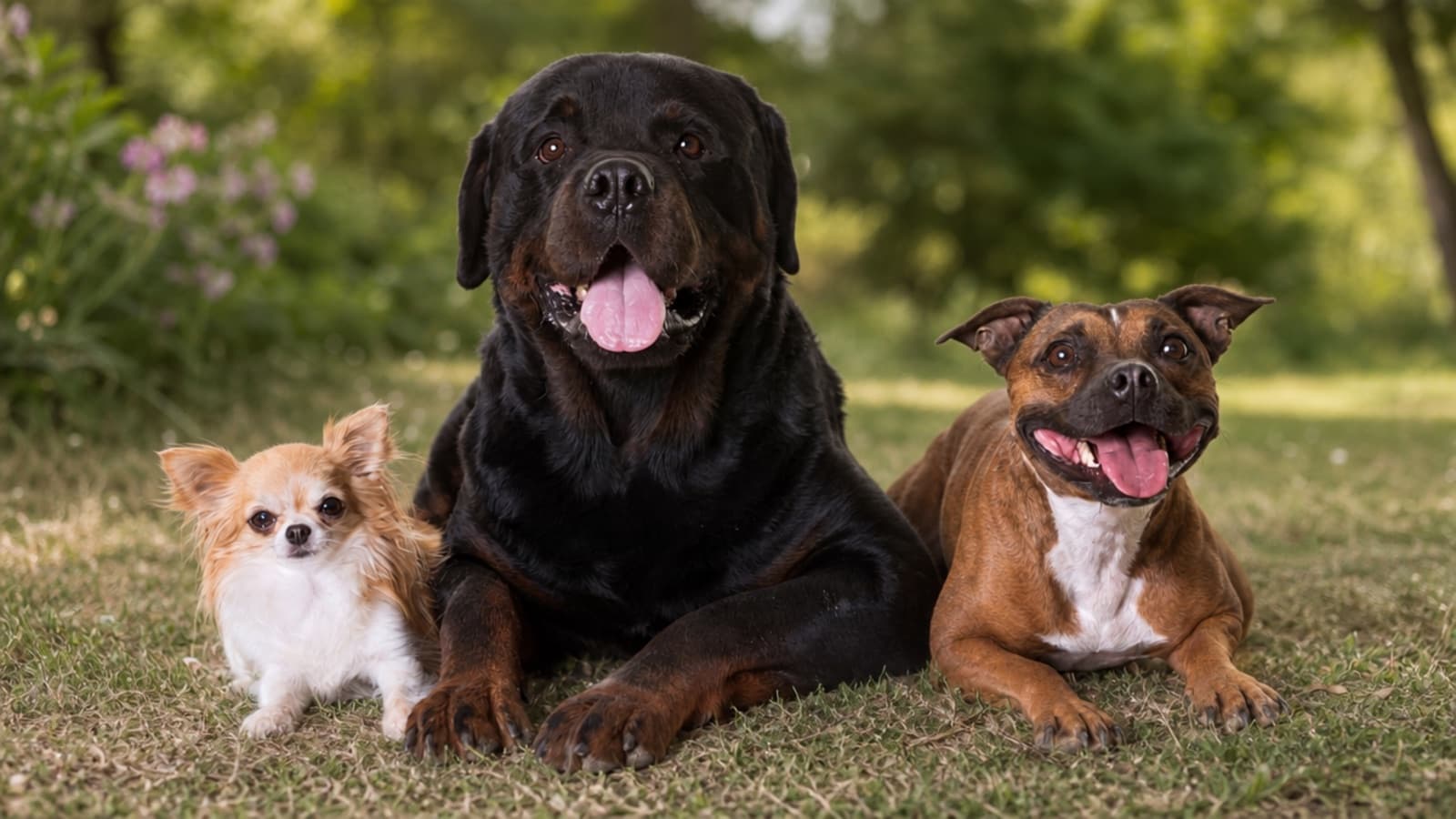
There are real differences at the extremes, and they are physical rather than genetic. Put a Great Dane and a Chihuahua in the same kitchen and the same recipe can honestly suit both. What cannot be shared is the amount in the bowl or the size of the pieces in it.
A tiny jaw does better with a small kibble it can actually crunch, and that is the clearest practical reason small breed ranges exist at all. Portions get fiddly at that end of the scale, which is why we wrote about feeding a toy or small breed. At the other end, a very large dog has to take in a whole day of energy without the bowl being filled to the brim in one sitting. Energy density and splitting meals start to matter. Neither of those is about breed DNA. Both are about plumbing.
Everything else comes back to portioning, which is why body condition beats any feeding chart on the back of a bag. The chart is a starting point written for an average dog. Your hands on your own dog's ribs are the correction.
The one detail worth checking on a big puppy
Growth is the place where the label earns real attention. Large and giant breed puppy recipes are formulated with a controlled calcium level, and steady growth in a big puppy is something good breeders and vets take seriously. The calcium figure and the timing of the switch are both covered in feeding a large or giant breed puppy.
The trouble is finding the number. Of the 1,324 puppy recipes we analysed, only 44% declare calcium at all. Fewer than half. If you are raising a big puppy, a declared calcium figure on the pack is a quiet sign that the brand has thought about the thing that matters most at that age. A missing one is worth a question to the manufacturer.
Beyond that, keep it simple. Choose from puppy food built for the right size, and feed to a plan, not to appetite. Our guide to feeding a puppy month by month walks through the stages. Anything clinical about growth rate belongs with your vet, who can put hands on the dog.
Does a senior dog need a different recipe?
This is the same question wearing a different coat, and the data answers it in much the same way. We hold 1,308 senior recipes. The median dry matter protein in adult dry food is 27.5%, and in senior dry food it is also 27.5%. The fat medians sit at 14.3% for adult and 13.2% for senior.
In other words, the average senior food is an adult food with slightly less fat. That is a sensible adjustment for a dog who is moving a bit less, and it is not a transformation. If your older dog is holding a good shape and eating with enthusiasm, a change of bag is not automatically owed to them the moment a birthday arrives.
If the shape is drifting or the appetite has changed, that is worth acting on. Raise it at the next check up. Age is a reason to look more closely at the dog. It is not, on its own, a reason to change the recipe.
How should you judge a breed branded food?
Warmly, and on its own merits. Some breed named ranges are thoughtfully built, with a piece size and an energy level that really do fit the dog pictured on the front. Others are a general recipe with a new photograph on it. You cannot tell which from the front of the bag, so turn it over.
Look at the composition first. Then check the life stage and the declared analysis against the dog you actually have. If the recipe suits your dog's size and stage, the breed name is a pleasant bonus. It is not the reason to buy. If it does not, no picture is going to rescue it.
That is how we assess food across the site, and it is why our breed pages match by fit and not by name. A recipe does not know what your dog's parents looked like. It only knows how big the bowl needs to be.
Where to start with your own dog
Start with the dog, not the label. Weigh what you can and be honest about the waistline and about how much exercise actually happens on a wet Tuesday in February. Then look for a food that matches that picture, whatever is on the packaging.
If you are still choosing a dog, our guide to which breed fits your life is a far better first step than the food aisle. If your dog is already asleep on the sofa, every one of our breed guides sets out the care and feeding picture in plain terms. From there the will narrow the shelf down to a handful of sensible matches in a couple of minutes.
Frequently asked questions
Is breed specific dog food worth buying?
Sometimes, but not because of the breed. Judge the recipe sitting behind the name. If it matches your dog for size and life stage, it is simply a good food that happens to have a breed on the front. Of the 4,700 recipes we analysed that carry size information, 77% list all five sizes, so most breed pictures sit on top of general recipes.
Does a small dog really need small breed food?
Often the piece size helps more than the recipe does. A small jaw copes better with a small kibble, and that is the most practical reason small ranges exist. Only 489 of the recipes we analysed are built specifically for small or toy dogs. If your dog eats a standard kibble happily and holds a good shape, there is no need to switch.
What should I look for in food for a large breed puppy?
A declared calcium level, and a recipe built for large breed growth. Of the 1,324 puppy recipes we analysed, only 44% declare calcium at all, so the number is worth hunting for. Feed to a written plan, never to appetite, and keep your puppy lean while the frame is still growing. Questions about growth rate belong with your vet, who can examine the dog.
Do I need to change food when my dog gets older?
Not automatically. In our data the median dry matter protein is 27.5% in both adult and senior dry food, with fat at 14.3% for adult and 13.2% for senior. Senior food is usually a slightly leaner adult food rather than a different thing. Change when the dog changes, not when the birthday arrives. Weight loss or new fussiness deserves your vet's opinion.