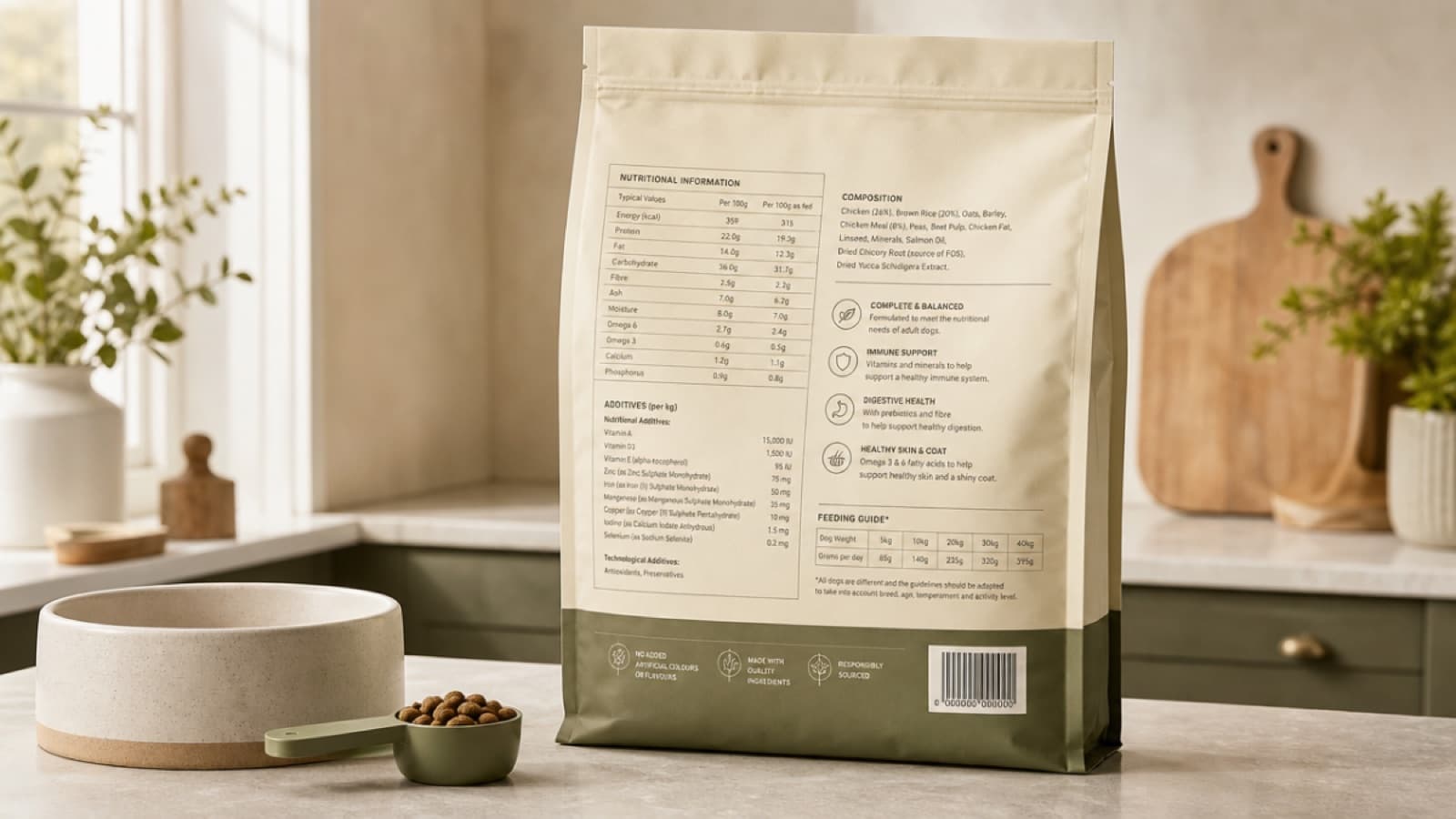
Start with the feeding guide on the pack, matched to your puppy's weight now and, for a big dog, his expected adult weight. That gives you a total for the day, which you then split across his meals. Weigh him weekly and adjust in small steps so he grows steadily, never in bursts.
How much should a puppy eat each day?
The number on the back of the pack is your starting point, and your puppy is your correction. Feeding guides are written for an average puppy at a given weight, and an average has to cover the one who sleeps all afternoon and the one who never sits down. Find the row that matches his weight now and, on large-breed charts, the adult weight you expect him to reach. What that gives you is a total for the day, not a total for the bowl.
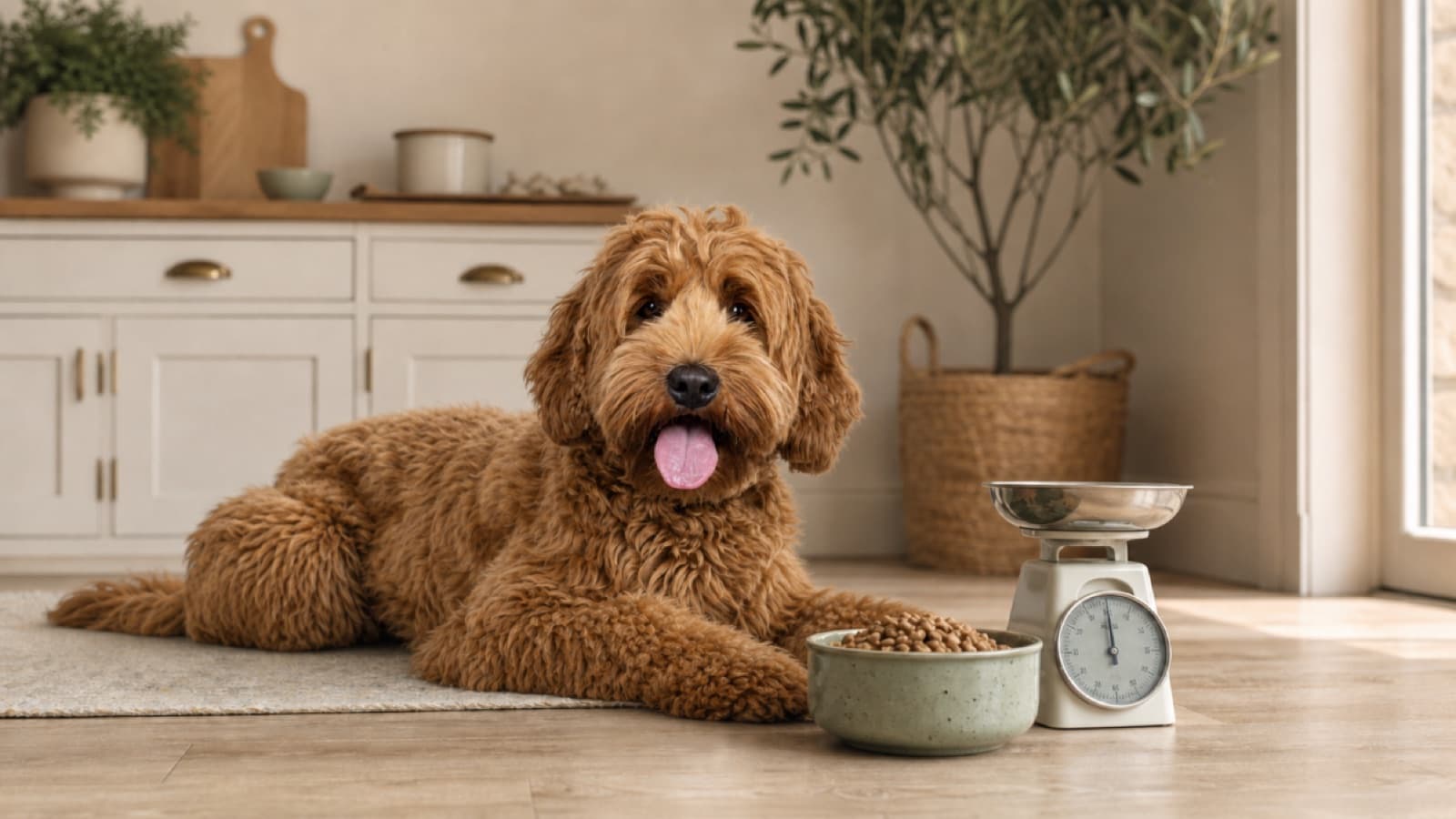
Weigh the day's food out in the morning and stop scooping it by eye. Scoops drift. With dry food a small drift is a surprising amount of energy, because the food is dense and the dog is small. Once the day's amount is measured, split it evenly across his meals and keep a handful back for training, so no treats go on top. If you want a second opinion on the total, our calorie calculator gives you a daily figure to sanity check the pack against.
Feed to the growth curve, not to the ribs
With an adult dog you feed to body condition and hold it there. A puppy is different, because the body you are feeding is supposed to be changing. Aim for growth that is steady and unhurried, never for the fastest growth you can get. Quick weight gain in a young dog is not a win.
So weigh him weekly. Same day, same scales, written down. A steadily climbing line is what you want. Two weeks of sharp gains with a waist that is quietly disappearing means trimming the daily amount a little and holding it there. A line that flattens while he is still young means the opposite. Change things in small steps and give each change a week to show, because puppies eat unevenly from one day to the next. Our guide to portions and body condition covers the hands-on checks in more detail.
If his weight moves in a way that does not fit what you are feeding, or he seems unwell with it, your vet comes first.
Month by month: what actually changes
Eight to twelve weeks. Four meals a day suits most puppies here, because the stomach is tiny and the demand is not. Keep him on whatever the breeder or rescue was feeding for his first week with you. If you want to change, move him across slowly, since a new home and a new food at once asks a lot of a young gut. Switching food without upset walks through the pace.
Three to six months. Most puppies drop to three meals a day somewhere in this window, and appetite climbs with them. This is also teething, so a few flat days at the bowl are normal. Softening kibble with a little warm water helps while the mouth is sore. What matters is that the total for the day stays roughly where you set it.
Six to twelve months. Two meals a day is the usual landing point, and growth begins to slow. With a deep chested breed, keep those meals separate and calm, and read up on bloat and mealtimes. Puppies often need less food for each kilo of body weight than they did, which is why the bowl that was right in spring can quietly become too much by autumn. Keep weighing. If he is neutered during this stretch, watch his waist for a few weeks afterwards and be ready to trim.
Twelve months and beyond. Small dogs are essentially finished by now. Bigger dogs are still filling out, and giant breeds carry on for a while yet. Frame drives the timing far more than anything else, and our breed pages are a useful place to sense-check what to expect from your dog's size.
Large breed puppies and the calcium question
If your puppy is going to be a big dog, calcium during growth is the one thing worth being fussy about. Rapid growth on a food that was not formulated for a large-breed puppy is the situation to avoid, which is also why leaving food down all day is a poor idea for a big youngster. Recipes written for large-breed growth are built with that balance in mind. There is a fuller walk through growth, calcium and joints in a big puppy if yours is heading that way.
The awkward part is that labels do not always help you check. There are 4,983 UK dog food recipes in our analysis. Of the 1,324 written for puppies, 44% declare calcium at all. That leaves more than half of the puppy shelf asking you to take it on trust. Where a recipe does publish the figure, that transparency is worth having. Reading the back of the pack is how you find it. If you are unsure whether a food suits a large-breed puppy, ask your vet before you settle on it.
When do you move to adult food?
Size decides it, not a birthday. Small breeds usually move across at around a year and medium breeds a little after. Large and giant breeds wait longer, often nearer 18 months. There is no prize for switching early. Puppy food is built for growth, and while growth is still happening it is doing a job.
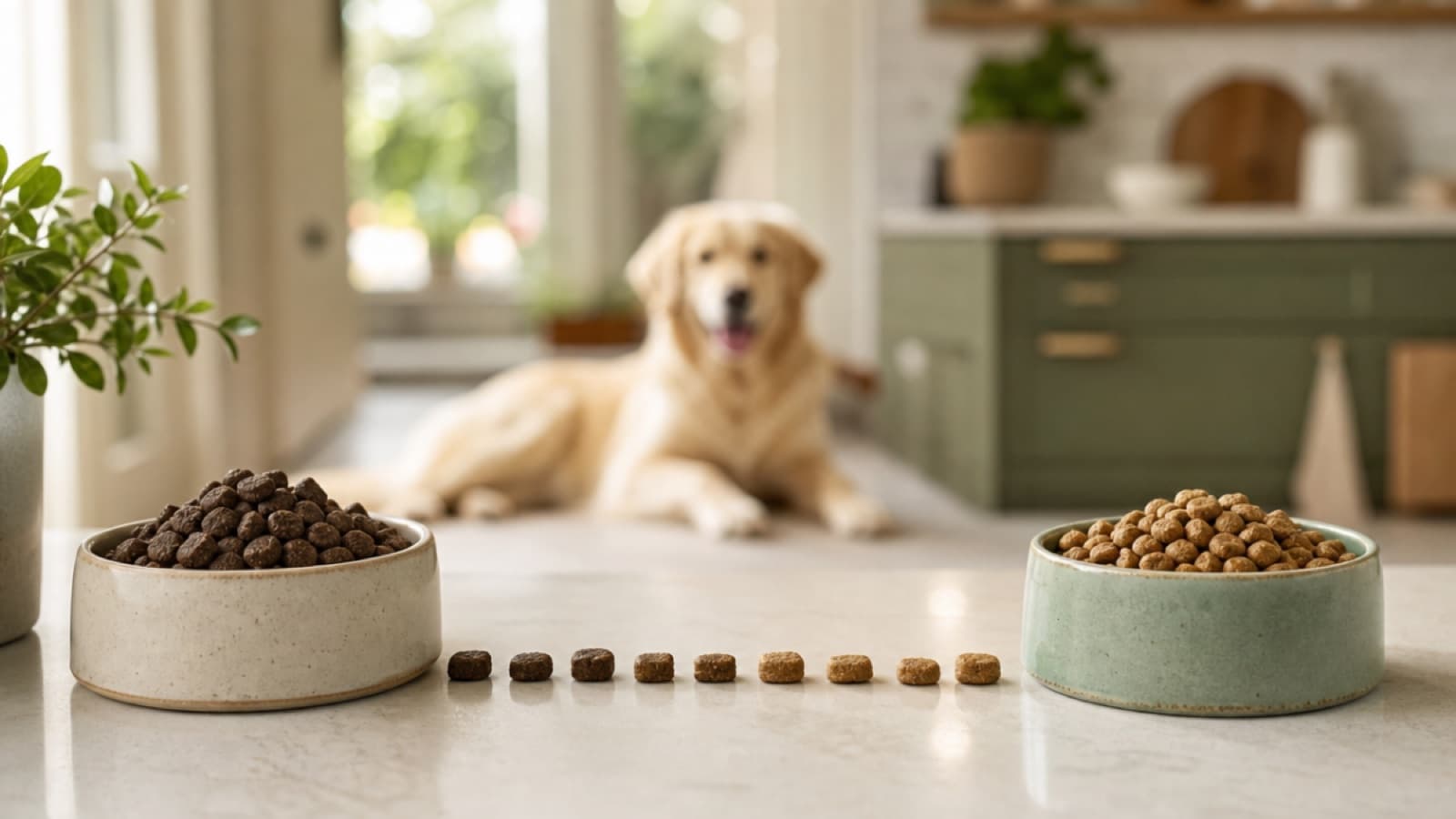
It is also worth knowing that a life-stage badge does not always mean a dramatic change in the recipe. Across the dry foods in our reviews, adult and senior sit at the same median protein once you take the water out, at 27.5%, with fat at 14.3% for adult and 13.2% for senior. Badges are a filter, not a promise. When you do move him onto adult food, read the composition and not the front of the bag. Every food in our reviews is scored on protein and processing, nutritional balance, transparency and value, which is another way to compare like for like.
What if the guide and your puppy disagree?
Loose stools that turn up soon after a change usually mean the change went too quickly, not that the food is wrong. Slow the transition down and give it a week to settle. Looseness that persists, anything with blood in it, or a puppy who is generally off in himself is a vet call rather than a food experiment.
A puppy who leaves food is often teething, or simply bored of a bowl that has been sitting there since breakfast. Pick it up after fifteen minutes and offer it again at the next meal. A puppy who acts permanently starving while gaining nicely is usually just being a puppy. If you have worked through all of that and still think the food itself is the problem, let the narrow the shelf for you. It asks how your own puppy eats, and not how puppies eat in general.
Frequently asked questions
How often should a puppy be fed each day?
Four a day from about eight weeks. That drops to three at around three months, then to two as he approaches a year. The daily total matters far more than the number of sittings. When you drop a meal, keep the amount the same and share it across the ones that are left. Small, frequent meals simply suit a small stomach and a fast metabolism.
Should I leave food down all day for a puppy?
Better not. Measured meals show you exactly what he eats, which is your early warning when something is off. They also make house training far more predictable. Free feeding also makes fast growth easier in a large-breed puppy, which is the thing you are trying to avoid. Put the bowl down, give him fifteen minutes, then lift whatever is left.
My puppy always seems hungry. Am I underfeeding him?
Usually not. Puppies beg enthusiastically whether or not they need the food, so trust the scales rather than the eyes. If he is gaining steadily week to week and keeping a waist you can feel, the amount is right. If the line has flattened and he feels bony over the ribs and hips, add a small amount and check again in a week. Constant hunger alongside weight loss deserves a vet visit.
When should I switch from puppy food to adult food?
When growth is finished, which depends on his size, not his age in months. Around a year suits most small dogs. Larger breeds are usually nearer 18 months, with giant breeds later again. Make the change over a week or so, mixing increasing amounts of the new food into the old. Nothing is gained by moving him early while he is still filling out.