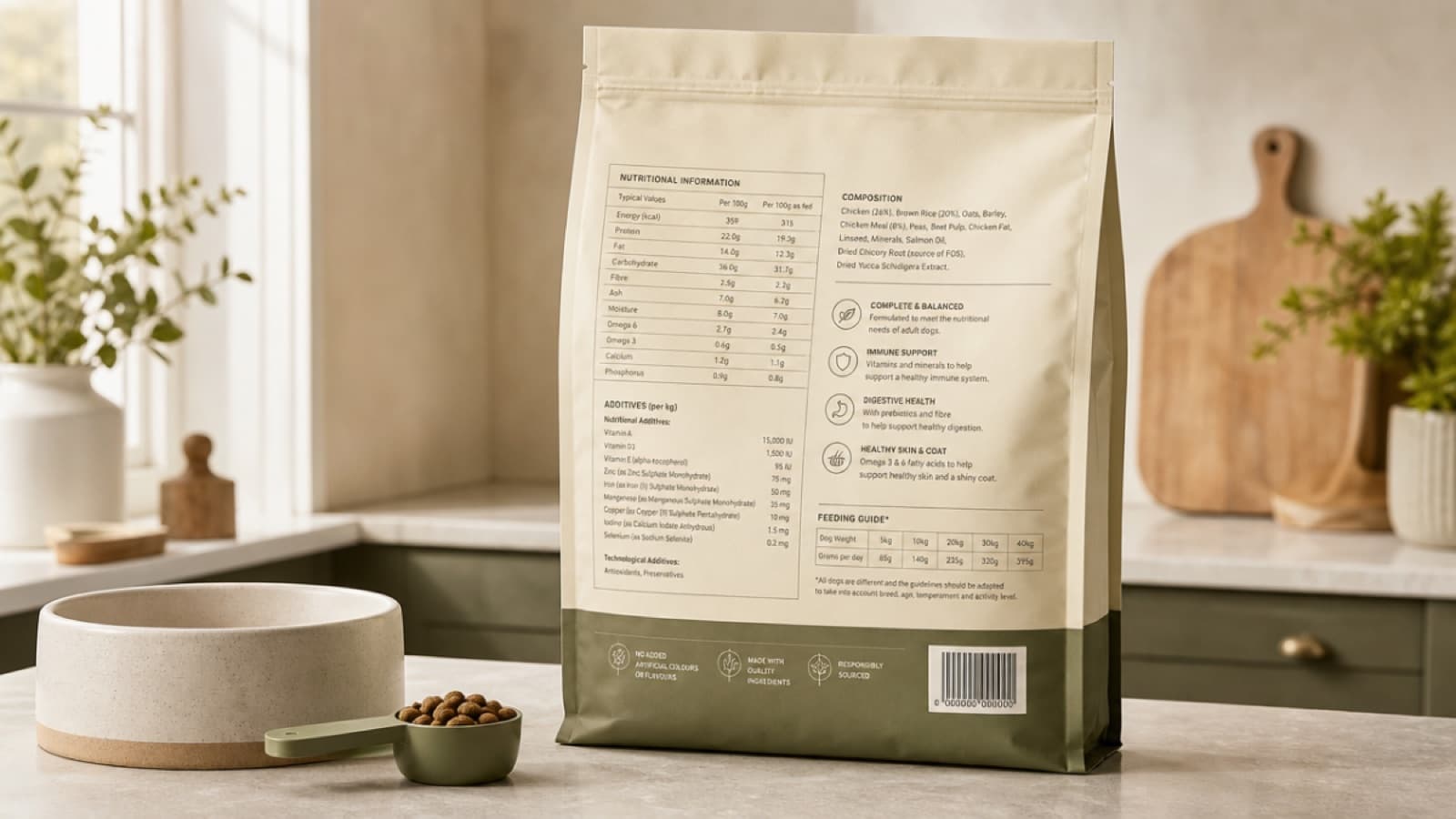
Start in the middle of the pack's feeding guide for your dog's weight, and weigh the food out. Do not scoop it. Feed that same amount for two weeks, then run your hands over the ribs and look at the waist from above. If the shape is drifting either way, adjust by a small amount and check again a fortnight later.
Why the feeding guide on the pack is only a starting point
The chart on the back of the bag is doing an honest job with very little information. It knows roughly how much your dog weighs, and that is about it. It does not know that your spaniel runs for two hours every morning. It cannot see the neutered lab who has slowed down since spring, or the half slice of toast that goes under the table most days.
So use the chart the way it is meant to be used. Start in the middle of the range for your dog's weight and feed that amount consistently for a couple of weeks. Then let your dog's body tell you whether the number was right. The chart gives you the first guess. Your hands give you the answer.
Every dog lands somewhere slightly different, which is why we built the around size, age and the little quirks that change what suits a particular dog.
How much should I feed my dog? The maths behind the number
There is a rough energy estimate sitting behind most feeding charts. For a typical neutered adult dog, daily maintenance energy is often estimated as 110 multiplied by body weight in kilograms to the power of 0.75. That exponent is the interesting part. Energy needs do not climb in a straight line with weight, so a dog twice as heavy does not need twice as much food.
Treat that sum as an estimate, not a prescription. It describes a typical, moderately active neutered adult. Depending on how much they move and how efficiently they run, plenty of real dogs sit either side of it. Once you have a daily figure in kcal, divide it by the food's energy per 100g and multiply by 100. That gives you your grams. Our calorie calculator does the whole thing for you and saves the mental arithmetic at seven in the morning.
Why the same dog needs different grams on different foods
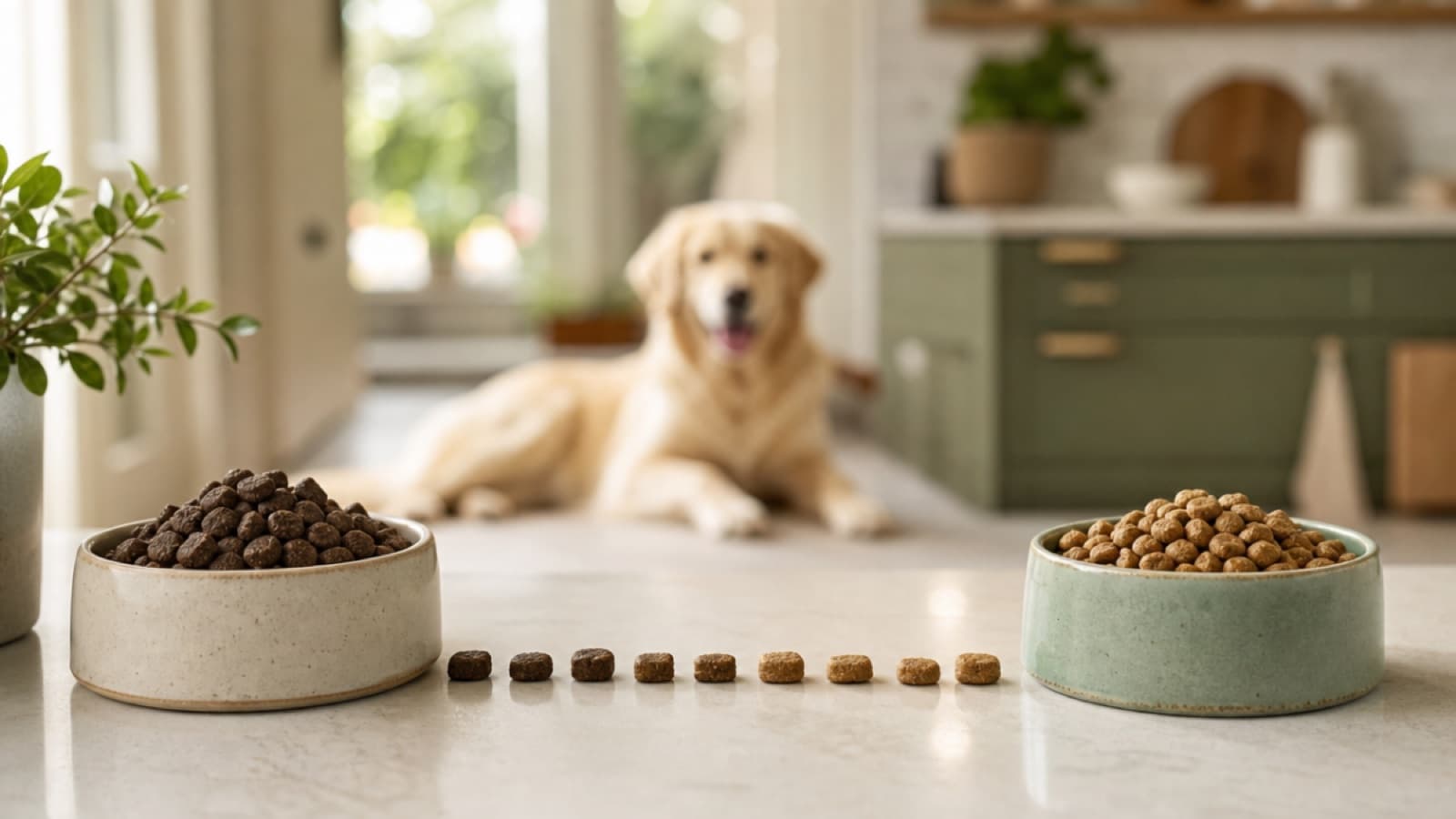
We analysed 4,983 UK dog food recipes, and even inside a single format the energy spread is wider than most owners expect. Among dry foods the median is 362 kcal per 100g, with the bulk of recipes running from around 330 at the lower end to around 390 at the upper end. Move between two dry foods at opposite ends of that spread and the correct portion shifts noticeably, even though nothing about your dog has changed.
Across formats the gap is bigger again, because water carries no energy at all. Wet food has a median of 78% moisture and around 99 kcal per 100g. Raw sits near 155 and fresh near 145, while air-dried comes in around 390 and freeze-dried around 466. A tray of wet and a small handful of freeze-dried can carry similar energy at completely different weights, so the grams you learned for one food tell you very little about the next.
This is the single most common reason a dog quietly gains or loses after a switch. The bowl looks the same, the habit is the same, and the energy is not. Every food in our reviews is scored on protein and processing, nutritional balance, transparency and value. The energy per 100g sits right there with it, so you can redo the sum before the first meal.
How do I check my dog's body condition?
Put both hands flat on your dog's sides just behind the shoulders and run them back along the ribcage with gentle pressure. You should be able to feel the ribs easily under a thin covering, roughly the way you can feel the bones on the back of your own hand. If you have to press to find them, there is more covering than there should be. If they feel sharp and bare, there is too little.
Then use your eyes. From above, there should be a clear waist behind the ribs, narrower than the chest. From the side, the belly should tuck up towards the back legs rather than running level. Do the check on the same day each week and take ten seconds over it. Staying lean matters even more for a dachshund or corgi, as protecting a long back explains.
The weekly habit matters more than the technique. A dog can put on covering slowly enough that the person who sees them every day never notices, and the person who visits at Christmas notices instantly. Your hands catch it long before your eyes do.
Weigh the food instead of scooping it
The scoop is where good intentions quietly come undone. A level scoop and a generous scoop are not the same portion. Kibble settles differently depending on how the bag has been handled, and nobody scoops quite the same way when they are late for work. Kitchen scales take about five seconds and remove the whole problem.
The tidiest routine is to weigh the full day in the morning and tip it into a tub on the counter. Both meals then come out of that tub. You can see at a glance whether the day is on track, and anyone else in the house can feed the dog correctly. Treats come out of the same tub, and nothing lands on top. On a small dog those extras eat up the day fast, and the treat maths for toy breeds shows how.
What to do when the number needs to change
Change in small steps and give each step time to show. A fortnight to three weeks is usually long enough to see a difference in body condition, and anything faster is mostly water and guesswork. Big sudden cuts tend to produce a hungry dog who scavenges, which is a harder problem than the one you started with.
If your dog needs to lose a little, slow and steady wins it. Our guide to helping your dog lose weight walks through the routine week by week. If you want a shortlist, 165 of the recipes we analysed carry a light or weight related name, which you can browse on the weight management page. Movement belongs in the plan too, and the exercise calculator gives you a realistic daily target for your dog, not a generic one.
If the shape changes without you changing anything, your vet comes first. Weight that moves on its own is a health question before it is a feeding question. Older dogs are worth extra attention here, because muscle can fade while the scales barely move. That is why the check is about what you feel under your hands. There is more on that in feeding an older dog.
Frequently asked questions
How much should I feed my dog a day?
Start with the middle of the pack's feeding guide for your dog's weight, weighed out and not scooped. Hold that amount steady for two weeks, then check the ribs and the waist. If covering is building, bring the portion down slightly. If the ribs are getting sharp, bring it up. The chart gets you close and your hands finish the job.
Should I feed my dog once or twice a day?
Twice is the sensible default for most adult dogs. Splitting the daily amount into a morning meal and an evening meal keeps hunger steadier and gives you two chances a day to notice a dog going off their food. Puppies need more frequent meals than that. The important part is that both meals come out of one weighed daily total, with neither one judged by eye.
Do treats count towards my dog's daily food?
Yes, and they mount up faster than most owners expect. Chews and training rewards carry energy, and so does the odd scrap. None of it appears on the feeding chart. The simplest fix is to weigh the day's food in the morning and take treats out of that same amount. Nothing goes on top. If your dog is gaining, treats are the first place to look.
Is my dog overweight?
The rib check settles it. Frame changes how wide a dog looks, but it does not change how easily you can feel the ribcage or whether there is a waist behind the ribs. If the ribs need a firm press to find and the outline runs straight from chest to hip, that is covering rather than build. Your vet can confirm it and rule out anything medical.