Weigh every meal and count the treats. Feed towards your dog's ideal weight, not the number on the scales today. A rough maintenance estimate is 110 multiplied by body weight in kilograms to the power of 0.75 in calories a day, then trim gently from there. Build walks up slowly, and check the ribs every fortnight.
Where do you start when your dog needs to lose weight?
If the vet has said your dog needs to lose a bit, the first feeling is usually guilt. Put it down. Weight creeps on through ordinary kindness. It starts with a crust of toast at breakfast and a heaped scoop where a level one would do. Before long, the ribs have quietly disappeared under a layer you cannot feel any more.
The good news is that it comes off the same way it went on, through small daily habits and nothing drastic. Most of the work happens in the kitchen, not on the walk. Weighing meals and counting what goes in on top of them will do more in a month than an extra loop of the park.
Before you change anything, book a weigh in at your practice. Your vet comes first here, especially if the gain has been fast, if there is a health condition in the picture, or if your dog is on medication. A target weight from someone who has their hands on your dog beats a number from the internet.
How do you know your dog is carrying extra?
The scales matter less than your hands. Run both palms flat along the ribcage using light pressure. You want to feel the ribs easily under a thin covering, roughly the way you can feel the knuckles on the back of your hand. If you have to press to find them, there is a layer to lose.
Then look from above for a waist behind the ribs, and from the side for the tuck where the belly rises towards the back legs. A thick coat hides a great deal, so do this with your hands and not by eye. Repeating the same check every couple of weeks tells you far more than a weekly weigh in, and our guide to portions and body condition walks through exactly what you should be feeling for.
How much food should your dog actually be getting?
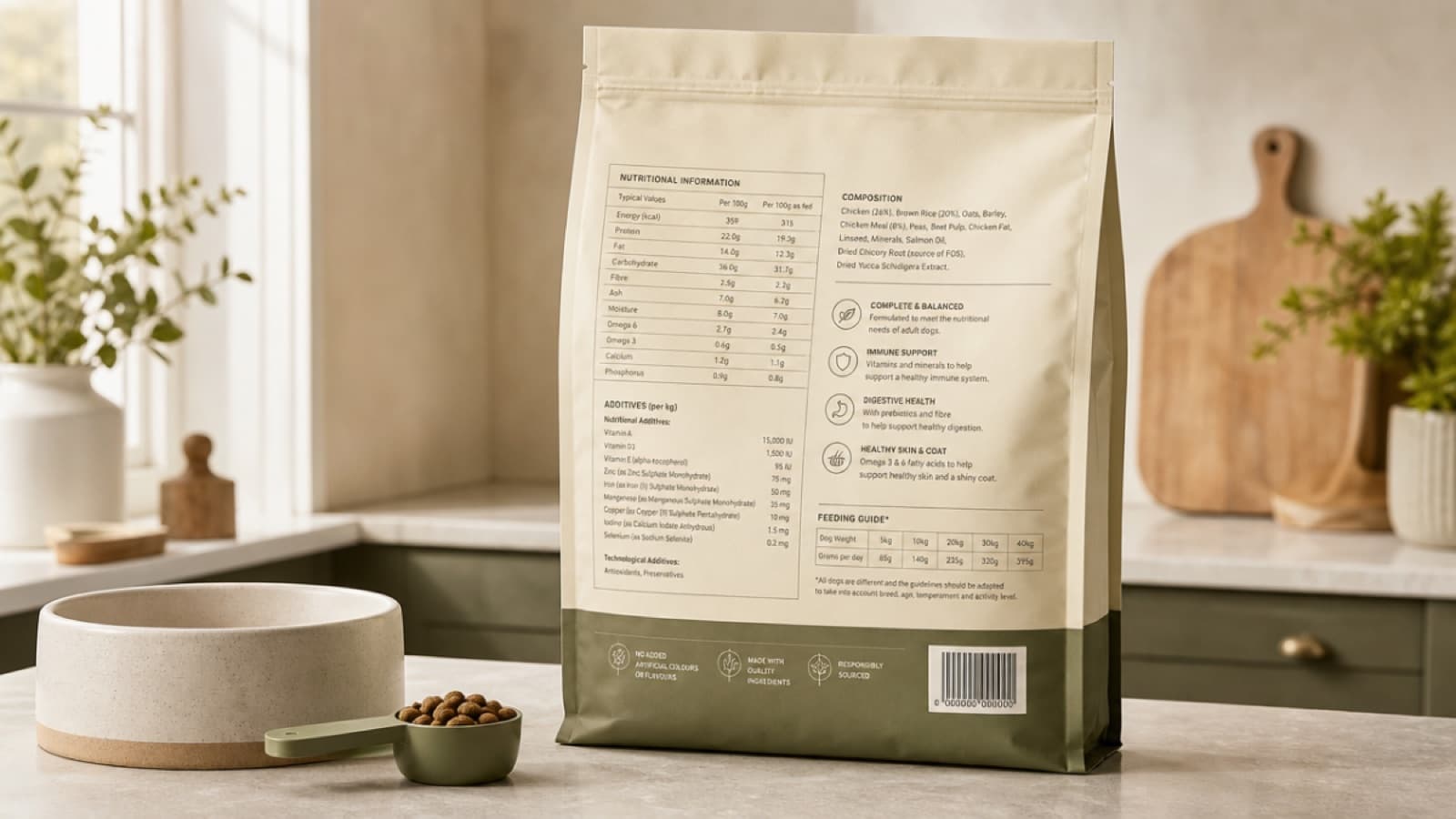
Start from calories rather than scoops. A reasonable maintenance estimate for a typical neutered adult is 110 multiplied by body weight in kilograms to the power of 0.75, which gives a rough daily calorie figure. Divide that by the calories per 100g printed on your food, multiply by 100, and you have the grams for the day. Our calorie calculator does the arithmetic if the maths makes your eyes glaze.
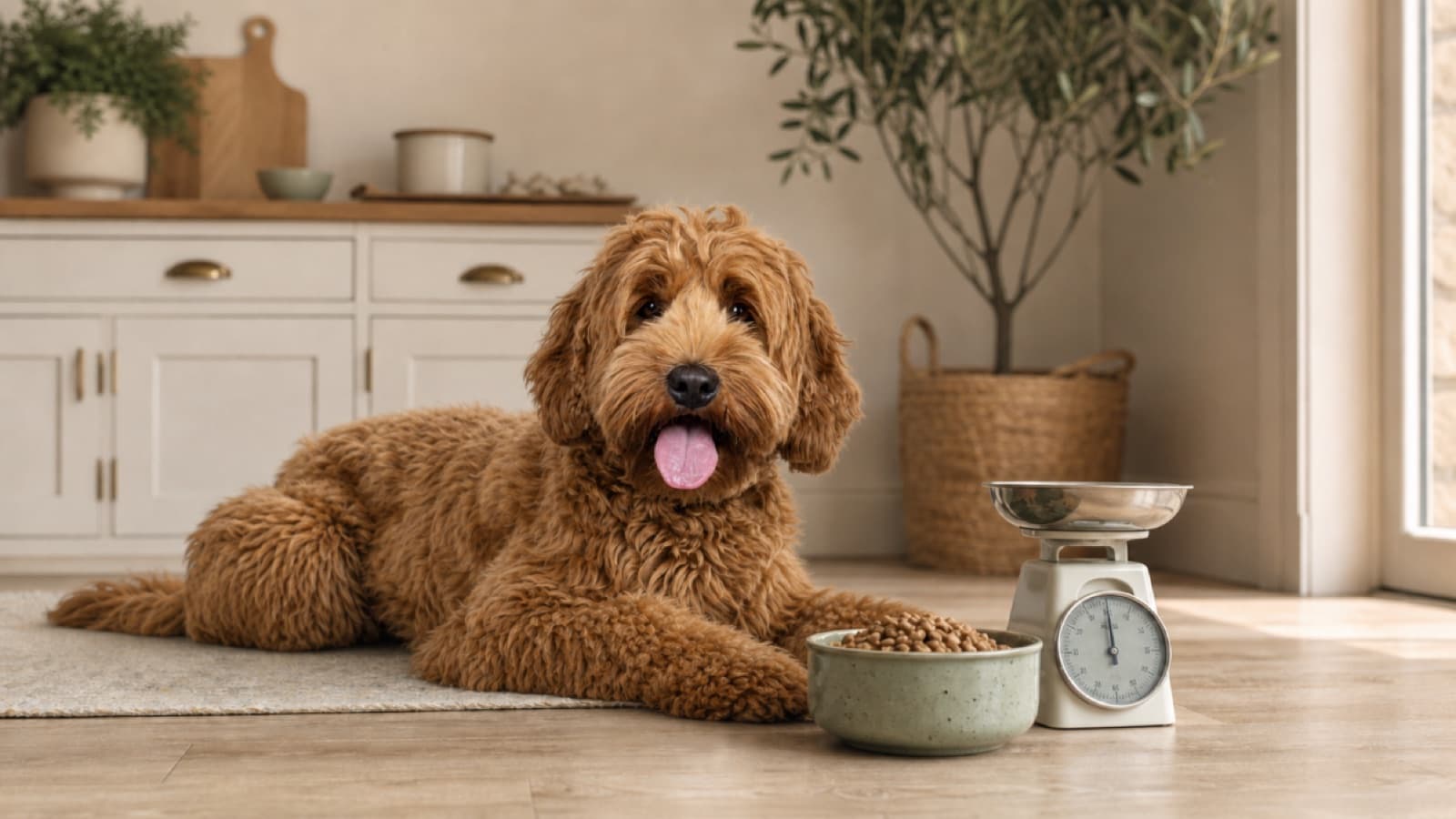
Two details change everything. Feed towards the weight your vet has agreed as the target, not the weight your dog is carrying today. And weigh the food on kitchen scales, without trusting the scoop. A generously filled scoop holds a good deal more than a level one. That gap then repeats twice a day for months on end.
Split the ration into two meals so the bowl still looks like a proper dinner. If your dog inhales it in seconds and then stares at you, a slow feeder bowl or a snuffle mat stretches the same portion out and takes the edge off the staring.
Do treats really make that much difference?
They are usually where a careful feeding plan quietly falls apart. Everything that goes into the dog counts. Training rewards and the dental chew are obvious enough. Less obvious is the corner of cheese wrapped round a tablet, or whatever the children pass down under the table. It helps to agree in the house that the day has one allowance and everybody is drawing from it.
The neatest trick is to take the treats out of the ration and never pile them on top. On a tiny dog that sum is brutal, which is why treat maths for small breeds deserves a proper look. Measure the full day's food in the morning, tip a handful into a pot for training and rewards, then feed the rest at mealtimes. From your dog's point of view nothing has been taken away, because the reward still arrives on cue.
If you want something to hand over that is not food from the bowl, plain vegetables such as carrot or green beans suit many dogs. Part of their own meal, frozen into a rubber toy, turns dinner into an afternoon's occupation. Check with your vet before introducing anything new if your dog has a sensitive gut or a diagnosed condition.
Does a lighter recipe help?
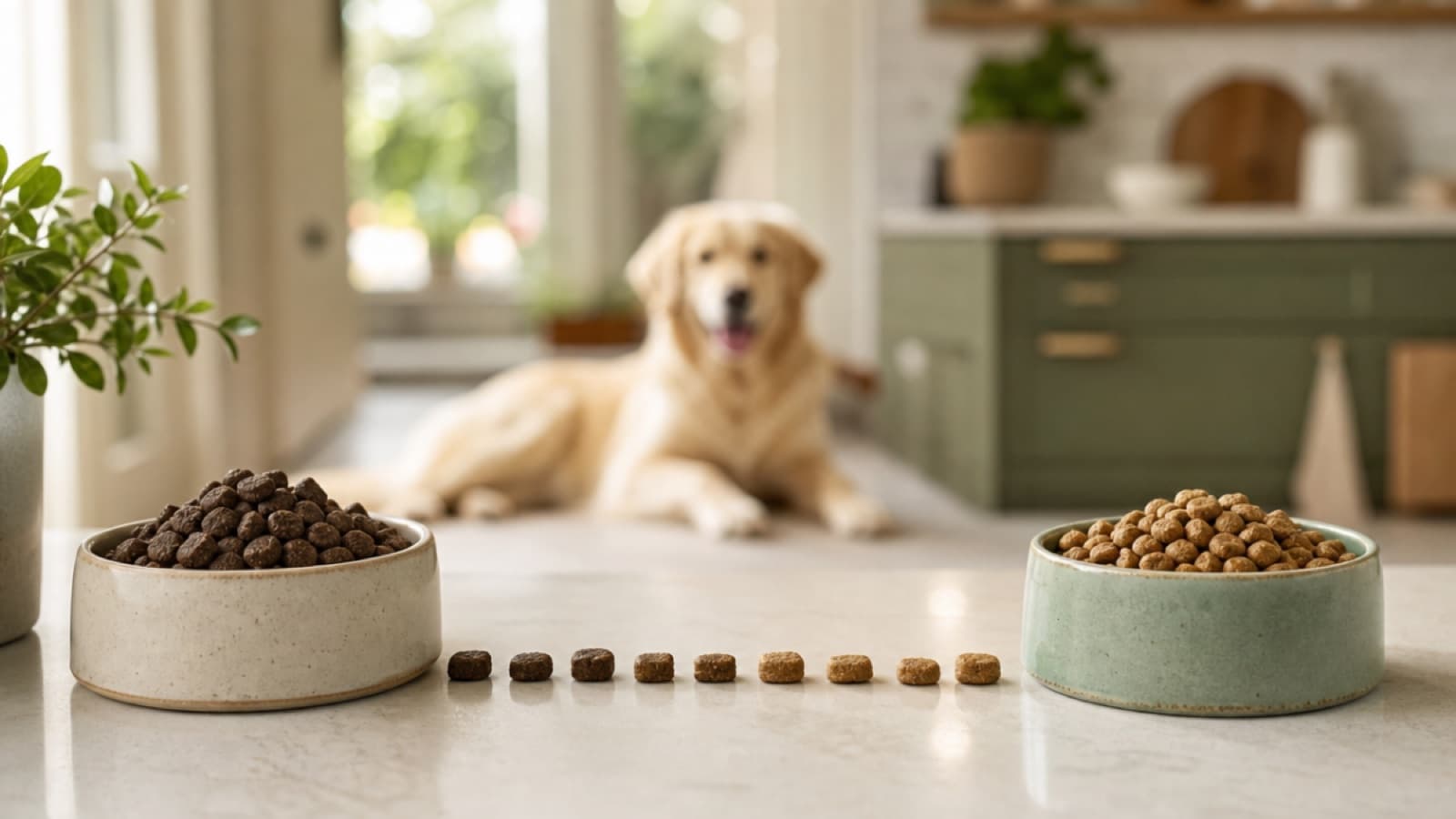
It can, and the reason is simple. The same bowl of dry food does not hold the same calories from one recipe to the next. Across the dry foods in our analysis of 4,983 UK dog food recipes, the middle of the range sits at about 362 kcal per 100g. The lighter tenth come in around 330 and the richer tenth around 390.
That spread means a swap can take calories out of the day without shrinking what your dog sees at dinner. It matters a lot if yours is the sort who watches the bowl going down and looks utterly betrayed. In our reviews, 165 recipes are named for light feeding or weight, although plenty of ordinary dry foods sit at the lighter end without announcing it on the front of the bag.
Whatever you choose, change over slowly across a week or so, because an upset stomach in the middle of a weight plan is discouraging for everyone. Our guide to switching food without upset sets the pace. Every food in our reviews is scored on protein and processing, nutritional balance, transparency and value, and you can read how we score if you want to know what sits behind that.
How much exercise, and how fast should you build it up?
Exercise is the supporting act here, but it earns its place. It protects muscle while the weight comes off and burns off the boredom that turns into begging. Best of all, it gives the two of you something to share that has nothing to do with the bowl.
Build it slowly. A dog carrying extra is already working joints that are under more load than usual, so add a little to the walk each week and skip the whole new regime on Saturday morning. Long backed dogs feel every extra pound, and protecting a dachshund or corgi spine starts with staying lean. Slow, sniffy, meandering walks tire a dog out more than most owners expect. Swimming and hydrotherapy suit some dogs beautifully, and your vet will tell you whether it makes sense for yours. Our exercise calculator gives you a sensible starting point for the daily total.
Older dogs need the gentlest version of all this. Stiffness and a slower pace are common, so several short walks usually beat one long push. If that is the stage you are at, there is more on feeding an older dog.
How do you know it is working?
Use your hands as the main measure. The ribs become easier to find weeks before the scales look impressive, and the waist reappears before the number does anything interesting. Weigh monthly, because daily weights bounce around and are mostly noise.
Slow is the goal. A steady, unhurried loss over months is kinder on your dog and much more likely to stay off than anything dramatic. If nothing has shifted after a few weeks of honest weighing and counting, go back over the calories before you cut harder. Something may well be going in that nobody has been counting.
When you are ready to look properly at what is in the bowl, the narrows things down by size, age and how your dog is doing. Every dog is different, and the plan that suits next door's spaniel may not suit yours at all.
Frequently asked questions
How quickly should my dog lose weight?
Slowly. A gradual loss over several months holds far better than a rapid drop, and it protects muscle while the fat comes off. Your vet will set a safe pace for your dog and can weigh them regularly at the practice, often at no charge. If the weight falls away fast without you changing anything, that is a reason to ring the vet rather than celebrate.
Should I just feed less of my dog's current food?
Usually yes, at first. A modest reduction plus honest treat counting is the simplest place to start. There is a floor, though. Cut the same food too far and the daily portion stops supplying the vitamins and minerals your dog needs alongside the calories. That is the point at which a recipe designed for lighter feeding does a better job than a smaller scoop.
Do I feed for my dog's current weight or their target weight?
Target weight, agreed with your vet. Feeding to the weight your dog is now simply maintains it. Work the calorie estimate from the number you are aiming at, then recheck every few weeks as things change. If your dog is a long way off target, your vet may prefer a staged goal so the reduction stays gentle and you both get a win early on.
My dog acts starving on a smaller portion. What can I do?
Change the shape of the day and leave the total alone. Split the ration across two or three sittings. A slow feeder or snuffle mat makes eating take real time, and holding back a handful for training keeps the rewards coming. A recipe at the lighter end of the calorie range fills the same bowl for fewer calories, which often settles the staring.