

There is no single best food for itchy skin, because the right food depends on what your dog reacts to. Have your vet rule out fleas and skin infection first. If food is still suspected, run a strict trial of eight weeks or more on one novel or hydrolysed protein, then challenge it deliberately to confirm the result.
Is your dog itching because of the food?
Start with the honest answer, because it will save you months. Most itching in UK dogs is not caused by food. Fleas are the commonest reason of all, and a sensitive dog can react to a couple of bites without you ever finding a flea in the coat. Environmental allergy comes next, a reaction to pollen or to house dust that tends to land on the paws, the belly and the face.
Food does cause itching in some dogs. It is simply further down the list than the internet suggests. That matters, because the only way to prove it involves eight weeks or more of genuinely strict feeding, and most households have the patience to do that properly once. Running the trial while a flea problem simmers away in the background wastes the whole attempt and leaves you no wiser.
What your vet rules out before the bowl
Before you change anything, have a proper conversation with your vet. If you have not settled on a practice you trust, it is worth choosing one carefully, because itchy skin is a long game and continuity helps.
Expect three things. Parasite control brought fully up to date for every animal in the house, not only the one who is scratching. A look at the skin itself under the microscope, which finds mites and the yeast or bacterial infections that turn a mild itch into a raw one. And a check of the ears, because sore skin and grumbly ears usually travel together, particularly in dogs who swim or push through wet grass on winter walks.
Phone the practice the same day if the skin is broken, weeping or smells sour, or if your dog cannot settle or sleep for scratching. Phone too if the face or muzzle swells, if hives appear, or if vomiting or diarrhoea comes alongside the itch. Any sign of difficulty breathing is an emergency rather than a wait and see.
What an elimination food trial actually involves
An elimination trial is not “try a sensitive recipe and see how we get on”. It is a controlled experiment with one rule. For eight weeks or more your dog eats one food and nothing else. That food is built around a protein your dog has genuinely never had before. The alternative is a hydrolysed diet your vet prescribes, where the protein is broken down small enough that the immune system tends to overlook it.
Nothing else at all is the part that trips people up. No dental sticks. No training treats. No flavoured wormer or toothpaste without checking with your vet first. No scrapings from the roasting tin. If your dog takes medication wrapped in cheese, ask your vet what to use instead. One slip a week is enough to keep the itch ticking over and leave you unable to read the result.
The other half is the challenge, and it is the half most owners skip. If the skin quietens down, you go back to the old food deliberately and watch. An itch that returns within a fortnight is the strongest evidence you will get that food was involved. Without that step you have a coincidence rather than an answer.
Why swapping brands every fortnight tells you nothing
Skin is slow. A coat takes weeks to reflect a change in the bowl, and the calendar keeps moving underneath you while you wait. Pollen rises and falls. The heating goes on. A flea treatment falls due. If you change food every two weeks, you are reading noise and calling it evidence.
Frequent swapping causes a second problem. Gut upset from a rushed transition looks a lot like a reaction, so you end up blaming an ingredient that did nothing wrong. Whatever you feed, move across gradually, and our guide to changing food without an upset stomach sets out the pace. If loose stools are part of the picture too, calming the gut is worth reading alongside this.
Why chicken and beef are the usual suspects
When food is the trigger, the protein is usually the part that matters, and chicken and beef come up most often. That is not because they are poor ingredients. It is arithmetic. A dog reacts to what it has eaten a great deal of, and those two are what most dogs have eaten a great deal of.
The numbers back it up. Chicken appears in 45% of the 4,983 recipes we analysed, which is why it is so easy to keep feeding by accident and why it turns up so often as the suspect. The other side of that is cheering. 2,766 of those recipes, 55% of them, contain no chicken at all, so there is plenty to work with once you start looking properly. Our chicken-free feeding guide goes through the swaps in detail.
Recipes built on a single meat species make a trial far easier to run, because you can actually tell what your dog is eating. 1,306 of the recipes we looked at, 26% of the market, keep to one meat species, and between them they draw on 32 distinct main proteins. That is a wide field to find a novel protein in, and it is why reading the composition list in order beats trusting the badge on the front.
Does grain-free help an itchy dog?
Usually not. Grain is a far less common trigger than the shelf implies, and going grain-free often just swaps wheat for potato while leaving the chicken exactly where it was. If the protein is the problem, a grain-free chicken recipe changes nothing at all. We have written up where grain-free genuinely earns its place if you want the longer version.
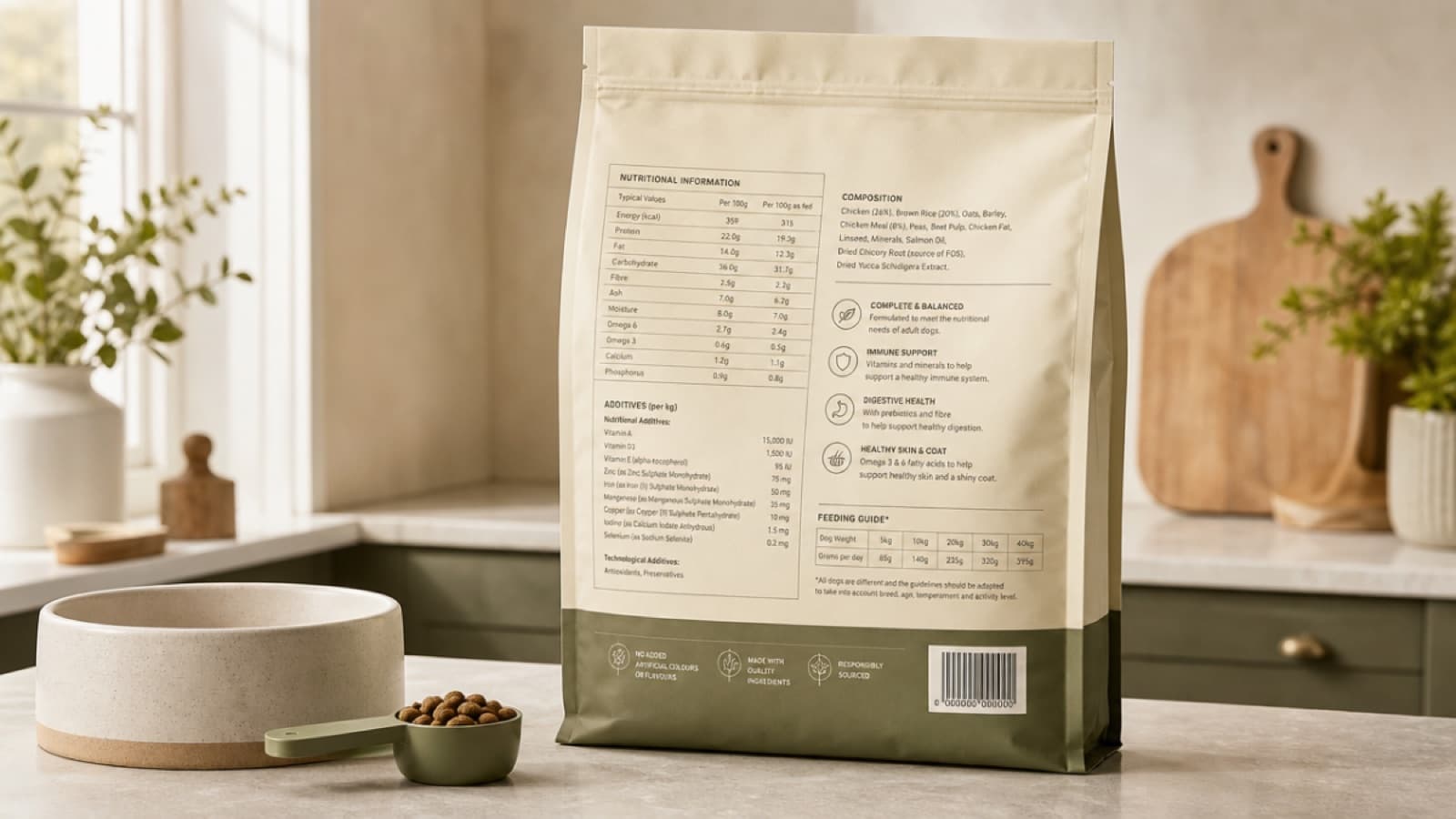
The same goes for the word hypoallergenic on the front of a bag. It is a marketing term, and no regulator stands behind it. Plenty of foods carrying it contain the very proteins dogs most often react to. Look at the composition on the back of the bag.
How to choose the food you will trial
Pick one recipe with a short and legible ingredient list, built on a protein your dog has not met. Check the whole list, because a fish recipe with chicken fat in the small print is not a fish trial. Then commit to it for the full run and keep a note of what the skin is doing each week.
Some breeds bring itchy skin up more often than others, and owning one of them is a good reason to know what tends to show up and when. Our guides for the West Highland Terrier and the French Bulldog both cover the skin side in detail, and the Staffordshire Bull Terrier and Shar Pei pages do the same. None of that makes a breed a problem. It means you go in with your eyes open.
When you are ready to shortlist, our foods for sensitive dogs is a sensible starting shelf. Every food in our reviews is scored on protein and processing, nutritional balance, transparency and value, so you can see why a recipe sits where it does. The Food Finder will narrow things further once you tell it your dog's age and what you need to avoid.
Frequently asked questions
How long does a food trial for itchy skin take?
Eight weeks or more of strict feeding, then a deliberate challenge. Skin and coat respond slowly, so a fortnight tells you nothing either way. Give it the full run with no treats and no scraps, then put the old food back and watch for another fortnight. If the itch returns, you have your answer. If nothing changes at either end, food was probably not the trigger.
Can I just buy a hypoallergenic dog food instead?
You can feed one, but it is not a substitute for a trial. Hypoallergenic is a marketing word with no regulated meaning, and the recipe underneath may still contain chicken or beef. What matters is the composition list, not the claim on the front. For a genuine test, either use a protein your dog has never eaten or ask your vet about a hydrolysed diet.
My dog's food has not changed, so can it still be the food?
Yes, it can. Food sensitivity tends to build with repeated exposure, so a dog can eat the same recipe happily for years and then begin reacting to it. That said, a new itch in a dog on an unchanged diet is more often fleas or the season. Have parasites and skin infection ruled out first, then consider a trial if the scratching carries on.
Will fish or lamb fix an itchy dog?
Only if the protein your dog reacts to is the one you have taken out. Fish and lamb work well as trial diets because plenty of dogs have never eaten them, not because they soothe skin on their own. If your dog has had lamb regularly, it is not novel for them. Choose by what your dog has not eaten, and read the whole list for hidden chicken fat or unnamed animal derivatives.