

More than half of it. Of the 4,983 UK dog food recipes we analysed, 2,766 contain no chicken at all, which is 55% of the shelf. Chicken is still the aisle's default protein and turns up in 2,217 recipes, often as fat or liver rather than as the meat on the front. Fish is even more common.
Why is chicken in almost half of all dog food?
Chicken is the default protein of the British dog food aisle, and the numbers say so plainly. Our analysis covers 4,983 UK dog food recipes. These counts come from the 4,935 of them that publish a full ingredient list. Chicken appears in 2,217 recipes, 45% of the shelf, once you count every form it takes.
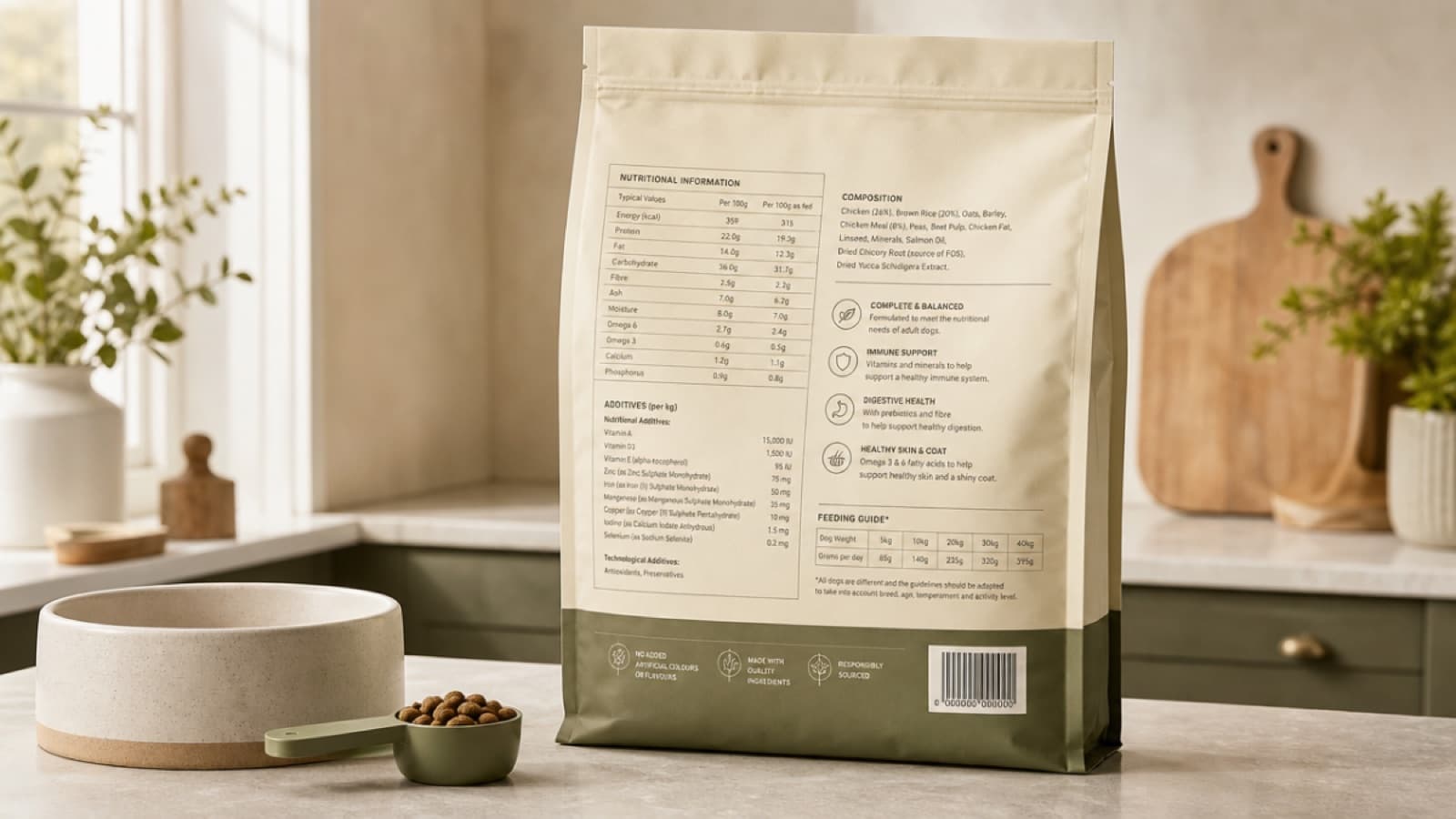
That last part matters more than the headline. Chicken is not only the meat pictured on the front of the bag. It arrives as chicken fat, as chicken liver, as dried chicken protein and as chicken gravy in a wet food fronted by something else entirely.
So a dog who reacts to chicken has almost certainly met it again and again, in foods whose front label suggested lamb or fish. It is rarely bad faith. It is simply the ingredient the industry reaches for first. Our guide to reading a dog food label shows you where those quieter versions sit.
How much of the shelf is left without chicken?
More than half of it. 2,766 recipes, 55% of everything we analysed, contain no chicken in any form. That is the number to hold onto if your vet has just asked you to take chicken out, because it means you are not being pushed into some strange corner of the market. You are choosing from a bigger pool than the one you were standing in before.
It does not feel like more than half when you are standing in a shop, and that is worth explaining. Chicken dominates the ranges that get the most shelf space, so the eye sees it everywhere it looks. Counted recipe by recipe across the whole UK market, the balance is far more even than the aisle in front of you suggests.
Chicken free is not a quality mark on its own. Leaving one ingredient out tells you very little about the rest of a recipe. Our bands run from Outstanding down to Poor, and a food lands where it lands on what it is built from rather than on what it avoids. That is how we score every food on the site, and every UK dog food we have reviewed is there to browse.
The surprise finding: fish is in more recipes than chicken
Here is the finding that surprised us most. Fish is the most common ingredient class in the entire market, ahead of chicken. It appears in 2,896 recipes, 58% of the shelf.
Most of that is not a fish dinner. It is salmon oil or fish oil added in small amounts for the fats, sitting well down the composition of foods that say beef or lamb on the front. Nothing on the packaging tells you it is in there.
For most dogs that is a good thing, because those oils are doing useful work for skin and coat. For the dog who reacts to fish, it is the most easily missed ingredient on the shelf. That alone explains a lot of trials that seemed to fail for no reason. If it is your dog's gut giving the trouble, read calming a sensitive stomach next.
Which proteins are left once chicken is out?
After chicken, the shelf thins out faster than most people expect. Beef appears in 1,009 recipes and turkey in 981. Egg turns up in 746, which catches owners out, because egg is rarely the thing a shopper thinks of as a protein at all.
Turkey deserves a note of its own. It is the obvious swap when chicken is out, and often the right one. But because turkey and chicken are both poultry, not every dog draws a line between the two. If your vet has asked you to avoid chicken, ask whether turkey should come out too before you buy a big bag of it.
Grain gets blamed for a great deal of what a protein is actually doing, and the two questions get tangled together constantly. There is a separate piece on whether your dog needs grain-free food.
What does an elimination trial actually need?
An elimination trial works by shrinking the ingredient list down to as little as possible, then adding things back one at a time and watching what happens. It only works if the food itself is simple. A recipe carrying four different meats gives you nothing to learn from.
This is where the census turned genuinely encouraging. 1,306 recipes, 26% of the market, keep to a single meat species. That is a quarter of the shelf already built the way a trial wants it, which is far more than the handful of specialist options owners tend to assume they are limited to.
One thing needs saying plainly. An elimination trial belongs with your vet. They will tell you what to take out, how long to hold it and what a genuine result looks like. Part of the job is also ruling out the things that look like a food reaction and are not. Your vet comes first on anything clinical.
How do you find the foods without your dog's trigger?
Reading every composition on a shelf is a miserable job, and it is exactly the job the was built to take off you. Tell it which ingredients your dog cannot have and it drops every recipe containing them before it shows you anything, including the versions hiding in the fats and the flavourings. Chicken fat goes when chicken goes. Salmon oil goes when fish goes.
It also helps to write your dog's trigger list down and keep it on your phone. Reactions rarely arrive with a tidy label attached. By the time you are in front of a wall of bags, the ingredient your vet mentioned three weeks ago has a way of quietly going missing.
What comes back is a shortlist that is already safe for your dog. The ranking then comes from how good the food actually is, not from what it happens to leave out. After that the only thing left is to go slowly, because a new protein and a rushed changeover at the same time will muddy everything you are trying to learn. Our guide to switching food without upset has the timings.
Frequently asked questions
If chicken is out, is turkey a safe swap?
Not automatically. Turkey and chicken are both poultry, and some dogs treat them as much the same thing while others are perfectly fine with the swap. Turkey is a real option on paper, appearing in 981 of the recipes we analysed, so the choice is there if your vet is happy with it. Ask them before you commit, particularly if you are partway through a trial and want a clean result.
Does chicken free mean grain free?
No. They are separate questions that get muddled constantly. Chicken free is about the protein, and plenty of chicken free recipes contain grain quite happily. Of the 4,983 UK recipes we analysed, 2,766 contain no chicken at all, and those span both grain free and grain inclusive foods. Work out which one your vet actually wants removed, then filter for that and leave the foods that promise both alone.
How do I know chicken is really the problem?
You cannot know from the bag alone, which is the honest answer. A vet led elimination trial is the only reliable way, and it needs a simple recipe to work against. That part is easier than it sounds, because 1,306 recipes, 26% of the market, keep to a single meat species. Your vet decides what comes out and for how long, then you reintroduce one thing at a time and watch what happens.
Why does a lamb food contain chicken fat?
Because fats and organ meats are easy to source from poultry and useful in a recipe, so they get added whatever the front of the pack advertises. Chicken fat and chicken liver are the usual culprits, and neither has to appear in the product name. It is the same reason fish shows up in 2,896 recipes, 58% of the shelf, mostly as salmon oil in foods that never mention fish anywhere obvious.