



Green Petfood
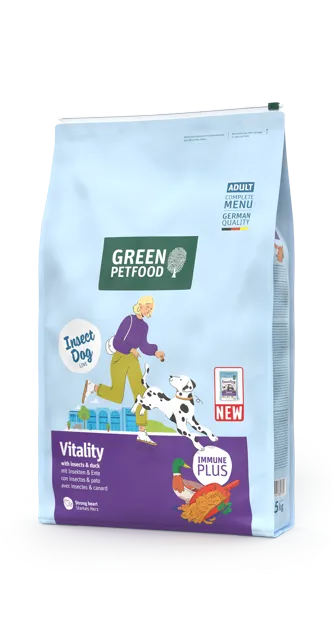
Green Petfood InsectDog: Vitality With Insects & Duck review
Flavour
Green Petfood InsectDog builds complete dry food around insect protein, and that is the whole point of it. Almost no dog has met this protein before, and rearing it takes far less land and water than conventional meat. Five recipes share the insect base and then part company, some pairing it with salmon or duck, others keeping the animal side to insects alone. Taurine and L-carnitine are dosed on every published panel. The range runs from our Average band up to our Good band, and that spread is mostly a story about how much of each bowl is animal and how plainly it is named.
Our view
Likely to suit
When the usual proteins have all been tried and none of them agreed with your dog, this range opens a door that most brands do not.
- Dogs that have worked through chicken, beef and lamb without success, since insect protein is new to nearly every dog that meets it
- Owners who want a lower-impact protein without giving up the convenience of a complete dry food
- Households that like to rotate, with five recipes sharing one base and one feeding system
- Older dogs, with taurine and L-carnitine dosed on every published panel
- Big dogs, because the feeding tables on several recipes run all the way to 80kg
Worth watching
Read the label habits that run through the whole range before you pick a bag.
- Insects are not named by species and several recipes list oils and fats with no source, enough to unpick a strict elimination trial
- The published additive panel for the High Protein recipe prints no zinc, copper or selenium, where the other four print all three
- Starch does most of the carrying in the Sensitive and Vitality recipes, at 57.0% and 58.3% of dry matter
Written by our editorial team. Independent guidance, not veterinary advice.
How this scores
How we scoreThe Details
Dog fit
When the usual proteins have all been tried and none of them agreed with your dog, this range opens a door that most brands do not. Read the label habits that run through the whole range before you pick a bag.
Dry
Adult, Senior
Medium
Duck
The score, in context
The five recipes fan out across two of our bands, with High Protein reaching our Good band alongside the typical adult dry food and the other four a step back in Average. The pattern behind that is consistent: the more of the bowl that comes from a named animal, the higher a recipe lands. High Protein puts 20% insects next to 18% dried salmon protein and finishes top of the range, while Hypoallergenic leans on potatoes and pea flour and finishes bottom. None of that measures the thing these foods are actually built for, which is feeding a dog whose system has fallen out with conventional meat. On that job the bands have nothing to say, and the quietest recipe here may still be the one your dog needs.
What's in it
Ingredients, as declared: rice, insects : 10 %, dried duck protein : 10 %, oils and fats, hydrolysed yeast, beet fibre, yeast : 4 %, minerals, psyllium husks, ground chicory root (natural source of inulin) : 0.1 %, herbs, fruits (raspberry, peppermint, parsley, chokeberry, chamomile, licorice root, blueberry, marigold, fennel) : 0.1 %
Named ingredients
Nutritional additives
_Nutritional additives per kg:_ | Additive | Amount | |---|---| | vitamin A | 16.000 I.E. | | vitamin D3 | 1.200 I.E. | | vitamin E | 400 mg | | vitamin C (ascorbyl monophosphate calcium sodium salt) | 200 mg | | vitamin B1 | 10 mg | | vitamin B2 | 15 mg | | vitamin B6 | 15 mg | | vitamin B12 | 70 mcg | | calcium-D-pantothenate | 30 mg | | niacinamide | 60 mg | | folic acid | 4 mg | | biotin | 600 mcg | | taurine | 1.000 mg | | L-carnitine | 300 mg | | iron (iron(II) sulphate monohydrate) | 90 mg | | zinc (zinc chelate of glycine, hydrate (solid)) | 110 mg | | manganese (manganese (II) oxide) | 7,00 mg | | copper (copper(II) chelate of glycine hydrate (solid)) | 10,00 mg | | iodine (calcium iodate anhydrous) | 1,30 mg | | selenium (sodium selenite) | 0,10 mg | _Technological additives:_ Antioxidants: tocopherol extracts of natural origin.
Ingredient notes
Insect protein is the reason to be here. Dried insect meal carries a full spread of amino acids and digests well. For a dog raised on chicken and beef it is about as novel as a protein gets, and that is how it earns its place in exclusion diets. The share varies across the range, at 20% in the High Protein and Mini recipes, 15% in Sensitive and 10% in Hypoallergenic and Vitality. The one thing the labels never do is name the insect.
The plant side is where these recipes differ most. Pea flour, dried red lentil and tapioca carry the grain-free builds, potato and sweet potato appear in two of them, and rice leads both Sensitive and Vitality. Pea flour is worth understanding, because it is a concentrated plant protein as well as a starch. Some of the protein on the analysis panel is coming from the field and not from the animal.
Two of the labels hand you a genuine limitation. Oils and fats appears with no source named on four of the five recipes, and Mini uses poultry fat without pinning it to a bird. Hydrolysed fish protein sits low on the High Protein list. For most dogs none of that matters. For a strict exclusion diet run with your vet, that means no recipe here is a clean single-source bowl.
The supplement side is generous and consistent. Every panel carries the full B group, vitamin C, biotin, taurine and L-carnitine, all with figures against them, and four of the five list zinc as a glycine chelate along with copper, iodine and selenium. The High Protein panel is the exception, printing no zinc, copper or selenium at all, which is reproduced here as the brand publishes it.
Gut support is threaded through the range in small, sensible amounts: partially hydrolysed yeast and yeast cell walls, beet fibre, apple fibre, psyllium husks and ground chicory root as an inulin source. Inulin is a prebiotic, and what it feeds is the useful bacteria down in the large intestine. Psyllium is soluble fibre of the kind that steadies a loose stool.
How this variety differs
Rice first, then insects at 10% and dried duck protein at 10%, with yeast at 4% and the same fruit and herb blend at 0.1%. Duck gives the bowl a second named animal, which some dogs simply prefer, and this panel carries the highest vitamin E dose of the five. Protein sits at 21.7% of dry matter with estimated carbohydrate at 58.3%, so it is the starchiest recipe in the range.
Price and value
£5.08 a kilo on the High Protein, Mini and Vitality recipes. Bags run 900g and 3kg across the range, with 7.5kg on High Protein, Mini and Vitality and 10kg on Hypoallergenic and Sensitive, plus 5x900g and 3x3kg multipacks.
As a guide, we work from about 840 kcal a day for a 15kg adult dog in moderate condition (110 × bodyweight^0.75, the standard maintenance estimate). That comes to between 223 and 240 grams a day, depending on the recipe. On the three recipes with a per kilo figure that comes to £1.13 a day for Mini, £1.16 for High Protein and £1.18 for Vitality.
Nutritional analysis
Declared analysis
20%
10.5%
2.2%
5.7%
Dry weight
21.7%
11.4%
2.4%
6.2%
58.3%
As-fed composition
Estimated breakdown of the finished product by ingredient category, from the declared ingredient list and ingoing weights. These are estimates, not measurements.
20%
40.8%
0.2%
13.3%
25.8%
Pricing & size
- Pack size
- 900g, 5x900g, 7.5kg, 3kg, 3x3kg
- Retailer pricing
- Coming soon
Live retailer pricing is not yet available for this food. Prices, cost per day and where to buy will appear here once retailer data is live.
Ingredients and nutrition are taken from manufacturer data. Retailer pricing is not yet live for this food.
Related dog food guides
Ranked shortlists that include foods like this one.