


Green Petfood
Green Petfood VeggieDog: Grainfree review
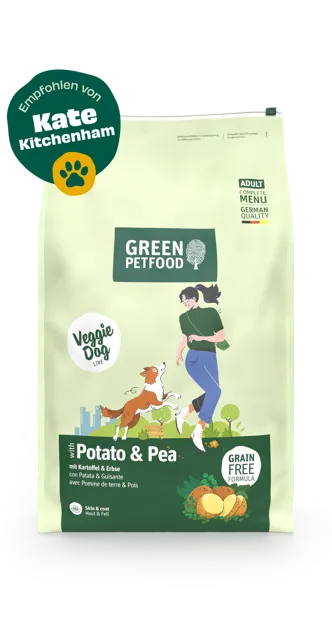
Green Petfood VeggieDog is a complete dry food, and not one ingredient in it comes from an animal. It is made for households feeding a plant-based diet, and for dogs who have run out of meats they can tolerate. Two recipes make up the range, one grain free on potato and pea, the other built on rice and red lentil. Both carry taurine and L-carnitine with figures against them, which is the part a meat-free bowl has to get right. Both land in our Average band, and that deserves reading properly. Our scoring is built around named animal protein, so a food designed to contain none starts a long way back on paper whatever else it does well.
Our view
Likely to suit
A meat-free bowl asks more of a recipe than a meaty one does, and this is a range that clearly knows it.
- Households feeding a plant-based diet who want a complete food and not a home-made one
- A dog who has reacted to one animal protein after another, since there is nothing here to react to
- Owners working with a vet on an exclusion diet, because a bowl with no meat in it makes a clean starting point
- Owners who want the amino acid gaps covered in print, with taurine and L-carnitine dosed on both panels
- Bigger dogs, as the feeding tables on both recipes run to 80kg
Worth watching
Go into a meat-free bowl with your eyes open, and here is what the labels tell you.
- A dog uses plant protein less efficiently than meat protein, and every gram of protein here is plant protein, so the analysis reads a little better than it eats
- Vegetable oil is the added fat on both recipes and the plant it came from is not named
- Estimated carbohydrate is 50.9% of dry matter on Grainfree and 57.6% on Origin, both above the 46.2% typical of adult dry food
- Neither label declares moisture or calcium, so our dry matter figures here use the standard 8% assumption for a dry food
- A meat-free diet is worth talking through with your vet, particularly for a growing, pregnant or unwell dog
Written by our editorial team. Independent guidance, not veterinary advice.
How this scores
How we scoreThe Details
Dog fit
A meat-free bowl asks more of a recipe than a meaty one does, and this is a range that clearly knows it. Go into a meat-free bowl with your eyes open, and here is what the labels tell you.
Dry
Adult, Senior
Medium, Large
The score, in context
Both recipes land in our Average band while the typical adult dry food sits in our Good band, and the reason is structural rather than a fault anyone would find in the bag. Our scoring rewards named animal protein and the share of the bowl it fills, so a food built deliberately without any cannot collect those points however carefully it is made. The pillars are the more useful read here. Protein and processing reads Poor on both, with plant protein carrying so much of each recipe, while nutritional balance holds Average on the pair and transparency reads Excellent on Grainfree and Good on Origin. If you are feeding plant-based by choice, the band is measuring a decision you have already taken. The questions that matter are whether the amino acids are covered and whether your dog does well on it.
What's in it
Ingredients, as declared: dried potato : 17.5 %, dried sweet potato, pea flour (natural source of amino acids) : 17 %, potato protein, vegetable oil, partially hydrolysed yeast, apple fibre, beet fibre, minerals, hydrolysed vegetable protein, ground chicory root (natural source of inulin), herbs, fruits (raspberry, peppermint, parsley, chokeberry, chamomile, licorice root, blueberry, marigold, fennel) : 0.1 %
Named ingredients
Nutritional additives
_Nutritional additives per kg:_ | Additive | Amount | |---|---| | vitamin A | 16.000 I.E. | | vitamin D3 | 1.200 I.E. | | vitamin E | 130 mg | | vitamin C (ascorbyl monophosphate calcium sodium salt) | 100 mg | | vitamin B1 | 10 mg | | vitamin B2 | 15 mg | | vitamin B6 | 15 mg | | vitamin B12 | 70 mcg | | calcium-D-pantothenate | 40 mg | | niacinamide | 60 mg | | folic acid | 4 mg | | biotin | 600 mcg | | taurine | 1.000 mg | | L-carnitine | 250 mg | | iron (iron(II) sulphate monohydrate) | 70 mg | | zinc (zinc chelate of glycine, hydrate (solid)) | 120 mg | | manganese (manganese (II) oxide) | 4,00 mg | | copper (copper(II) chelate of glycine hydrate (solid)) | 8,00 mg | | iodine (calcium iodate anhydrous) | 1,70 mg | | selenium (sodium selenite) | 0,20 mg | _Technological additives:_ Antioxidants: tocopherol extracts of natural origin.
Ingredient notes
The protein comes from pea flour, potato protein, dried red lentil and hydrolysed vegetable protein. What that means deserves saying plainly. Plant proteins are less complete and less digestible for a dog than animal ones. The 23.9% of dry matter that both recipes declare is not doing quite the same work as the same figure on a meat-led food. The counterweight is that the recipe knows this and supplements accordingly.
Taurine is where a meat-free diet earns or loses its stripes. It is concentrated in animal tissue, and most dogs make their own from other amino acids. A bowl with no meat in it is exactly the place you want to see taurine printed with a dose. Both panels carry it, along with L-carnitine, the full B group, biotin and vitamin C.
The mineral side is thorough. Zinc arrives as a glycine chelate at 120 mg per kilo on both recipes, a well absorbed form and a sensible choice given that plant diets carry phytates that can tie zinc up. Copper is dosed alongside it, with iodine and selenium too.
Fibre and gut support run through both labels: apple fibre, beet fibre and ground chicory root for its inulin on Grainfree, with yeast cell walls and psyllium husks on Origin. Inulin is food for the helpful bacteria that live further down, in the large intestine. Psyllium is the soluble sort of fibre that firms a loose stool.
The one entry that could be better is vegetable oil, which appears on both recipes as the main added fat without naming the plant behind it. Fat quality is one of the places a plant-based diet has to work hardest, since the omega 3 in seed oils comes in the form a dog converts slowly. A named oil would tell you more than this one does.
How this variety differs
Dried potato at 17.5% and dried sweet potato lead this one, with pea flour at 17% as the main protein source and no grain anywhere in it. Of the two this is the richer, carrying fat at 15.2% of dry matter and energy at 372 kcal per 100g, and it holds more fibre at 3.5%. The fruit and herb blend at 0.1% is decoration rather than nutrition, and the feeding table stretches from 5kg dogs up to 80kg ones.
Price and value
Grainfree comes in 900g, 3kg and 10kg bags with 5x900g and 3x3kg multipacks; Origin comes in 900g, 5x900g and 10kg.
As a guide, a 15kg adult dog in moderate condition eats about 226 grams a day of Grainfree or 236 grams of Origin. All of that works from around 840 kcal a day (110 × bodyweight^0.75, the standard maintenance estimate). The labels' own tables put a 20kg dog on 240 grams and 250 grams respectively, so the two readings sit close together.
Nutritional analysis
Declared analysis
22%
14%
3.2%
6%
Dry weight
23.9%
15.2%
3.5%
6.5%
50.9%
As-fed composition
Estimated breakdown of the finished product by ingredient category, from the declared ingredient list and ingoing weights. These are estimates, not measurements.
82.2%
4.6%
6.1%
7%
Pricing & size
- Pack size
- 900g, 5x900g, 10kg, 3kg, 3x3kg
- Retailer pricing
- Coming soon
Live retailer pricing is not yet available for this food. Prices, cost per day and where to buy will appear here once retailer data is live.
Ingredients and nutrition are taken from manufacturer data. Retailer pricing is not yet live for this food.
Related dog food guides
Ranked shortlists that include foods like this one.