
Of the 4,935 UK recipes that publish an ingredient list, 249 name sugar, caramel or syrup, around 5%. Makers add it for taste and appearance rather than nutrition. The telling part is the company it keeps. 194 of those 249 sit in our Average or Poor bands and not one reaches Outstanding. Your dog has no dietary need for it.
Why do makers add sugar to dog food?
There are three honest answers and not one of them is nutrition. The first is taste. Sugar makes a recipe more moreish for a dog in much the same way it does for us, and a food that gets eaten with enthusiasm is a food that gets bought again. The second is colour. Caramel is sugar cooked until it browns, and a small amount turns a pale meat mix into something that looks like a rich stew in the tray. The third is texture. Syrups help gravies and jellies set the way a maker wants, and they carry flavour through the sauce.
None of this is hidden or against the rules. Added sugars are permitted in pet food and they appear in the composition like any other ingredient. The amounts are usually small. So the useful question is not whether a trace of caramel will harm your dog, because that is not really what is at stake. It is what the decision to reach for it tells you about everything else in the recipe.
How many UK dog foods contain added sugar?
We analysed 4,983 UK dog food recipes. 4,935 of them publish an ingredient list, and 249 name sugar, caramel or syrup somewhere in the composition. We counted the sweeteners a maker adds and not the sugar beet pulp that is there as fibre. That is about 5% of the market. The great majority of recipes on UK shelves manage without any of it, which is worth saying plainly before anyone panics about the bag in their cupboard.
249 is not a fringe number either. It is enough recipes to fill an aisle, and because added sugar clusters in particular formats it is far more common in some corners of the market than 7% suggests. If you have never turned a bag over and read the composition in order, our guide to reading a dog food label covers the thirty seconds it takes.
Is added sugar more common in wet food or dry?
Wet, comfortably. 200 wet recipes name added sugar, which is 13% of the wet food we looked at, or one in seven. That fits what wet food has to do. A tray or pouch is judged on how it looks and smells the moment the lid comes off, and sugar helps on both counts.
Dry food is not exempt. 39 dry recipes name added sugar too, usually as a browning agent or a binder and not as a gravy ingredient. The difference is that dry is by far the biggest part of the market, so a count of that size represents a much smaller share of what is on offer.
Does added sugar go with weaker recipes?
This is the finding that settles the argument. Of the 249 recipes naming added sugar, 194 sit in our Average or Poor bands. That is 78% of them. Not one reaches Outstanding, and only two reach Excellent. Two, out of 249.
We do not mark a food down for sugar on its own. Our bands are built from the whole recipe, and the workings are all in how we score dog food. What the pattern shows is association rather than punishment. Recipes that lean on sugar for appeal tend to be the same recipes leaning on other shortcuts, and the finished food ends up weak for reasons that go well beyond the sugar itself. If you want the full picture of what divides the top of the market from the bottom, we set it out in what separates the best dog foods from the worst.
It also means the reverse test is a fair one. If you are holding a recipe that names added sugar and everything else about it reads well, those two Excellent recipes prove the combination is possible. It is just rare enough that we would not plan on finding it by accident.
Does a dog need sugar in its diet?
No. Dogs get all the glucose they need from the carbohydrates and protein already present in a balanced food, and there is no dietary requirement for added sugar at any life stage. It is there for the recipe, not for the dog. Little dogs feel mouth trouble earliest, so it helps to know what food and chews really do for their teeth.
That is a statement about need, not a warning. The quantities in a pouch are small and nothing in what we found suggests a dog eating one of these foods is in trouble. If your dog has a diagnosed condition where sugars matter, your vet comes first and their advice beats anything you read here. If you are managing a waistline, the more useful lever is usually portion size, which we cover in helping your dog lose weight.
There is one more thing worth separating out. Added sugar in the composition is not the same as the sugars that occur naturally in fruit, vegetables or milk products. We counted added sugars by name, which is the version a maker chose to put in.
How do you spot added sugar on a label?
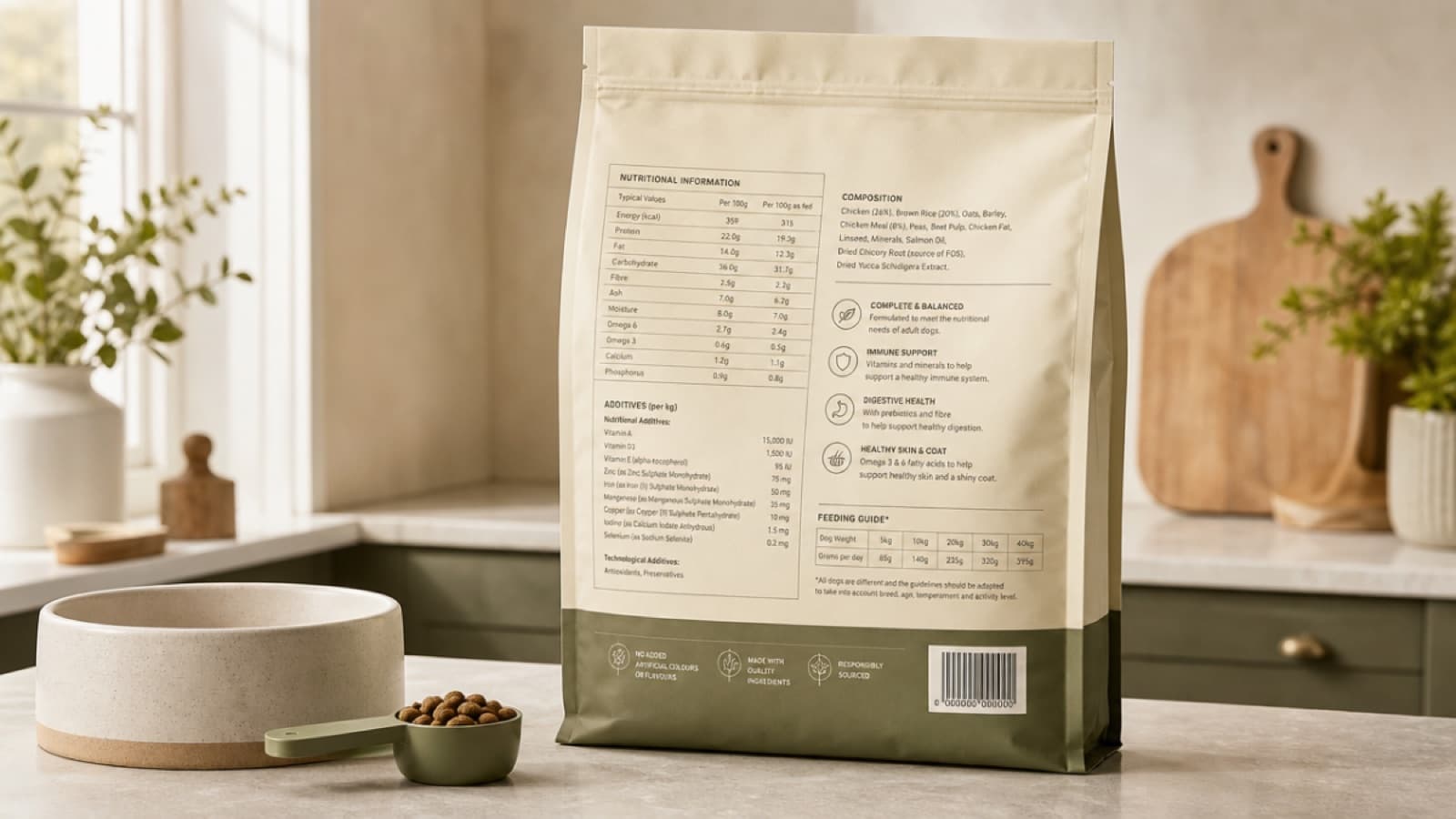
The front of the bag will never tell you. Sugar is not a selling point, so it lives only in the small print on the back. Read the composition and look for a handful of words. Sugar and sugars are the obvious ones. Caramel is sugar too, whether it appears among the ingredients or under additives as a colourant. Molasses counts, and so does any syrup. So does the catch-all phrase various sugars, a permitted category term with no ingredient named.
Position matters as much as presence. Composition is listed in descending order by weight, so an added sugar near the end of a long list is a small inclusion, while one appearing early is doing real work in the recipe. Category terms are where labels get vaguest, and we looked at that vagueness across the whole market in how honest is a dog food label.
What should you do with this?
Nothing dramatic. Added sugar is not a reason to bin a bag your dog is doing well on. It is a reason to look at the rest of the label with sharper eyes, because what we found says it rarely travels alone. Turn the tray over, find the composition, and see what the sugar is keeping company with. If you would rather skip the reading, our asks a few questions about your dog and puts the strongest matches in front of you, every one of them assessed the same way.
Frequently asked questions
Is sugar in dog food bad for my dog?
Not in the amounts involved, and that is not really the point. Added sugars are permitted and the inclusions are small. No single ingredient decides whether a food is good. The reason we flag it is what it sits alongside, because 194 of the 249 recipes naming added sugar land in our Average or Poor bands. Treat it as a prompt to read the rest of the label. If your dog has a diagnosed condition, your vet comes first.
What does various sugars mean on a dog food label?
It is a category term and not a named ingredient. Labelling rules let makers group certain ingredients under a heading with none of them named, so the phrase can cover more than one added sweetener without telling you which. It is legal and common, and it is also the least informative way a maker can describe what went in. When you see it, check where it falls in the composition order.
Do dogs even taste sweet things?
Yes. Dogs have working sweet taste receptors, which is exactly why sugar earns its place in a recipe from the maker's point of view. A dog that dives into the bowl is a dog whose owner keeps buying that food, and palatability is one of the easiest levers to pull. A dog's enthusiasm at the bowl and the quality in the bowl are two different things.
Should I avoid any food that lists caramel?
Not automatically. Caramel is there for colour, and it tells you the maker wanted the food to look richer than it otherwise would. On its own that is a small thing. In practice it rarely appears on its own, which is a large part of why so many recipes naming it land in our Average or Poor bands. Check the meat content and the rest of the composition, and let those decide.