

Trust a label for what it says, not for what it leaves out. We analysed 4,983 UK dog food recipes. In 42% the fat source is never named, and among those that publish an ingredient list, 10% open the meat line with a catch-all category. Everything there is legal. Four checks tell you which kind of label you are holding.
What did we actually measure, and on what?
We read every label across 4,983 UK dog food recipes, the way a careful owner would. Where a finding below concerns the ingredient list, it comes from the 4,935 recipes that publish one.
Almost nothing we found is about rule-breaking. Pet food labelling law is permissive by design, and a recipe can follow it to the letter while telling you very little about what is actually in the bag. So the question we set out to answer was not whether labels are legal. It was simpler than that. When a label had the chance to be specific, how often did it take it?
The answer turned out to be: less often than you would hope, and in patterns that repeat across the market. Transparency matters enough to us that it is one of the four pillars we score every food on, banded from Outstanding down to Poor in its own right. You can read how we score dog food for the full method. The short version is that a recipe which names what it contains earns credit for doing so.
Why do 42% of recipes never name their fat?
This was the biggest single finding, and the one that surprised us most.
Of the 4,983 recipes we analysed, 58% name the fat source they use. The remaining 42% do not. Within that group, 16% of all recipes list something generic such as "oils and fats", and 25% do not state a fat source anywhere on the label.
Fat is not a minor line on a recipe. It carries a large share of the energy in a complete food, and it is where the fatty acids behind skin and coat condition come from. Naming it takes four words.
A named fat tells you what you are dealing with. Salmon oil and beef tallow are not interchangeable to a dog with a known sensitivity, and an owner working around one needs to know which is which. A generic term tells you only that the recipe contains fat of some kind. It can also mean one thing this batch and something else the next, because the wording stays accurate whatever goes in.
The 25% that say nothing at all are a slightly different problem. The analytical constituents will still give you a fat percentage, so you know how much is in there. You simply have no way of knowing where it came from.
What does "meat and animal derivatives" actually tell you?
The meat line opens with "meat and animal derivatives" on 498 recipes, 10% of the 4,935 with a published ingredient list.
That phrase is a legal category rather than an ingredient. It can cover animal material from more than one species, and the label does not have to say which. It does not have to stay the same from batch to batch either. The word "meat" is doing a great deal of work there while telling you almost nothing.
A named meat does the opposite. When the label says the animal, you know what is going in the bowl. That matters if you are working around a suspected intolerance, or you simply want to feed the same thing week after week.
Naming is only half of it, because the percentage attached to a named meat is measured in a way most owners would not expect. We took that apart in the meat content number that isn't one.
How often do labels use catch-all category terms?
607 of the 4,935 recipes with a published ingredient list, which is 12%, use at least one catch-all category term in the composition. The meat line is where it shows up most often, though the same style of wording turns up against cereals and vegetable material too.
Category terms exist for a reason, and it is a practical one. They let a maker use whatever is available at the time and keep the label accurate all year round. That flexibility is genuine. It is also the exact opposite of what a label is for from where you are standing, which is knowing what is in the bowl this week.
So the read is straightforward. A composition that names things all the way down comes from a maker who is comfortable being pinned down. It turned out to be one of the clearest dividing lines between the top and the bottom of the market. We went further into that gap in what separates the best dog foods from the worst.
Why is any dog food coloured?
102 recipes, 2% of those publishing an ingredient list, still declare a colourant.
Dogs do not choose food by looking at it. They lead with their nose, and a rich brown kibble or a red tint in the gravy makes no difference to them whatsoever. Colour on a dog food is there for the person holding the bag.
We treat it as a recipe-quality signal and nothing to worry about, and anything clinical is a conversation for your vet. What a colourant tells us is about intent. Somewhere in the development of that recipe, an ingredient slot went to appearance and not to nutrition. Worth knowing when you are weighing one label against another.
2% is a small share, and the great majority of labels we read carry no colourant at all. It is a habit most of the market has left behind, which is exactly what makes the ones still doing it stand out.
What does "suitable for all life stages" really promise?
569 recipes, 11% of the 4,983 we analysed, claim suitability for every life stage at once.
This one is not dishonest. A recipe formulated to meet the growth standard will comfortably meet an adult dog's needs as well, so the claim can be perfectly true. What goes missing is the specificity.
A puppy is growing and an adult is not, and the two want different things from the same bowl. Large breed puppies in particular are sensitive to how much calcium a recipe carries, and a food written for every dog at once cannot be tuned to that. Feeding a puppy month by month goes through what changes and when.
The same applies at the other end of a dog's life. An older dog with less to burn is better served by a recipe built around that than by one built around everything.
None of which makes an all life stages food a poor choice. It makes it a general one. If your dog is at a stage with real needs attached, a food written for that stage has had the harder thinking done for you. That is how our puppy and senior shelves are sorted.
So what should you look for on the back of the bag?
Four checks cover most of what this census turned up, and none of them takes long.
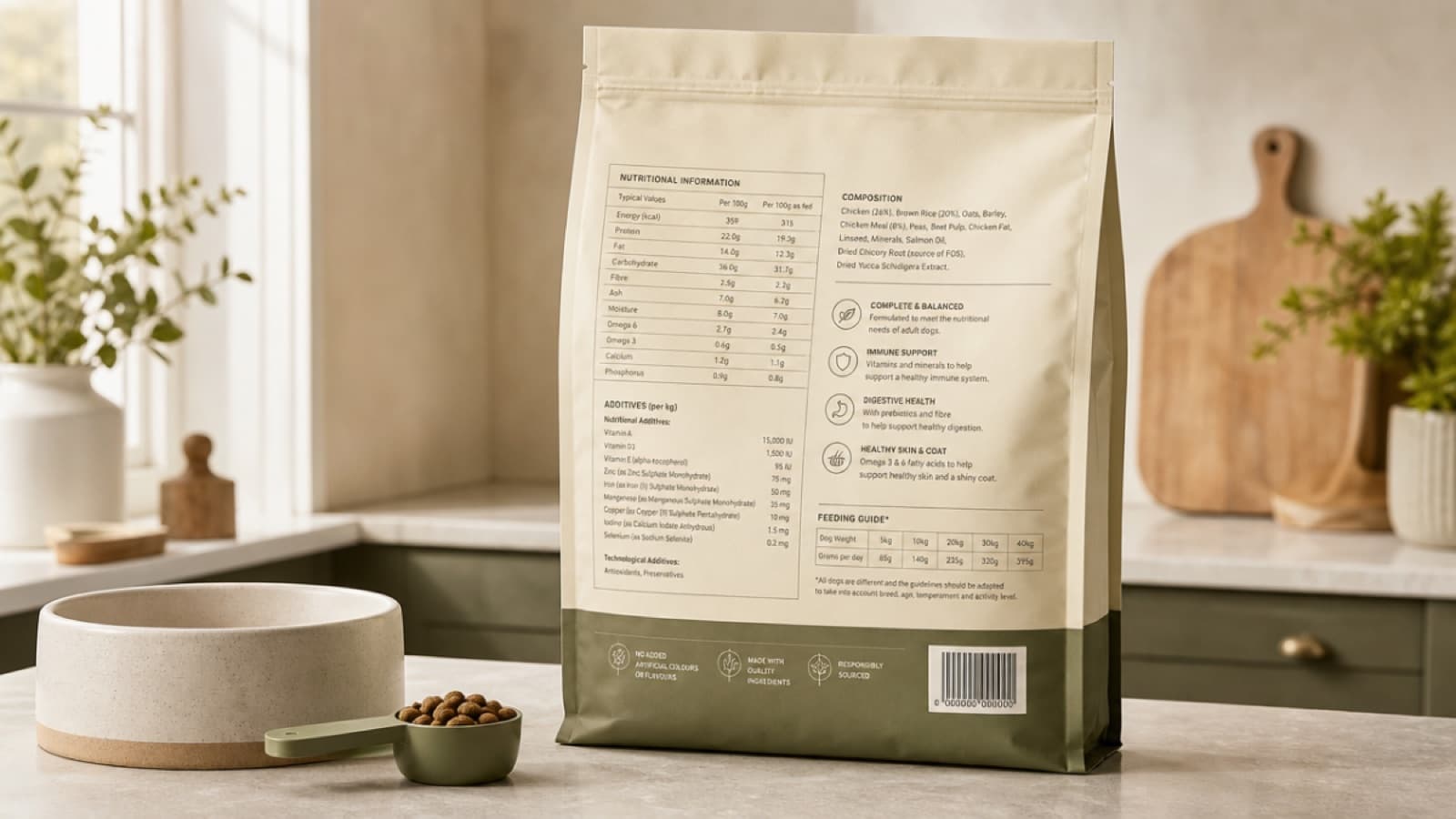
Find the fat and see whether it is named. Read the first ingredient and see whether it names an animal or falls back on a category. Scan the rest of the composition for that same category wording. Then check that the life stage on the front of the bag matches the dog in front of you.
That is about thirty seconds once it becomes a habit. For the rest of the back of the bag, our guide to reading a dog food label covers the parts that are more useful than they look.
If you would rather not do it standing in an aisle, that is what we are here for. Every recipe in our dog food reviews has been read this way already, with transparency banded alongside the nutrition and the food as a whole banded from Outstanding down to Weak. The vague labels sort themselves to where you would expect them to, and the specific ones rise.
Frequently asked questions
Are vague dog food labels legal?
Yes, and that is the point of this study. Pet food labelling rules allow category wording, and a recipe using it is fully compliant. Nothing in our findings is about rule-breaking. It is about how much a compliant label actually tells you, which varies enormously. The 42% of recipes that never name a fat source are all playing within the rules while leaving you guessing.
Does "meat and animal derivatives" mean the food is poor quality?
Not automatically, but it does mean you cannot tell. The phrase is a legal category covering animal material that the label is not required to identify, so the same wording can sit over very different recipes. In our data it opens the meat line on 10% of recipes with a published ingredient list. A named animal removes the guesswork, which is why we credit it when we score.
How can I find the fat source if the label does not name it?
Usually you cannot, and that is the honest answer. The analytical constituents tell you how much fat a recipe contains but never where it came from, so a generic term or a missing line leaves nothing to work backwards from. If you are managing a specific sensitivity, treat a named fat as a requirement and not a bonus, then choose a recipe that gives you one.
Should I avoid food labelled for all life stages?
No, but know what you are getting. A food meeting the growth standard genuinely suits an adult too, so the claim on those 569 recipes, 11% of the market, is fair. It is simply a general recipe rather than a tuned one. If your dog is still growing or noticeably slowing down with age, a stage-specific food has done more of the thinking.