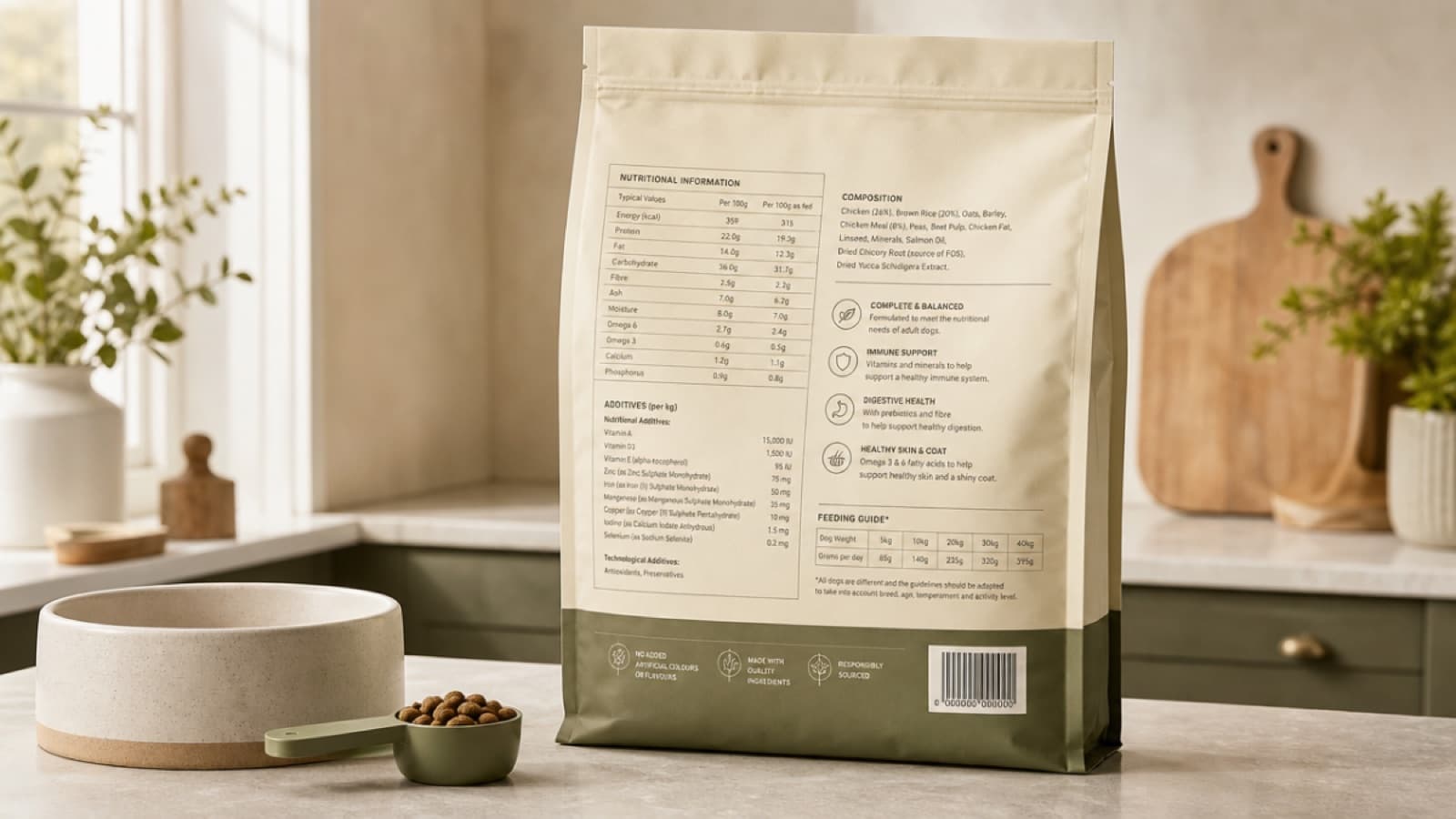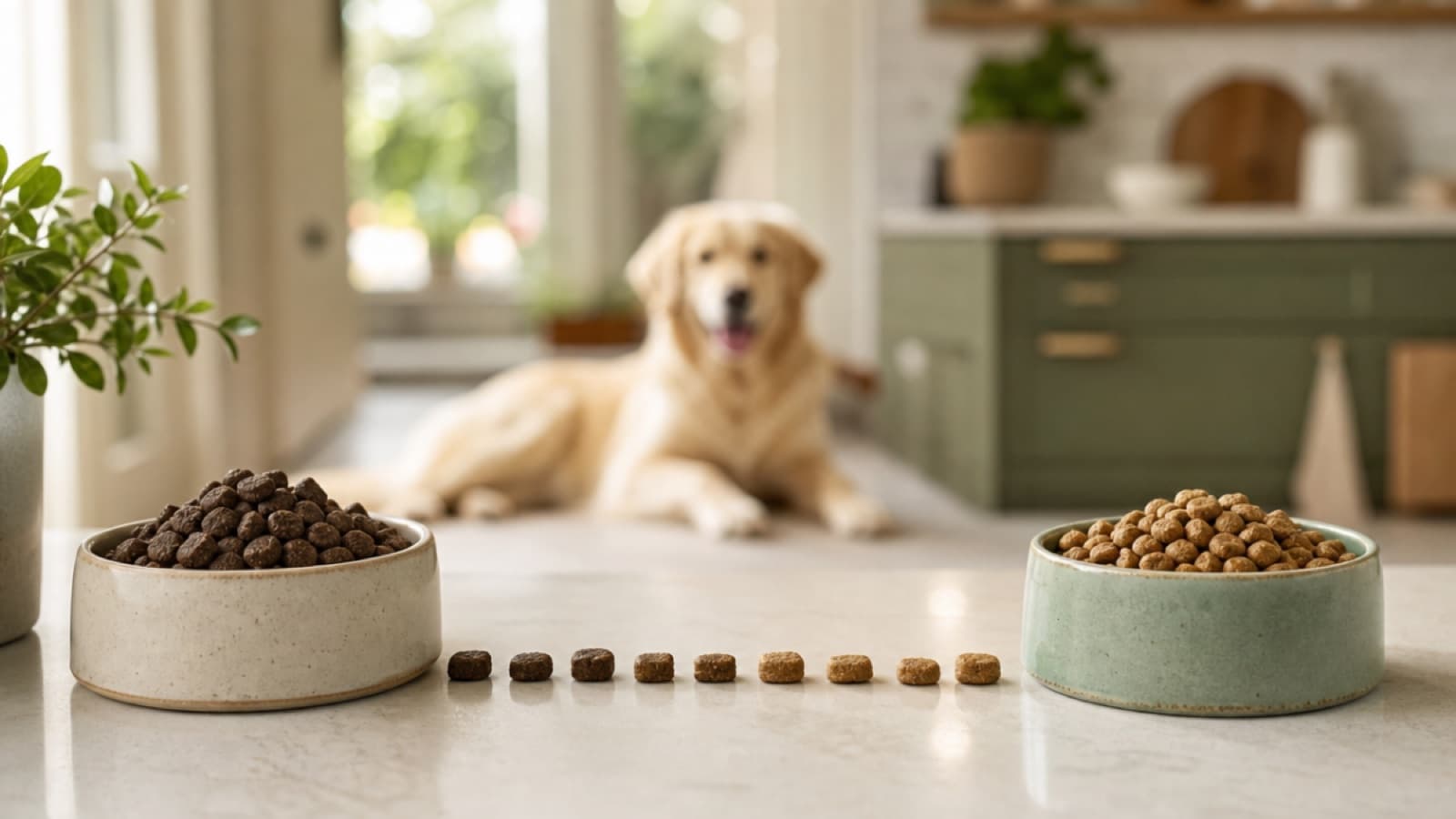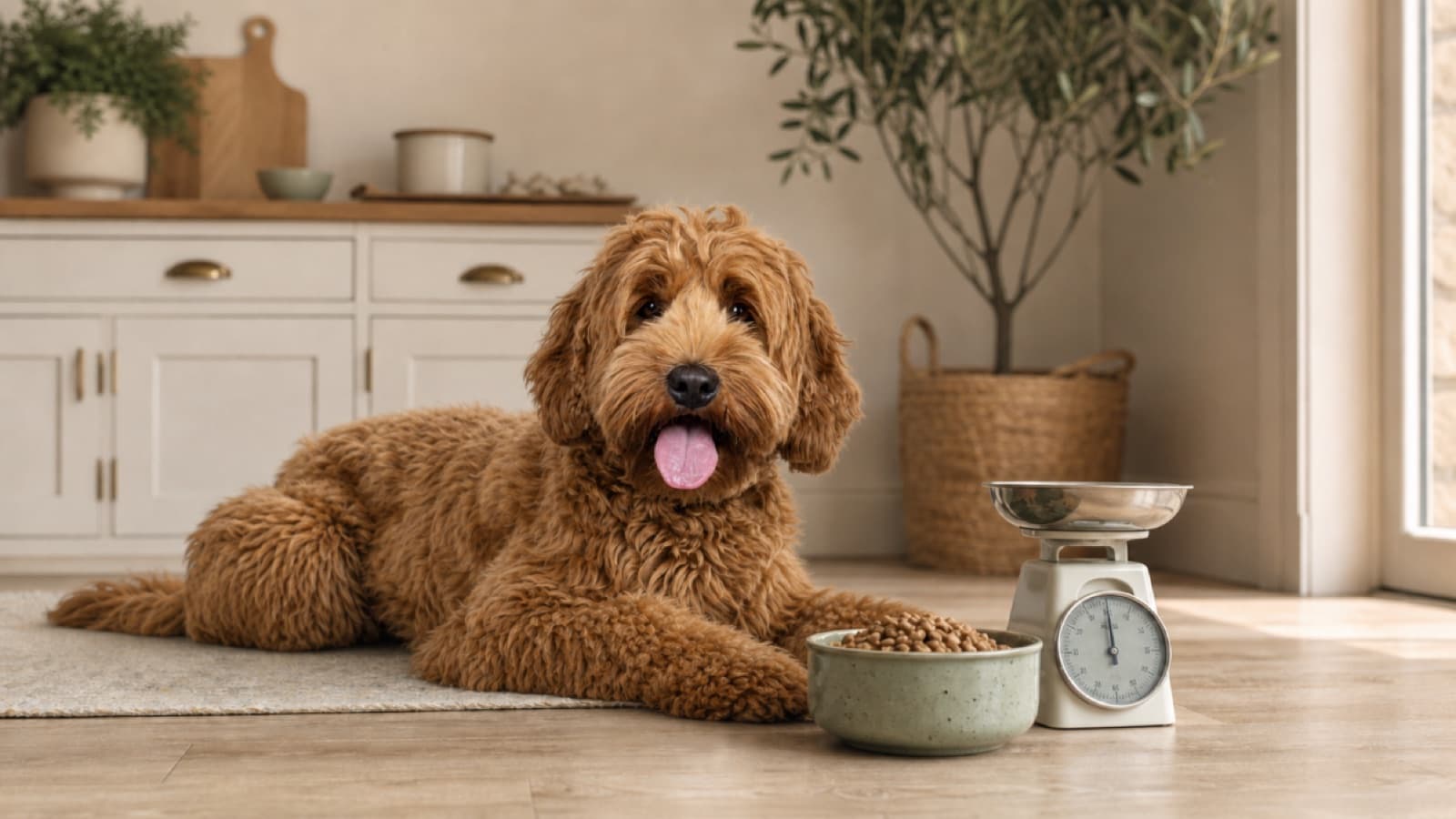
The clearest signal is naming. We analysed 4,983 UK dog food recipes. Catch-all category terms such as "meat and animal derivatives" appear on 92% of the labels in our Poor band and on 0% of the labels in our Outstanding band. A recipe that names its meat and names its fat is almost always the better food.
What did we find when we lined up the best labels against the worst?
We scored all 4,983 UK dog food recipes the same way, on the same pillars and the same evidence. Then we asked a question that sounds almost too simple to be useful. If you put the labels of the foods in our Outstanding band next to the labels of the foods in our Poor band, what would actually be different about the words on the packet?
Quite a lot, as it turns out. The difference is not tone or design or how glossy the photography is. It comes down to naming. The best recipes on the UK market tell you what is in them. The weakest ones use language that keeps its options open. They do it so consistently that you can spot a weak recipe from the ingredient list alone, before you have read a single nutrition figure.
Our bands run from Outstanding at the top, through Excellent, Good and Average, down to Poor. The full method is set out in how we score dog food. What follows is what those bands look like in plain language, on the back of the bag.
Why do catch-all terms like "meat and animal derivatives" matter?
4,935 recipes publish an ingredient list, and category terms are the sharpest divider we found across them. Catch-alls such as "meat and animal derivatives", "cereals" and "derivatives of vegetable origin" appear on 92% of the labels in our Poor band, the 98 recipes at the bottom of the table. The rate is 46% in our Average band. In our Outstanding band they appear on 0% of them.
Zero is a strong word, so it is worth being precise about what it means. Not one recipe that reached our top band leaned on a category term to describe what it contains. Every single one of them names things instead.
A category term is legal and it is not a scandal. It describes a group, never a thing. "Meat and animal derivatives" can mean one species this month and a different one next month, and the label stays perfectly accurate either way. That flexibility is useful to a manufacturer and useless to you, because it removes the one thing you opened the list for. If your dog reacts to a particular protein, a category term turns the ingredient list into something you cannot act on. Our guide to reading a dog food label walks through the rest of the back of the pack, and we have looked more broadly at how honest a dog food label really is.
What does a named fat source tell you about the rest of the recipe?
Fat is the quiet one. Most people scan the ingredient list for the meat and stop there, but the fat line is where naming habits show up most reliably. A recipe can say chicken fat or salmon oil. It can also say animal fat, or oils and fats, which tells you nothing about what went in.
Of the recipes that list a fat or an oil at all, 88% of those in our Outstanding band say where it came from. In our Poor band the figure is 18%.
That gap matters for two reasons. The practical one is that fat carries flavour and it carries the fatty acids behind skin and coat condition, so knowing the source tells you something real about what your dog is eating. The other reason is what it reveals about the maker. Naming a fat source is easy, and nothing stops a maker doing it. Leaving it vague is usually a decision to keep room for change, which means the recipe you buy in spring may not be quite the recipe you buy in autumn.
Do percentages on the first ingredient separate good food from bad?
This one divides the market more sharply than we expected. A declared percentage on the first ingredient appears on 95% of Outstanding labels and 20% of Poor ones, a gap as wide as the one on category terms.
Even so, a percentage is a number without a context. A recipe can declare a confident meat figure measured before cooking, which is a very different quantity from the meat left in the finished kibble. A weak recipe can put a bold number on the front of the bag and still fill the rest of the list with material you cannot identify. We have written separately about meat content and the number that is not really one number.
So percentages are worth reading, and they are not worth trusting on their own. Naming is the better test, because naming is much harder to dress up.
Why do transparency and quality travel together?
None of these three signals measures nutrition. All three measure disclosure. And yet they sort the market almost perfectly, which raises the obvious question. Why would the way a label is written predict how good the food inside it is?
The honest answer is that a maker who is proud of a recipe names what is in it. Specific naming is a commitment. Once you have written salmon on the label, you have to keep putting salmon in the bag. Once you have written meat and animal derivatives, you can use whatever the supply chain offers that week and your label never has to change. Recipes built to stay flexible tend to be built around what is available, and not around what a dog thrives on. That shows up in our scoring as an Average or Poor pillar result long before anyone reads the ingredient list.
The same logic explains the smaller habits we see clustered on weak labels. Long lists that name the same base material several times in slightly different forms are doing a version of the same thing, which we cover in our piece on ingredient splitting. So are added sugars. We treat those as a recipe-quality signal. There is nothing to be alarmed about. Our look at why sugar turns up in dog food takes them on their own terms.
How can you check a food yourself in thirty seconds?
The ingredient list is on the back of the bag. Read it from the top. Ask whether the first few entries name an actual animal or an actual plant. Then find the fat line and ask whether it names a species. If both answers are yes, you are already looking at a food that behaves like the ones in our upper bands.
If either answer is no, that is not proof of a poor food. It is a strong reason to read the rest of the label properly before you commit. In our analysis, that combination of vague meat and vague fat almost never appeared at the top of the table and appeared constantly at the bottom.
You do not have to do any of this from scratch, though. We have already read the labels and banded the recipes. Start from our dog food reviews and narrow down from there. Or answer a few questions in the and let it shortlist foods that suit your own dog.
Frequently asked questions
Is "meat and animal derivatives" bad for my dog?
It is an information problem rather than a safety one. The term is legal, and it covers a whole group with no ingredient named, so what goes in can change while the label stays accurate. That is why we treat it as a quality signal, and why it appeared on 92% of Poor labels and 0% of Outstanding ones. For anything clinical, your vet comes first.
If a label names everything, is the food automatically good?
No. Clear naming is a strong signal rather than a guarantee, and plenty of clearly written recipes still land in our Good or Average bands once the nutrition is assessed. What our analysis shows is that the reverse holds firmly. A label leaning on catch-all terms almost never reaches the top band. Use naming as your first filter, then look at the food itself.
What is the fastest check I can do while standing in a shop?
Two lines on the back of the pack. Read the first few ingredients and ask whether they name an actual animal or plant, then find the fat line and ask whether it names a species. Among recipes that list a fat or an oil, 88% of those in our Outstanding band say where it came from, against 18% in our Poor band. That second question does a lot of sorting on its own.
Should I trust a big meat percentage on the front of the bag?
Read it, but do not lean on it. A declared percentage on the first ingredient appears on 95% of Outstanding labels and 20% of Poor ones, so it does sort the market, but the number itself needs reading with care. Figures are often measured before cooking, so the finished food holds less than the number suggests. Named ingredients tell you more than a bold number does.