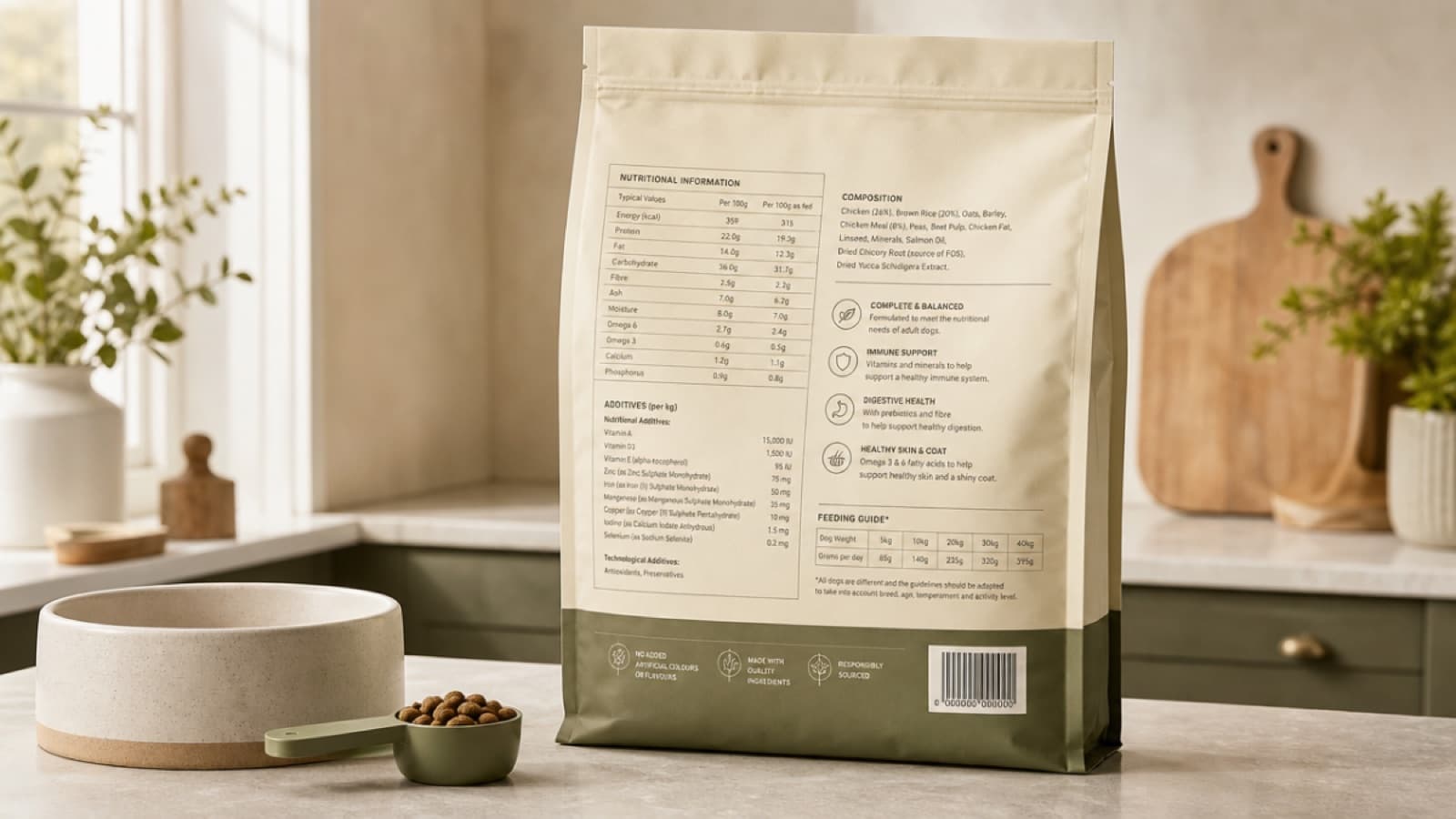


Ingredient splitting is when one ingredient is declared under several names, so each entry sits lower in the composition list while meat floats towards the top. Of the 4,935 UK recipes we analysed that publish an ingredient list, 1,697 do it, which is 34%. Potato and pea are split far more often than any grain.
What is ingredient splitting?
A composition list is ordered by weight, heaviest first. That single rule is what makes the back of the bag worth more than the front, and it is also the rule that can be worked.
Splitting works it. A recipe declares one carbohydrate two or three times under different names. Rice might appear as rice, then again as rice flour and rice bran further down the list. Each of those entries weighs less on its own than the single combined line would have, so each one sits lower in the order.
Nothing has been added to the recipe. Nothing has been taken out. Only the reading changes. Meat drifts up the list without a gram more meat going into the bowl.
Why does the order on the back of the bag matter?
Most of us judge a food in about five seconds, by whether a named meat is the first thing on the list. That instinct is a good one. It is also easy to satisfy without touching the recipe itself.
Order is a ranking, not a quantity. It tells you what outweighs what and it tells you nothing about by how much. The percentage in brackets after the meat is the figure that carries real weight. Even that comes with its own quirks, which we have unpicked in the meat number that isn't one. If you want the whole back panel decoded in order, our guide to reading a dog food label walks through it line by line.
How common is ingredient splitting in UK dog food?
We analysed 4,983 UK dog food recipes. 1,697 recipes carry a single carbohydrate family under two or more names, out of 4,935 with a published ingredient list. That is 34%, or near enough one recipe in three.
We did not go looking for a villain, and the finding is not that a third of the market is dishonest. The finding is quieter and more useful than that. A shopper who reads composition order at face value is misreading roughly every third bag they pick up, because the order they are reading has been spread across more lines than the recipe really needs.
Which ingredients get split most often?
Potato leads by a distance, split across 818 recipes. Pea follows on 482. The grains sit behind them, with rice on 284, maize on 219 and wheat on 139.
Those figures add up to more than 1,697 because a single recipe can split more than one family, and plenty of them do.
The forms are easy to recognise once you know to look. A potato can arrive as potato, potato starch and potato protein. A pea can arrive once as a protein and again as a fibre and a third time as a starch. Every one of those is a real ingredient with a real definition. Read as separate lines they look like a varied recipe. Read as one plant they often look like the biggest thing in the bag.
Why do grain-free recipes split the most?
This is the part of the census we did not expect. Potato and pea are not grains. Both are brought in to replace grains more often than anything else. Both are also the most split families we found, comfortably ahead of rice and maize.
So the corner of the market that sells simplicity is the corner where the label is arranged most, and the ingredients being divided up are the very ones that took the grain's place.
That is not an argument against grain-free food. It suits plenty of dogs, and plenty of owners choose it for good reasons, set out honestly in our grain-free guide. It is an argument for reading the whole list instead of the first line of it. Every grain-free recipe we have reviewed is judged on the same basis as everything else on the site, with the plant added back together first.
Is splitting always a trick?
No, and it would be lazy of us to say otherwise. A good deal of it is honest recipe design. A flour binds a kibble in a way a whole grain cannot. A fibre does a job in the gut that a starch does not. Pet food labelling rules expect distinct ingredients to be declared distinctly. So when a recipe genuinely uses three different forms of one plant for three different reasons, naming them separately is the accurate thing to do.
The problem is not the practice. The problem is the effect. Whatever the intention behind it, a split list flatters the recipe. Intention is not something the reader can tell from the label alone.
So splitting on its own does not make a food Weak, and one clean line does not make a food Outstanding. What splitting does is take away the five second shortcut and hand you a small job to do instead.
How do you add the family back together?
It takes about ten seconds and no maths. Read the composition list once through and group everything that came from the same plant. Every potato entry becomes one potato. Every pea entry becomes one pea. Then ask yourself where that rebuilt ingredient would have sat in the order, and judge the food on that version of the list.
Often the answer is that very little moves, and the recipe was straightforward all along. Sometimes the rebuilt plant lifts clear above the meat, and you have just learned the most useful thing the bag was ever going to tell you.
One habit makes it quicker. Scan for a repeated plant name before you read anything else. If it turns up near the top of the list, start adding. Whatever the order says, check the meat percentage in brackets too, because that is the one figure on the panel that cannot be rearranged.
Where have we already done the adding up?
Every published composition list we read gets this treatment before a mark is given, which is why a recipe cannot climb our scoring simply by writing itself out in more lines. You can see exactly how the marks are built in how we score dog food, and all of our dog food reviews are there to browse with the work already done.
If you would rather start from your dog than from a label, the narrows the field by age and size and the things your dog actually struggles with.
And if this has made you a little suspicious of the rest of the panel, it should. Splitting is one habit among several, and we have laid out what we found across the whole market in how honest is a dog food label.
Frequently asked questions
Is ingredient splitting against the rules?
No. Labelling rules require ingredients to be declared in descending order by weight. Different forms of a plant count as different ingredients under those rules, because a flour and a bran genuinely are different things. Nothing about splitting is a breach. It lives in the gap between what a label is obliged to say and what a shopper assumes it is saying, which is exactly why the habit is worth knowing about.
Does a split list mean the food is poor quality?
Not on its own. Some recipes split because three forms of one plant do three genuinely different jobs, and others split because the order simply reads better afterwards. You cannot tell which from the list alone, so treat a repeated plant name as a prompt rather than a verdict. Add the family back together and judge the recipe on the rebuilt version of the order, alongside the declared meat percentage.
Why is potato split more often than any grain?
Because potato is the workhorse of grain-free recipes, and it comes in several usable forms. We found it split across 818 recipes, more than any other family and well ahead of rice on 284. Once a grain comes out, something has to bind the kibble and carry the bulk. That replacement rarely arrives in a single form. The splitting follows the swap.
What should I actually check on the bag instead?
Start with the declared meat percentage in brackets, because that figure cannot be rearranged by the order of the list. Then read the composition through once for repeated plant names and mentally add them together. If your dog has a clinical issue behind the question, your vet comes first. For everyday comparison, those two checks take half a minute and tell you what the front of the bag never will.