No food cleans a small dog's teeth on its own. Dry food is not a toothbrush, and wet food does not rot teeth by itself. The best food for a small dog's mouth is a small-breed recipe with a piece size they can actually chew. Pair it with daily brushing and a chew soft enough to dent with a thumbnail. Your vet still does the dental check.
Why do small dogs get bad teeth so early?
Small dogs are not simply scaled down versions of big ones, and the mouth is where that shows most. The jaw got smaller over generations of breeding. The teeth did not shrink by the same measure, so in a toy mouth they sit shoulder to shoulder, sometimes turned sideways. Every tight gap is a place food packs into and a brush has to work to reach.
There is a second thing that catches owners out. Baby teeth in small breeds have a habit of hanging on after the adult tooth has already pushed through beside them, most often the little canines at the front. Two teeth sharing one tooth's worth of room will trap hair and food between them. Your vet will spot it at the puppy checks and tell you whether it needs to come out.
Plaque forms on every dog's teeth within a day of a clean mouth. Left where it is, it hardens into tartar and the gum line reacts. A crowded mouth simply gives that process more corners to hide in. That is why a Chihuahua or a Yorkshire Terrier can be in dental trouble at an age when a big dog is still fine. Flatter faced small breeds such as the Cavalier King Charles Spaniel get the same crowding with even less room to spare.
What does dental trouble look like from the sofa?
You will usually smell it before you see it. Dog breath is never floral, but breath that has turned properly sour is a change to take seriously.
Then look. Lift the lip on a calm evening and run your eye along the place where tooth meets gum. A healthy gum line is even and pale pink. Book a check if you see a red or puffy rim above the teeth, brown build up thickest on the back teeth, or chewing on one side only. Book one too for food dropped and picked up again, pawing at the face, or a sudden loss of interest in a chew your dog used to love.
A few things mean phone the vet now rather than at the weekend. Your dog stops eating altogether. A swelling appears under an eye or along the jaw. The mouth bleeds, or your dog cries out when you touch the face. None of this is yours to diagnose from the sofa, and none of it is fixed by changing food. If you are not settled with your current practice, it is worth finding a vet you trust before you need one in a hurry.
Does dry food clean a dog's teeth?
Not really, and it is worth saying plainly. The idea that kibble scrubs teeth on the way down has been repeated for decades. Most kibble is brittle by design. It shatters at the tip of the tooth and never touches the gum line, which is exactly where the trouble starts.
The opposite claim is overdone too. Wet food does not rot a dog's teeth by itself. A dog eating from a pouch whose mouth gets brushed most nights will do better than a dog on kibble whose mouth nobody has looked in for a year. If you are weighing the formats up more broadly, we go through them in our guide to dry, wet and raw food.
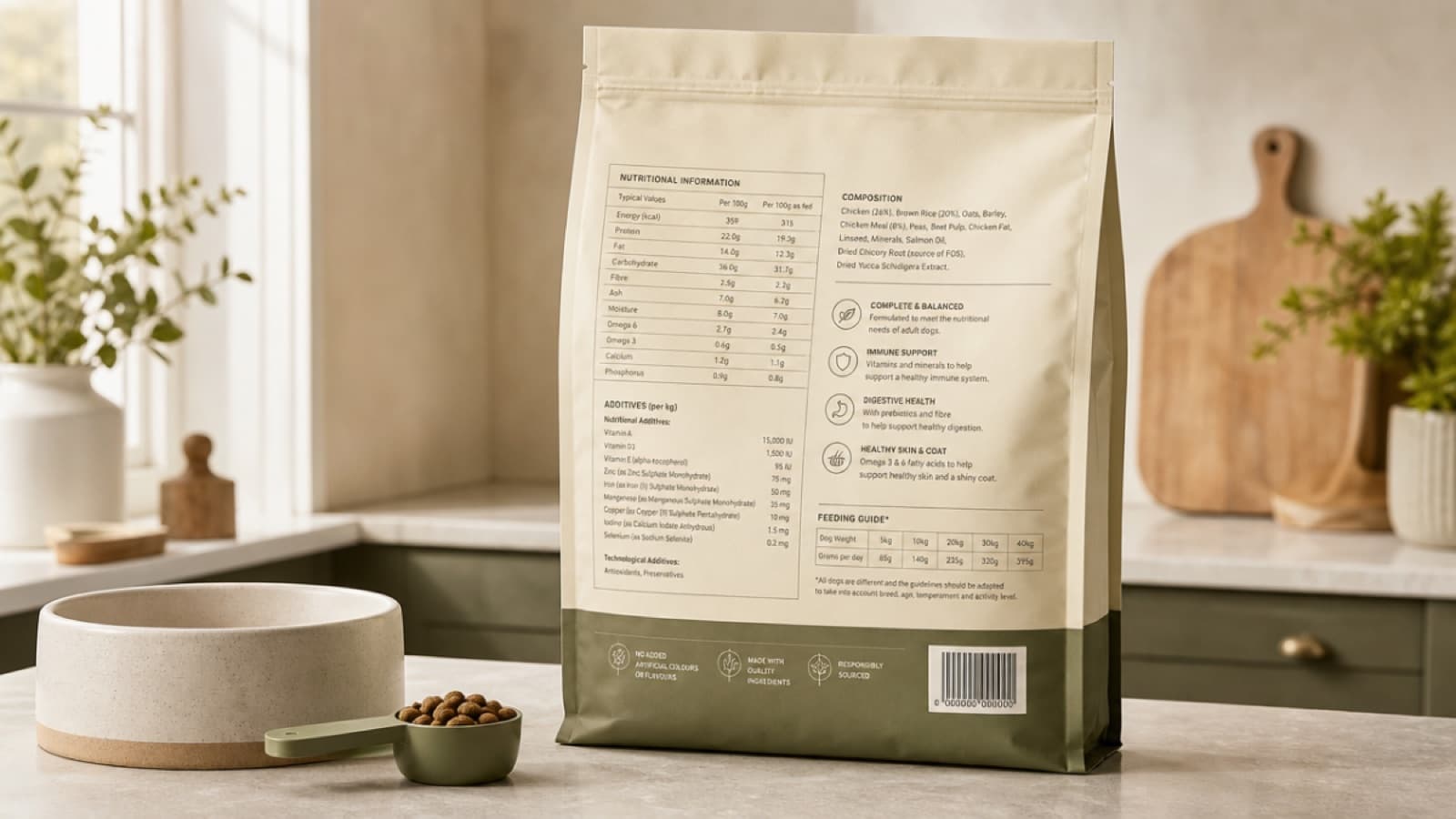
There is a middle case. Some recipes use a larger, more fibrous piece meant to hold its shape so the tooth sinks in and the piece does not snap. Those are a real category, and your vet is the right person to say whether one suits your dog. What matters is not to read the word dental on the front of a bag and assume the job is done. The front is advertising, and our guide to reading the label shows where the controlled information actually sits.
The thing that genuinely works
Brushing. That is the honest answer, and no product replaces it. Daily is the goal. Three or four times a week still helps a great deal. Once a month does very little, because plaque hardens long before that.
Start slower than feels necessary, especially with a small dog who has learned that hands near the face mean nail clippers. For the first week, just lift the lip and touch a tooth with a finger. Then stop and make a fuss of them. Next, let them lick a little dog toothpaste off your finger. Human toothpaste is not safe for dogs, so use one made for them. Then bring in a soft brush or a finger brush and do the outside surfaces only, a few seconds a side. The inside faces matter far less and almost no dog stands for them.
A brush and paste live perfectly well alongside the rest of your grooming kit, and the whole job takes less time than filling the bowl.
Which chews help, and which crack teeth?
Chewing does real work. It gets saliva moving, it keeps a busy little dog occupied, and a chew with some give to it wipes the tooth surface as your dog works at it. The problem in small breeds is that people hand them the things they would give a Labrador.
Use your thumbnail as the test. If you cannot press a dent into it, it is hard enough to crack a tooth. That rules out antlers, hooves, weight-bearing bones and the rigid nylon shapes. Small dogs' teeth are finer than a big dog's and they break the same way, quietly, with your dog carrying on as though nothing happened until the tooth turns sore months later.
What works better is a chew sized for the actual dog and soft enough to yield. Buy the size the maker states for your dog's weight, and do not size up to make it last longer. Stay in the room while they work at it and take it away once it is small enough to swallow whole. A stuffable rubber toy that you fill and freeze gives a determined chewer something to work at without the risk. There is a good range of them in the toys section of our accessories directory.
Does kibble size matter for a tiny mouth?
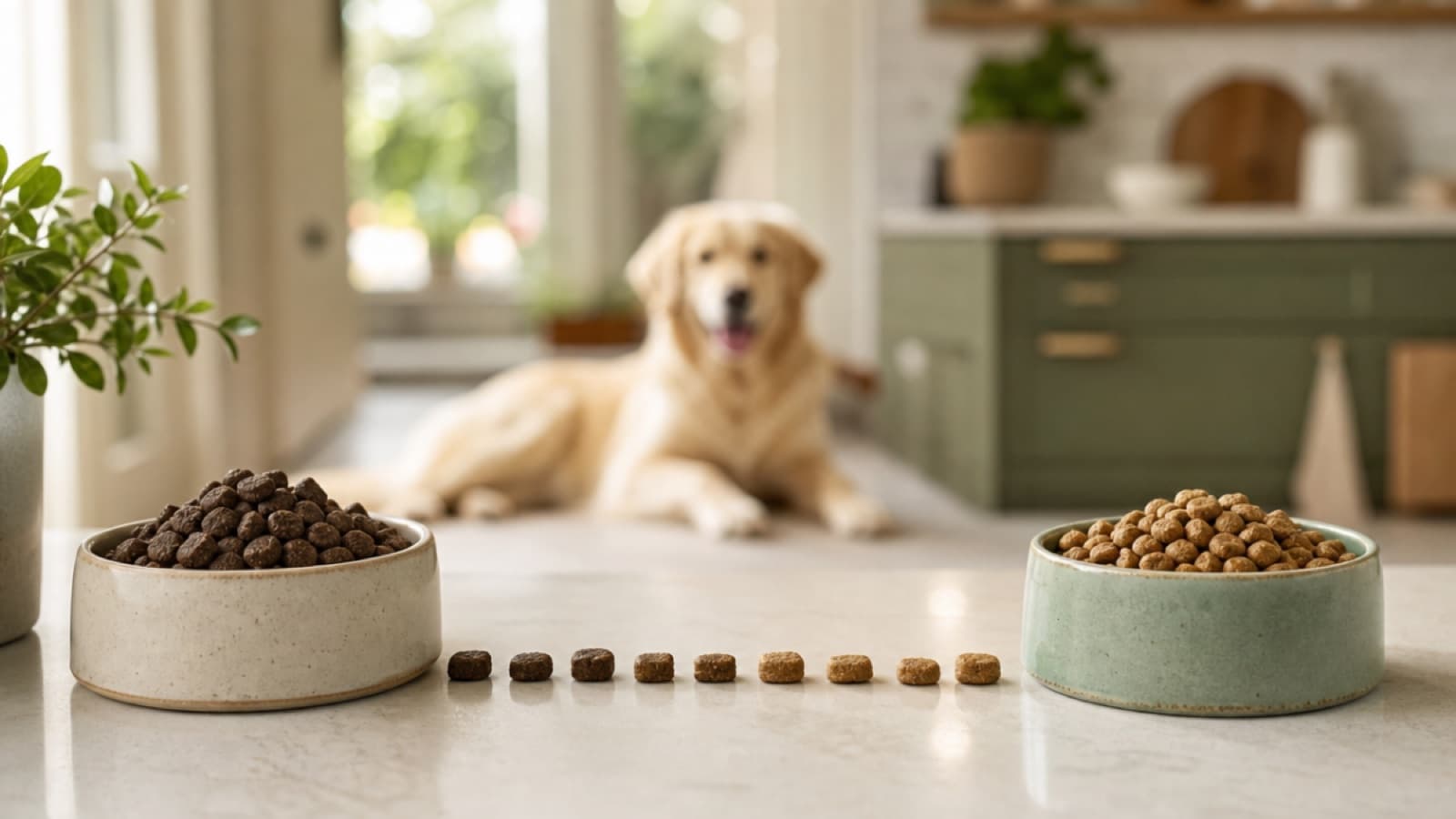
It matters, though for comfort more than for cleaning. A piece built for a big dog is awkward in a toy mouth. Some small dogs bolt it whole without chewing at all. Others give up and wander off, and their owner decides the dog is picky when the dog is really just struggling with the shape.
This is where a recipe built for the size of dog you own earns its place. We have analysed 489 recipes made for small or toy dogs, so the choice is real but narrower than a pet shop shelf makes it look. Every food in our reviews is scored on protein and processing, nutritional balance, transparency and value. The small-breed recipes are the ones where piece size and calorie density have been thought about together. We go further into portions and daily feeding for little dogs in our guide to feeding a toy or small breed.
What to do tonight
None of this needs a big decision. Lift the lip and look this evening, so you know what your dog's mouth looks like when it is normal. Book the dental check you have been putting off. Leave a soft brush somewhere you will see it and start with a finger and a taste of paste.
Then think about the bowl. Food will not cure a sore mouth and no chew undoes what is already there. What the right food does is support a dog who is being looked after in every other way, which is the whole point of matching the recipe to the dog in front of you. Our Food Finder walks you through that in a couple of minutes if you would rather answer a few questions than read bags.
Frequently asked questions
Do dental chews actually work?
They help, and they do not replace brushing. A chew with some give to it wipes the tooth surface while your dog works at it, which is better than nothing on the nights brushing does not happen. Choose the size the maker states for your dog's weight, supervise while they chew, and take it away once it is small enough to swallow. Anything you cannot dent with a thumbnail is too hard for a small jaw.
Should I switch my small dog to wet food if their teeth are sore?
Speak to your vet before you switch anything, because a sore mouth needs looking at and not working around. That said, softer food is often kinder for a dog who is finding chewing painful, and wet food does not cause dental disease by itself. Make any change gradually over a week or so, and treat it as a comfort measure while the actual problem gets seen properly.
How young can dental disease start in a small dog?
Earlier than most owners expect. Crowding starts the moment the adult teeth come in, so tartar and red gum edges can show up in a small dog who still looks and behaves like a youngster. That is why the mouth check belongs in the routine from the first year, long before middle age. Your vet will look at every appointment, and you can lift the lip at home once a week.
My vet has recommended a dental under anaesthetic. Should I be worried?
Your vet comes first here, and this is a very ordinary procedure. It is the only way to clean under the gum line and see what is happening at the roots, which no chew or food reaches. Ask what they expect to find, how your dog's anaesthetic risk is being managed, and what the aftercare looks like. Then plan the home routine that keeps the mouth clean afterwards.