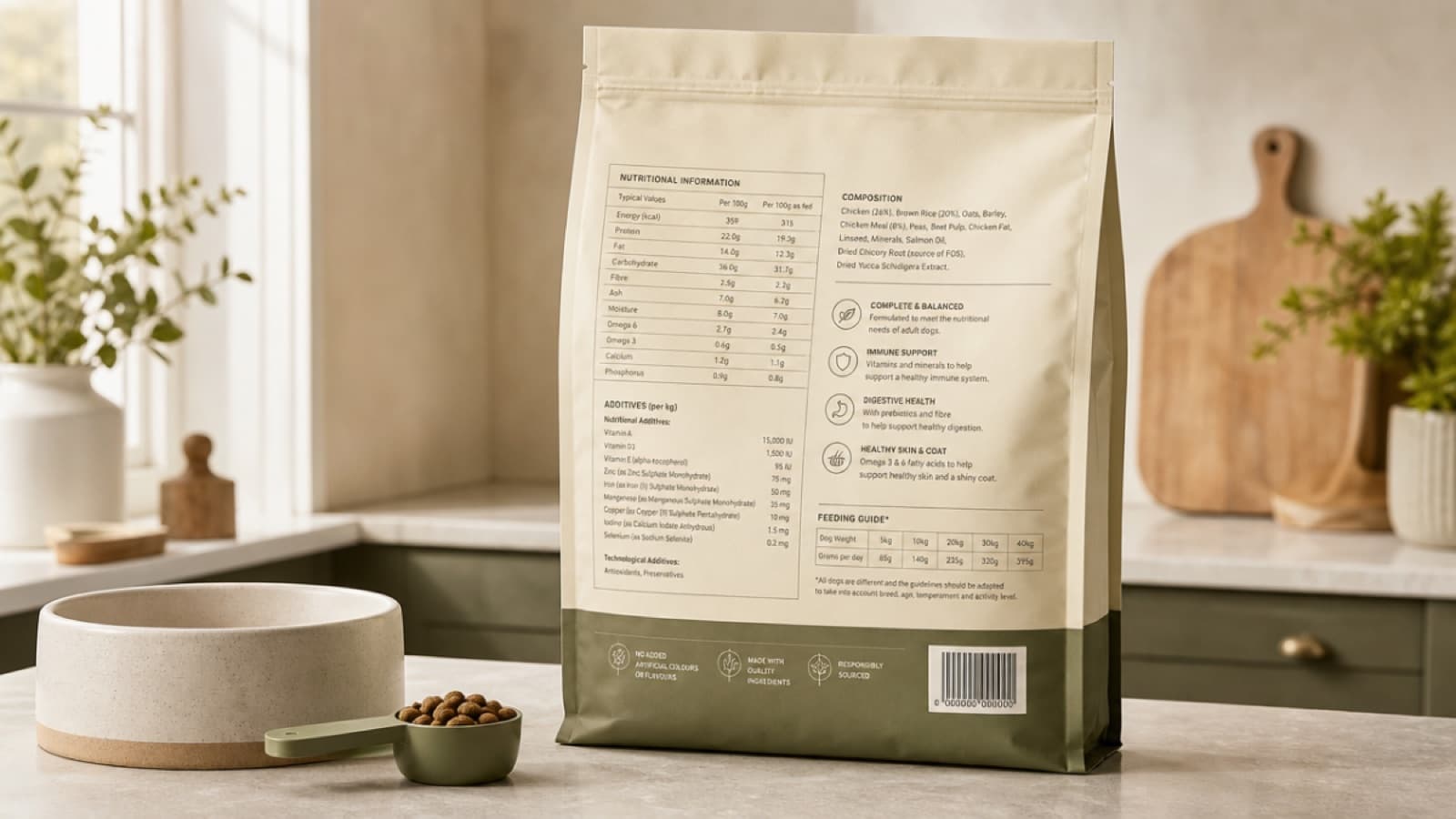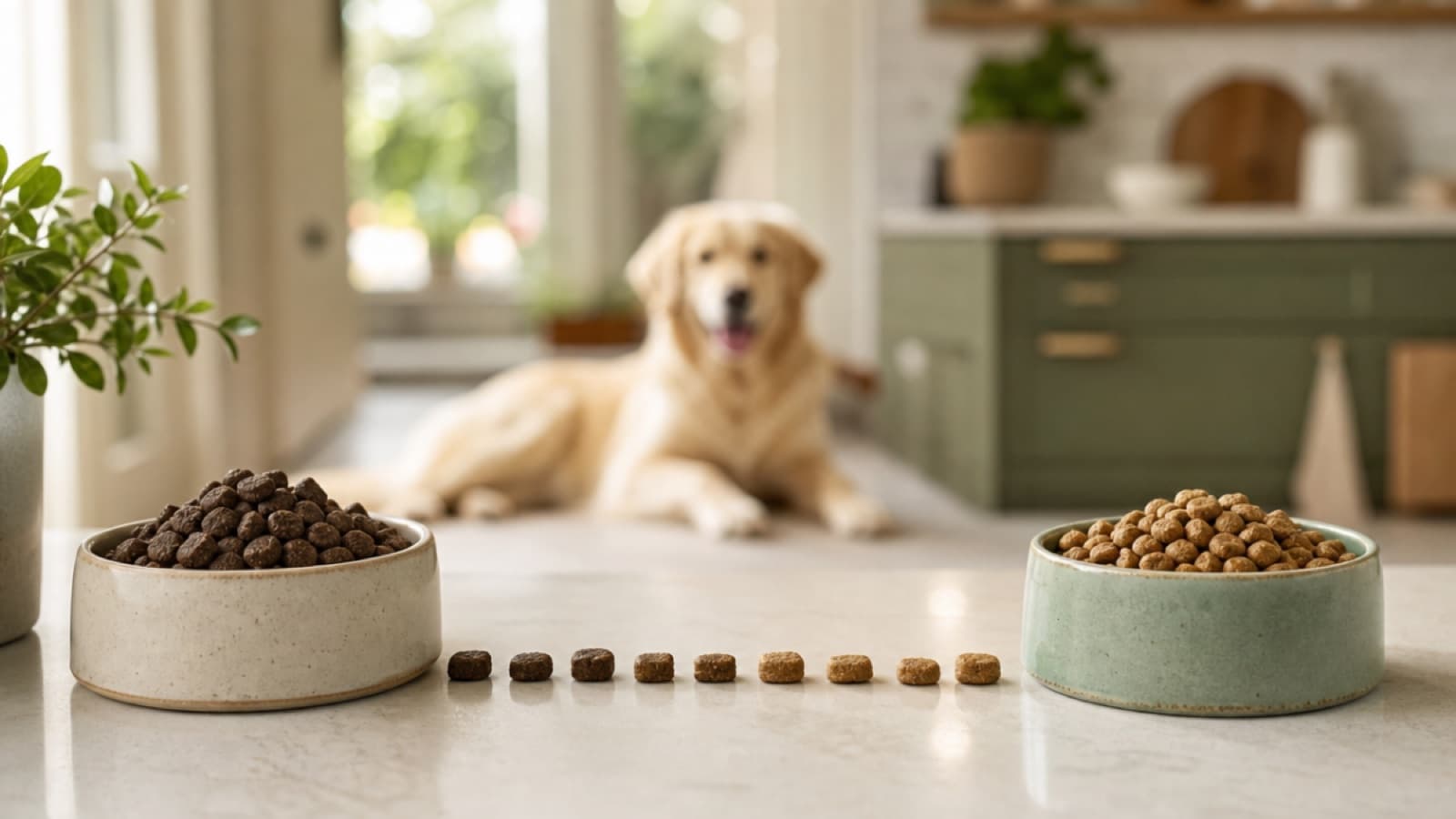
Dry, wet and raw are mostly a difference in water. Dry food sits around 8% moisture in our data, wet around 78% and raw close to 70%, which changes portion size and storage far more than it changes quality. Any of the three can feed a dog well. The right one is the one your dog eats happily and does well on.
What actually separates dry, wet and raw?
The honest answer is water. We analysed 4,983 UK dog food recipes. The gap between the formats has less to do with ambition than with how much moisture is left in the finished food. The median dry food holds 8% moisture. The median wet food holds 78%. Raw sits at 69.6% and fresh cooked at 70%.
That one number drives most of what you notice at home. A wet bowl looks generous because a good deal of what you tipped in is water. A dry bowl looks small because it is concentrated. The median wet recipe in our data carries 99 kcal per 100g, against 362 kcal per 100g for the median dry. A dog fed wet food works through far more food by weight to reach the same energy.
It shapes the small daily things too. Water rich food adds to what your dog takes on over the day. Dry food is quick to portion with a scoop and sits happily in the cupboard as long as the bag is sealed properly.
Why does wet food look weaker on protein?
Put two packs side by side and wet food usually looks weaker on protein. It is not. The declared figure includes the water, so a wet food is being judged with most of a glass of water in the total. To compare like with like, take the water out on paper and look at what is left, which is what nutritionists mean by a dry matter basis.
On that footing the picture turns around. Median protein comes out at 28.3% for dry, 42.1% for wet, 42.5% for fresh and 48.5% for raw. Fat follows the same shape, 15.2% for dry against 27.8% for wet and 34% for raw. None of that makes one format correct and another wrong. It simply tells you that raw and wet recipes tend to be richer in protein and fat once the water is set aside. Dry food leans harder on the starches that hold a kibble together. If you want the full tour of the back of the pack, our guide to reading a dog food label walks through every heading.
Who does dry food suit?
Dry food is what most British dogs eat. It is comfortably the biggest group in our data at 2,469 recipes. Median energy is 362 kcal per 100g, so portions stay compact, which matters if you feed a large breed or more than one dog.
It suits owners who want measuring to be quick and repeatable, and dogs who eat calmly without much persuasion. It travels well too, to kennels or on holiday. Kibble is also the easiest format to use for training, because a handful of the daily ration doubles as rewards.
Two things are worth watching. A scoop is not a fixed measure from one brand to the next, so weigh the first few portions on kitchen scales and then mark the scoop. And once a bag is open, keep it closed tight and work through it within a sensible window so the fats stay fresh.
Who does wet food suit?
Wet food covers 1,524 recipes in our data. At a median 99 kcal per 100g it is the least concentrated format on the list, which is exactly why it suits some dogs. A dog who needs a meal that looks and feels satisfying without carrying much energy can have one.
It tends to win with dogs who are hard to please at the bowl, because warm, strong smelling food is far more tempting than a dry biscuit. It also helps dogs who are not keen drinkers and dogs with worn or missing teeth, which is one reason it comes up so often when people are feeding an older dog. Wet food does not rot a mouth either, and what food and chews really do for small dog teeth clears that up.
The practical side is honest enough. Opened trays and tins live in the fridge. Portions are heavier to carry home. And some dogs pass softer stools for a few days when they first move across.
Who do raw and fresh food suit?
Raw covers 545 recipes and fresh cooked food covers 139. The two sit close together on water at 69.6% and 70%, and both are rich once you strip that out, with median protein of 48.5% and 42.5%. Raw also carries the highest median fat we measured at 34%, which is worth knowing if your dog gains weight easily.
Owners choose them for short ingredient lists, visible meat and the enthusiasm most dogs show at the bowl. Both ask something back. You need freezer and fridge room, and a routine you can genuinely keep on a Tuesday night. Handle raw food the way you would handle raw meat for the family: a separate board, hands and bowls washed straight after, and defrosting done in the fridge and never on the worktop.
If anyone in the house is pregnant, very young, elderly or taking medication that affects the immune system, or if your dog has a health condition, speak to your vet before you switch. Your vet comes first on anything clinical. Fresh cooked food is the middle path for a lot of people, gently cooked so the hygiene routine feels familiar, still served from the fridge.
What about cold pressed, air dried and freeze dried?
Cold pressed, air dried, freeze dried and semi moist are smaller groups. Each one exists because it solves something.
Cold pressed, 186 recipes, looks like kibble and sits at 8% moisture, but it carries the lowest median fat of any format we measured at 12.2%, with protein at 29.3%. It appeals to owners who want a leaner everyday bowl that still scoops.
Air dried, 30 recipes, keeps a little more moisture at 12% and lands at a median 390 kcal per 100g with 34.1% protein. It feels soft and meaty while behaving like a shelf stable food.
Freeze dried, 51 recipes, is the most concentrated thing in the whole data set at 466 kcal per 100g and 5% moisture. Portions are small, and it works beautifully crumbled over a meal to lift interest.
Semi moist, 39 recipes, sits at 18% moisture and 329 kcal per 100g. It is soft to chew and easy to break up, which suits small mouths and slow eaters.
So which should you put down tonight?
The dog in front of you decides. Appetite and digestion pull in different directions. So do age and how much running about your dog does. A format that suits your neighbour's collie may do nothing for your bulldog. Watch stools, coat, energy and weight over a few weeks. Let those answer the question, and not the marketing on the front of the pack.
Mixing formats is perfectly reasonable, and plenty of owners feed dry in the morning and wet in the evening. If you do, count both towards the day's total, and do not serve a full portion of each. Deep chested dogs do better on smaller, calmer meals, and the mealtime side of bloat explains the thinking. Whatever you land on, move across slowly rather than overnight. Our guide to switching food without upset sets out a changeover that takes about a week.
If you would rather not weigh all of this up on your own, the asks a few questions about your dog and shortlists foods that fit. Every food in our reviews is scored on protein and processing, nutritional balance, transparency and value, so you can see how the shortlist was reached.
Frequently asked questions
Is raw food better than dry food?
No format wins on paper. Raw recipes are richer once you take the water out, with median protein of 48.5% against 28.3% for dry. Your dog only gains from that if raw suits their digestion and you can keep the handling routine going every week. Plenty of dogs do beautifully on well made kibble. Judge by how your own dog looks and feels after a month, not by the format on the label.
Can I mix wet and dry food in the same bowl?
Yes, and lots of owners do. The catch is arithmetic rather than nutrition. Wet food sits at a median 99 kcal per 100g and dry at 362 kcal per 100g, so a full portion of each is a great deal more than one meal's worth. Split the day's total between the two instead. Introduce the second format over several days so your dog's stomach has time to settle into the change.
Why does my dog eat so much more wet food than dry?
Because most of it is water. The median wet recipe holds 78% moisture against 8% for dry, so the tray is largely liquid by weight. It takes a bigger serving to deliver the same energy, which is why wet portions look so generous next to a scoop of kibble. Nothing is wrong with the food or your dog. Weigh to the feeding guide, then adjust from your dog's waistline.
Which format is best for a fussy dog?
Wet food is usually the first thing to try, because warm, strong smelling meals are far more tempting than a dry biscuit. Freeze dried is the other useful trick, since a small amount crumbled over the bowl lifts interest without unbalancing the meal. Serve at room temperature, give it ten minutes, then lift the bowl. Fussiness that appears suddenly in a dog who normally eats well is worth a vet check.