




Step Up
Step Up Dry Food Adult: Beef With Lamb review
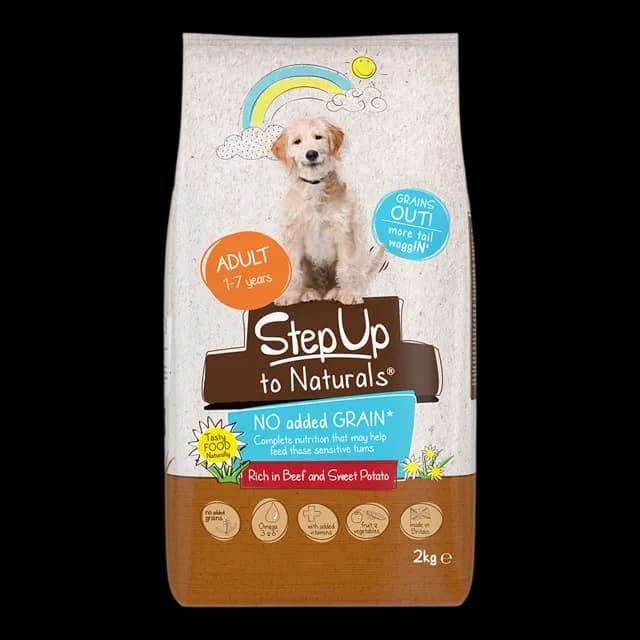
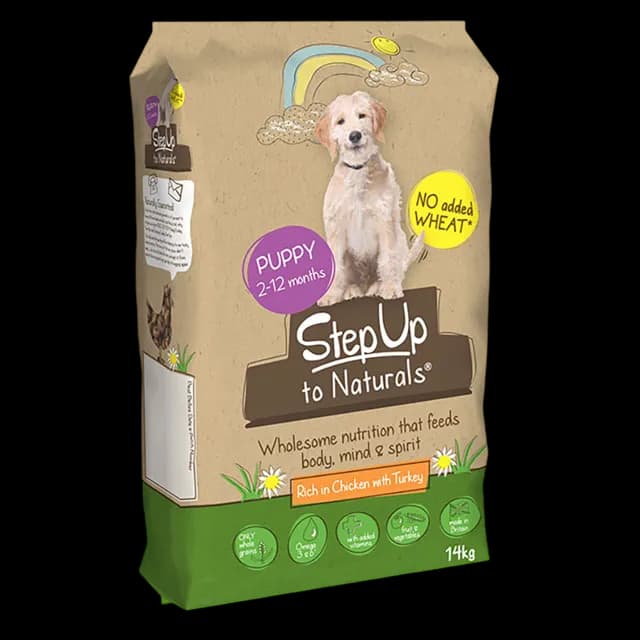
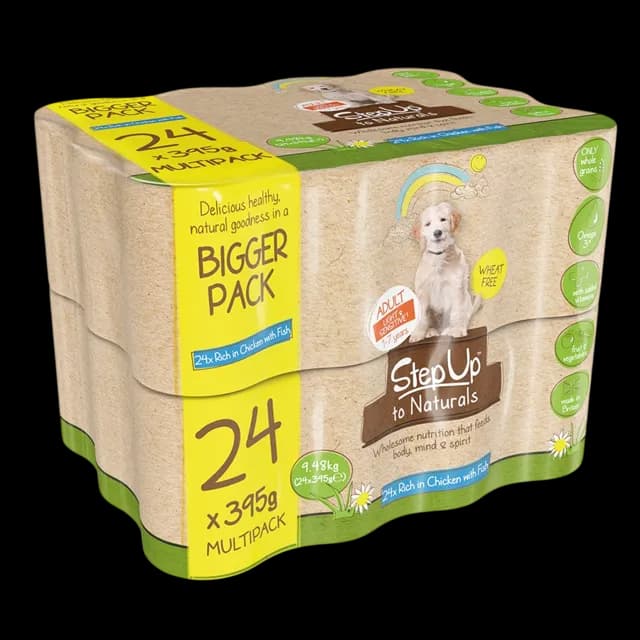
Step Up Dry Food Adult is a plain, unfussy British-style kibble sold in three recipes that share one construction. A concentrated meat meal sits at the front of each, then rice, whole barley at 16% and maize. Dried peas and whole grain oats follow, with a short tail of apple, sweet potato, salmon oil and chicory behind them. There is no grain-free posturing and no parade of botanicals, just a bag of food built to be eaten every day. All three sit in our Good band and finish close together, so let the animal on the front make the choice.
Our view
Likely to suit
Sometimes you are not looking for a philosophy in a bag, just something sensible your dog will clear every evening.
- Multi-dog homes, since all three recipes share a construction and swap only the meat
- Grain-tolerant dogs, with rice, whole barley at 16% and whole grain oats behind the meat
- Owners keen on a prebiotic, since dried chicory closes every one of the three ingredient lists
- Dogs with stiffening joints, since the chicken with fish recipe declares glucosamine and chondroitin outright
- Big eaters, because the 14kg bag is the size the whole range is built around
Worth watching
A few things run right through the range and are worth knowing whichever recipe you land on.
- Every one of the three recipes has salmon oil in it, so no version here is fish-free
- Poultry meal, poultry fat and poultry gravy name a family, not a bird, so this label cannot steer a dog with a specific poultry problem
- Carbohydrate runs high across the range, from 48.9% to 53.2% of dry matter against the 46.2% typical of adult dry food
Written by our editorial team. Independent guidance, not veterinary advice.
How this scores
How we scoreThe Details
Dog fit
Sometimes you are not looking for a philosophy in a bag, just something sensible your dog will clear every evening. A few things run right through the range and are worth knowing whichever recipe you land on.
Dry
Adult
Toy, Small, Medium, Large, Giant
Beef
The score, in context
All three recipes land in our Good band, which is also where the broad middle of the adult dry shelf comes to rest. They finish close enough together that our reading gives you no reason to prefer one over another. The meat is the thing keeping the range at that level. All of it is concentrated meal and none of it fresh, part of it named only by family, and on the beef recipe the leading entry is meat and bone meal. That names no animal at all beyond the beef declared inside it. What stops it slipping any lower is that everything else is set out plainly, with percentages printed against the grains, the peas and the extras, and a fully dosed vitamin and mineral panel underneath.
What's in it
Ingredients, as declared: Meat and Bone Meal (16% incl. Beef 8%), Rice, Whole Barley (16%), Maize, Dried Peas (8%), Poultry Meal, Poultry Fat (5%), Lamb Meal (4%), Whole Grain Oats (4%), Poultry Gravy, Beet Pulp, Dried Apple (1% equivalent to 6.5% Apple), Dried Sweet Potato (1% equivalent to 3% Sweet Potato), Minerals, Salmon Oil (0.5%), Dried Chicory
Named ingredients
Nutritional additives
Nutritional Additives: Vitamins: Vitamin A 15,000IU, Vitamin D3 1,500IU, Vitamin E 100mg; Trace Elements: Zinc (as Zinc Sulphate Monohydrate) 50mg, Iron (as Iron (ll) Sulphate Monohydrate) 40mg, Manganese (as Manganese (ll) Oxide) 30mg, Copper (as Copper (II) Sulphate Pentahydrate) 8mg, Iodine (as Calcium Iodate Anhydrous) 1.5mg, Selenium (as Sodium Selenite) 0.15mg
Ingredient notes
Every recipe opens with a meat meal. That is worth understanding, and nothing to worry about. A meal is meat that has been cooked and ground with most of its water already gone. That is why 18.5% of poultry meal counts for so much more in the bag than 18.5% of fresh poultry would. The catch is the naming. Poultry is a family word that covers goose and duck as much as chicken and turkey. The beef recipe's meat and bone meal is vaguer still. That is why the label helpfully prints the named share inside each one.
The cereal side is conventional and competently chosen. Rice is easy on most dogs, whole barley at 16% keeps its bran and brings fibre and micronutrients with it, and whole grain oats at 4% do a similar job. Maize sits in there as the everyday filler of the group. There is no wheat anywhere in the range, which will matter to a household that has been avoiding it.
Dried peas at 8% or 9% depending on the recipe do two things at once. Fibre and antioxidants come with whole peas, and so does a spread of vitamins. They also add plant protein that flatters the declared protein figure a little. At this level they read as a genuine ingredient rather than as bulk, which is the line peas cross when they start climbing higher up a list.
The tail is a mixture of the token and the useful. Dried apple at 1% is stated as the equivalent of 6.5% fresh apple and dried sweet potato at 1% as the equivalent of 3%, which is honest labelling of what are essentially garnishes. Salmon oil at 0.5% is small but purposeful, since a little of it goes a long way for coat condition. Dried chicory is the quiet winner of the group. It is a root rich in inulin, the fibre that useful gut bacteria feed on.
The added panel is dosed properly, with zinc at 50mg, iron at 40mg, manganese at 30mg, copper at 8mg, iodine at 1.5mg and selenium at 0.15mg per kilo. Vitamins A, D3 and E sit alongside them. The trace minerals are sulphates and oxides, the ordinary choice at this level of the market. Selenium arrives as sodium selenite, the form most makers use even though the yeast-based form is generally absorbed better.
How this variety differs
Meat and bone meal at 16% leads this one, with beef named at 8% inside it and lamb meal at 4% further down, so two red meats share the animal side. That leading entry is the vaguest in the range, since bone meal can come from any animal at all. The analysis shows it: crude ash is declared at 9.5% and calcium converts to 2.56% of dry matter. That is comfortably the highest of the three, a level suited to a settled adult and not to a growing dog. Moisture is declared here, not assumed, and carbohydrate works out at 48.9% of dry matter, the lowest figure in the range.
Price and value
£2.07 a kilo from the 14kg bag, which all three recipes are sold in. The chicken with fish recipe also comes in a 2kg bag, which works out at £2.70 a kilo.
As a guide, a 15kg adult dog in moderate condition would eat somewhere between 228 and 243 grams a day depending on the recipe. Both figures rest on around 840 kcal a day (110 × bodyweight^0.75, the standard maintenance estimate). The daily figure comes out between £0.47 and £0.50. The label's own table asks 200 to 340 grams for a dog between 12kg and 25kg, so weigh the first few meals and let the waistline settle where in that band your dog belongs.
Nutritional analysis
Declared analysis
22%
11%
3.5%
9.5%
10%
Dry weight
24.4%
12.2%
3.9%
10.6%
48.9%
As-fed composition
Estimated breakdown of the finished product by ingredient category, from the declared ingredient list and ingoing weights. These are estimates, not measurements.
32.8%
4%
56%
1.3%
5.5%
0.4%
Pricing & size
- Pack size
- 14kg - £28.99 (£2.07/kg)
- Retailer pricing
- Coming soon
Live retailer pricing is not yet available for this food. Prices, cost per day and where to buy will appear here once retailer data is live.
Ingredients and nutrition are taken from manufacturer data. Retailer pricing is not yet live for this food.
Related dog food guides
Ranked shortlists that include foods like this one.