



Boost
Boost Fresh Food Trays: Meatfeast review
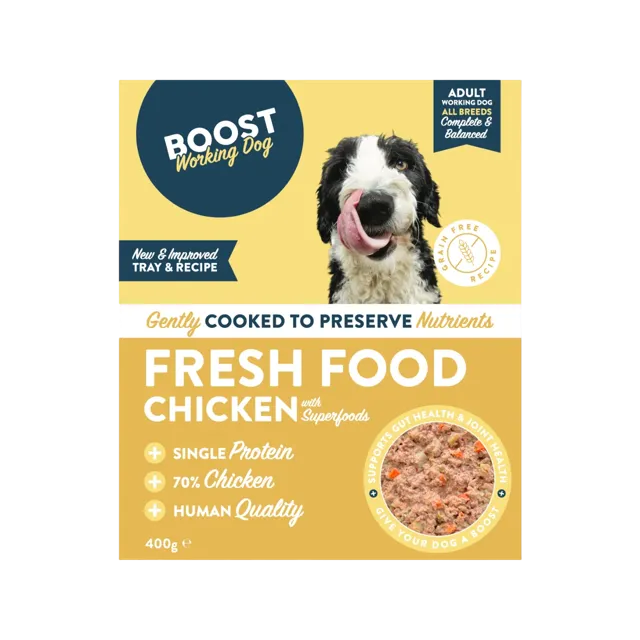
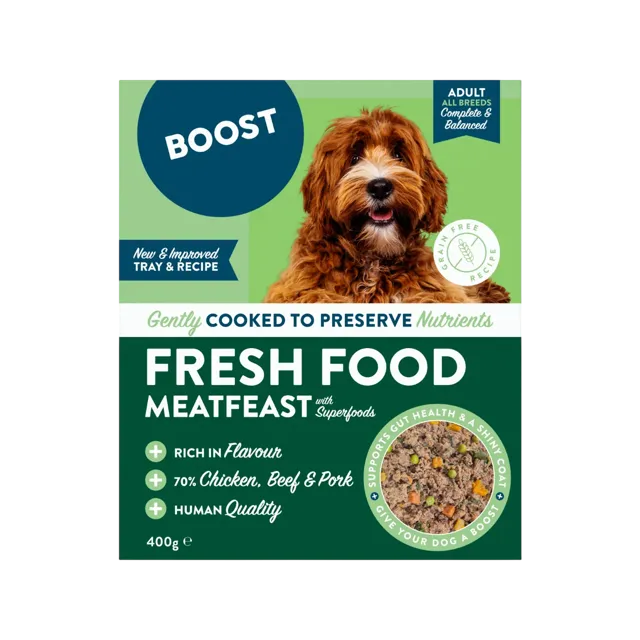
Boost Fresh Food Trays are gently cooked meals in a 400g tray, and the labels are refreshingly literal. Five of the six declare 70% meat and then tell you what that meat is made of, breaking it into the muscle, tripe, liver and heart cuts behind the headline. The sixth is built on 60% whitefish. Around that sit named vegetables with percentages against them, a pair of oils and chicory powder on every recipe as a prebiotic. Beef, chicken, fish, lamb, pork and a mixed Meatfeast cover most preferences. Five of them reach our Outstanding band with the Pork at the head of the range, and the fish sits a step behind in Excellent.
Our view
Likely to suit
If the idea of fresh feeding appeals but the faff does not, a sealed tray is about as simple as it gets.
- Dogs new to fresh food, since a tray needs no portioning or mixing and nothing to thaw before it reaches the bowl
- Owners who want to see inside the meat figure, with tripe, liver and heart broken out by percentage on most recipes
- Households rotating proteins through the week, with beef, chicken, fish, lamb and pork all built to the same pattern
- Adult dogs of any build, since every recipe is listed from toy right through to giant
- Dogs with a slightly unsettled gut, thanks to chicory powder appearing on every label as a gentle prebiotic
Worth watching
A quick read of the labels before you order will save you a surprise or two.
- Fish oil appears at 0.5% on five of the six recipes, so those trays are not fish free even where the meat is
- The Fish tray carries chicken at 10% behind its whitefish, and Meatfeast puts pork, beef and chicken into one tray
- Every recipe here is listed for adult dogs, so these trays are not where a puppy's growth diet starts
Written by our editorial team. Independent guidance, not veterinary advice.
How this scores
How we scoreThe Details
Dog fit
If the idea of fresh feeding appeals but the faff does not, a sealed tray is about as simple as it gets. A quick read of the labels before you order will save you a surprise or two.
Fresh
Adult
Toy, Small, Medium, Large, Giant
Pork
The score, in context
Five of the six reach our Outstanding band, which is where the typical fresh food sits as well, and the fish tray follows a step behind in Excellent. This range holds its own in the toughest category we score. Protein and processing, nutritional balance and transparency come back Outstanding on every recipe with value keeping pace, and the meat trays sit close enough together that preference should decide, not rank.
The Pork leads on our reading and the Meatfeast follows it. These labels earn their standing by itemising. The meat figure is broken open into its parts, nearly every plant entry carries a percentage, and the oils and prebiotics are declared to a tenth of a per cent. Very few makers write a label this legible.
What's in it
Ingredients, as declared: Pork 30%, Beef tripe 20%, Chicken 22%, Carrot 8%, Sweet Potato 6%, Kale 5%,Pea 4%, Potato Starch, Linseed oil (0.5%), Fish oil (0.5%), Minerals, Chicory powder (0.1%).
Named ingredients
Nutritional additives
_(the page labels this block "NUTRITIONAL ADDITIVES (PER KG):")_: Nutritional Additives per kg: Vitamin D3 200 IU, Vitamin E 50 mg, Zinc (Zinc Sulphate Monohydrate) 15 mg, Manganese (Manganous Sulphate Monohydrate) 10.0 mg, Copper (Copper (II) Sulphate Pentahydrate) 2.0 mg, Iodine (Anhydrous Calcium Iodate) 0.5 mg.
Ingredient notes
The meat share is the whole story. Five recipes declare 70% and then open it up. The Beef breaks out 17% tripe and 6% liver, and the Chicken splits into 20% chicken meat, 16% liver and 10% breast. The Lamb gives 12% tripe and 6% liver, and the Pork itemises 10% liver with 10% heart. Tripe and organ meat are not padding in that context, they are the nutrient-dense parts of an animal that a muscle-only recipe never touches at all.
The Fish tray works to a different plan, leading with 60% whitefish and adding 10% chicken behind it. It is the leanest thing in the range by a distance, with fat converting to 10.0% of dry matter. That makes it the tray to reach for when a dog needs its calories reined in without its protein being cut back at the same time.
The plants are few and every one is named. Carrot, sweet potato, kale and pea do most of the work, with apple in the Pork, broccoli in the Fish and green bean in the Lamb, and each one carries its own percentage. Potato starch follows as the binder. Pure starch brings little beyond energy, and it sits well down these lists.
Fat arrives from two directions on most of the trays. Linseed oil at 0.5% covers the plant form of omega 3, and fish oil at 0.5% covers the marine form that dogs use more directly. The Fish tray takes another route, doubling the linseed to 1% and leaving fish oil off entirely, since the whitefish is already covering that ground.
Chicory at 0.1% closes almost every list. Its inulin is a soluble fibre, and the good bacteria in a dog's large intestine live on it. The added panel is declared per kilo and dosed in print. Vitamin E sits at 50 mg, zinc at 15 mg, manganese at 10.0 mg, copper at 2.0 mg and iodine at 0.5 mg. Vitamin D3 is at 200 IU on every recipe bar the Fish.
Being gently cooked rather than extruded, these trays carry a lot of water, declared between 72.0% and 80.0%, and they belong in the fridge once opened. That is ordinary for the format, and it is also why the as fed protein figures look small beside a bag of kibble when on a dry matter basis they reach between 42.3% and 55.0%.
How this variety differs
Pork at 30%, chicken at 22% and beef tripe at 20%, the one tray in the range that mixes species deliberately. It sits among the richer options, with fat at 26.9% of dry matter and a low estimated carbohydrate of 13.5%. It is the natural choice for a dog with no sensitivities and a healthy appetite.
Price and value
£8.79 a kilo across every recipe, in 400g trays sold singly or in a multipack of 7.
As a guide, a 15kg adult dog in moderate condition gets through between 636 and 743 grams a day, the amount varying with the recipe. That rests on about 840 kcal a day from the standard maintenance estimate of 110 × bodyweight^0.75. That works out between £5.59 and £6.53 a day, the richer trays feeding in smaller amounts than the leaner ones.
Nutritional analysis
Declared analysis
13%
7%
0.5%
2%
74%
Dry weight
50%
26.9%
1.9%
7.7%
13.5%
As-fed composition
Estimated breakdown of the finished product by ingredient category, from the declared ingredient list and ingoing weights. These are estimates, not measurements.
72%
2.3%
11.2%
13.1%
1%
0.4%
Pricing & size
- Pack size
- 1 x 400 g (£3.70); 7 x 400 g multipack (£24.60)
- Retailer pricing
- Coming soon
Live retailer pricing is not yet available for this food. Prices, cost per day and where to buy will appear here once retailer data is live.
Ingredients and nutrition are taken from manufacturer data. Retailer pricing is not yet live for this food.
Related dog food guides
Ranked shortlists that include foods like this one.