


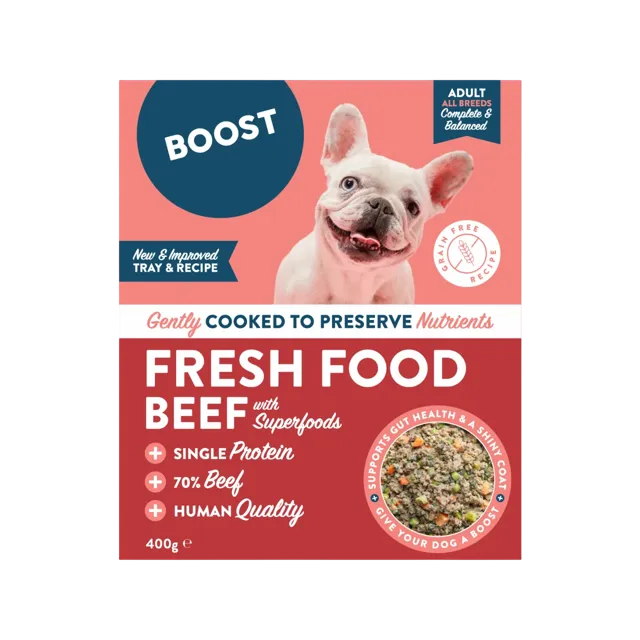

Boost
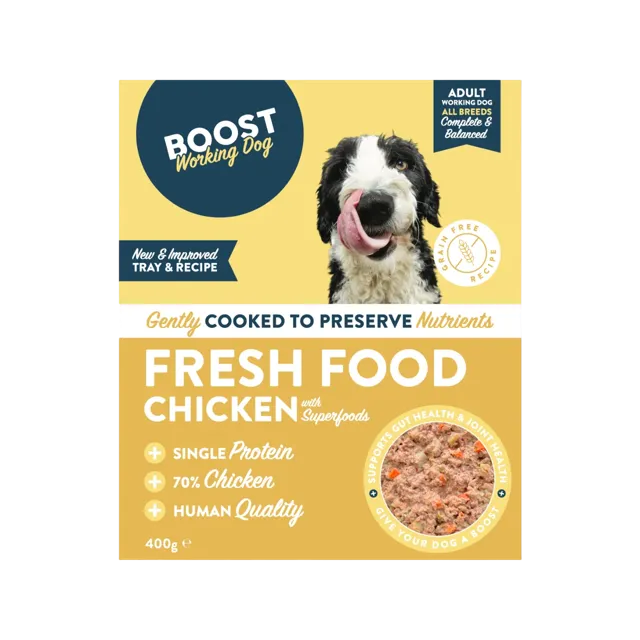
Boost Working Dog Trays: Chicken with Superfoods review
Boost Working Dog Trays take the brand's gently cooked format and turn the dial up for dogs that genuinely work. Both recipes declare 70% meat, one chicken and one turkey, on the same short base of carrot, potato and broccoli at 5% each, and both add glucosamine at 0.3% with chondroitin sulphate at 0.1%. Carbohydrate is remarkably low even for fresh food, and the Turkey in particular is a properly energy-dense bowl. The two sit level with each other in our Outstanding band.
Our view
Likely to suit
Some dogs burn through an ordinary dinner well before the afternoon is out, and these trays were made with them in mind.
- Working and sporting dogs, whose day burns through rather more than a standard bowl puts back
- Owners who want joint support built into dinner rather than added on top, with glucosamine and chondroitin both printed
- Any dog on a low-starch plan, with the Turkey's carbohydrate converting to only 3.3% of dry matter
- Any adult dog on fresh food who finishes an ordinary tray still looking for more
- Households that feed by tray, since a sealed portion travels to a kennel or a field as easily as it opens at home
Worth watching
The energy in these trays is the entire point, so read the labels with your dog's real workload in mind.
- Fish oil at 0.5% runs through both recipes, so neither of them is a fish free option
- Both trays are listed for adult dogs, so they are not a growth food for a puppy
- The Turkey is much the richer of the two, so match the portion to the days your dog is actually having rather than swapping tray for tray
Written by our editorial team. Independent guidance, not veterinary advice.
How this scores
How we scoreThe Details
Dog fit
Some dogs burn through an ordinary dinner well before the afternoon is out, and these trays were made with them in mind. The energy in these trays is the entire point, so read the labels with your dog's real workload in mind.
Fresh
Adult
Toy, Small, Medium, Large, Giant
Chicken
The score, in context
Neither tray outranks the other, and the difference is simply the amount of fuel your dog gets through. Both reach our Outstanding band. That is the same band the typical fresh food occupies, which makes it a genuinely competitive result in the strongest field we cover.
Every pillar reads Outstanding on each recipe, value included, and the carbohydrate figures are a large part of why they sit so high. At 9.6% of dry matter on the Chicken and 3.3% on the Turkey, almost everything in these trays is doing nutritional work. The joint supplements and the oils are not merely named: each carries a printed dose to one decimal place.
What's in it
Ingredients, as declared: Chicken 70%, Carrot 5%, Potato 5%, Broccoli 5%, Potato Starch, Linseed oil (0.5%), Fish oil (0.5%), Glucosamine (0.3%), Minerals, Chicory powder (0.1%), Chondroitin Sulphate (0.1%)
Named ingredients
Nutritional additives
_(the page labels this block "NUTRITIONAL ADDITIVES (PER KG):")_: Nutritional Additives per kg: Vitamin D3 200 IU, Vitamin E 50 mg, Zinc (Zinc Sulphate Monohydrate) 15 mg, Manganese (Manganous Sulphate Monohydrate) 10.0 mg, Copper (Copper (II) Sulphate Pentahydrate) 2.0 mg, Iodine (Anhydrous Calcium Iodate) 0.5 mg.
Ingredient notes
A 70% meat headline is the same figure the brand's standard trays carry, but here the label names the species and stops there. No breakdown into cuts. What changes is everything around it. Where the ordinary trays spread their plants across several entries, these keep to carrot, potato and broccoli at 5% each, with a little potato starch behind them. The difference shows up very plainly in the analysis.
The Turkey is the more concentrated of the two by some distance, declaring 14.0% fat as fed against the Chicken's 9.0%. That converts to 46.7% and 34.6% of dry matter and lands at 171 and 134 kcal per 100g. Fat is the fuel a working dog actually runs on, and that gap is deliberate. It is also why a dog on light duties wants a smaller bowl of the Turkey than the label's upper figure.
Carbohydrate is where these labels stand apart. The Chicken estimates 2.5% as fed and the Turkey just 1.0%, converting to 9.6% and 3.3% of dry matter. Potato starch is here as a binder, and the plant entries are whole vegetables that bring fibre and antioxidants of their own.
Glucosamine at 0.3% and chondroitin sulphate at 0.1% appear on both labels with figures attached. In a food aimed at dogs putting real mileage through their joints, that is a sensible inclusion. Glucosamine is thought to slow the breakdown of cartilage and chondroitin to calm the inflammation around it. Trial results have been mixed, but a declared level tells you far more than a name on a list ever could.
Linseed oil and fish oil sit at 0.5% each, covering both the plant and the marine forms of omega 3, and chicory powder at 0.1% brings inulin for the gut. The mineral panel is declared per kilo, with vitamin D3 at 200 IU, vitamin E at 50 mg, zinc at 15 mg, manganese at 10.0 mg, copper at 2.0 mg and iodine at 0.5 mg.
How this variety differs
Chicken at 70% on carrot, potato and broccoli. It is the gentler of the pair at 134 kcal per 100g, with fat converting to 34.6% of dry matter. That makes it the everyday option for a dog that works hard some days and rests on the others.
Price and value
Both recipes work out at £7.32 a kilo. The trays are 400g, sold singly or in a multipack of 7.
As a guide, the standard maintenance estimate of 110 × bodyweight^0.75 puts a 15kg adult dog in moderate condition at around 840 kcal a day. The Chicken then works out at about 627 grams a day, the Turkey at about 491 grams. That comes to roughly £4.59 a day on the Chicken and £3.60 on the Turkey, the difference following the Turkey's higher energy density. A dog genuinely at work will need more than that estimate allows for.
Nutritional analysis
Declared analysis
12%
9%
0.5%
2%
74%
Dry weight
46.2%
34.6%
1.9%
7.7%
9.6%
As-fed composition
Estimated breakdown of the finished product by ingredient category, from the declared ingredient list and ingoing weights. These are estimates, not measurements.
70%
8.1%
9.2%
10.1%
1%
1.6%
Pricing & size
- Pack size
- 1 x 400 g (£3.00); 7 x 400 g multipack (£20.50)
- Retailer pricing
- Coming soon
Live retailer pricing is not yet available for this food. Prices, cost per day and where to buy will appear here once retailer data is live.
Ingredients and nutrition are taken from manufacturer data. Retailer pricing is not yet live for this food.
Related dog food guides
Ranked shortlists that include foods like this one.