

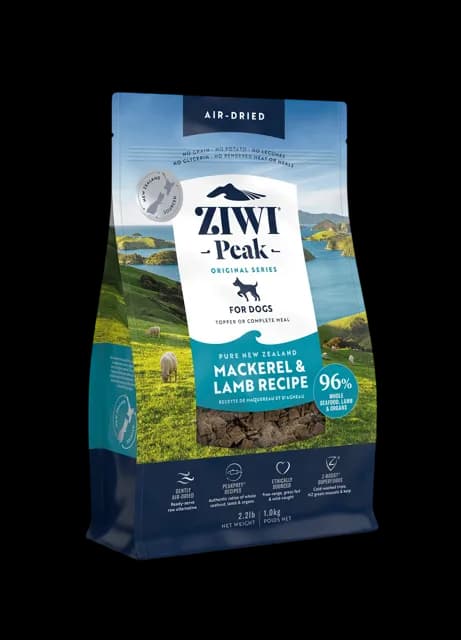

Ziwi Peak
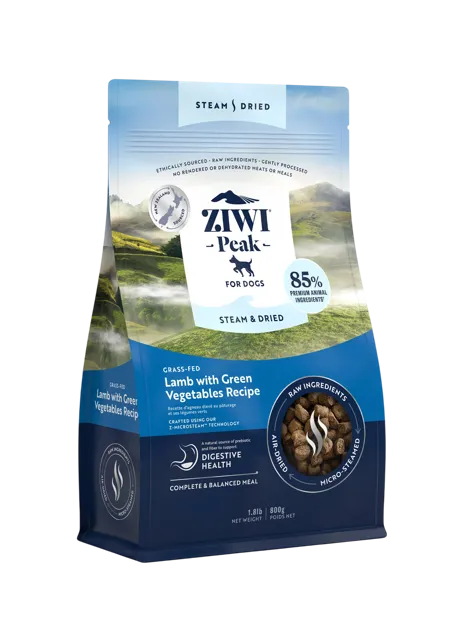
Ziwi Peak Steam & Dried: Lamb with Green Vegetables review
Ziwi Peak Steam & Dried is about as animal-heavy as a dry food gets. Each recipe declares 80% or more of its content as one animal and its organs, itemised down to the tripe and the cartilage. A small amount of pea, lentil and quinoa does what carrying is left. Fat runs high, energy runs higher still, and portions come out small as a result. All three recipes hold our Excellent band, level with one another, so the meat your dog prefers can settle it.
Our view
Likely to suit
Some dogs simply do better when almost everything in the bowl came off an animal, and this range is built for that dog.
- Dogs that want meat and little else, as the animal content is declared at 83% in the beef and lamb and 80% in the chicken
- Hard keepers and working dogs, since 430 to 440 kcal per 100g puts real energy into a small portion
- Owners feeding grain free, with peas, lentils and quinoa standing in for cereal entirely
- Dogs that eat offal happily, since liver and heart are named outright on every recipe
- Toy and small breed owners, because the label's feeding table starts at a 1kg dog and scales in tight steps
- Rotation feeders whose dog has fallen out with one common meat, since beef, lamb and chicken share the same construction
Worth watching
Before you switch your dog across, take in the points below.
- Every recipe carries fish oil, and that keeps all three off a strict single source elimination trial
- Fat is declared between 28% and 30%, a figure to have in mind for a dog asked to keep fat low
- Energy is high and portions are correspondingly small, so a steady-going dog is easy to overfeed unless you weigh the food
- Fibre is low at 1.1% of dry matter, and a dog that needs bulk to keep things formed may want something alongside
- The chicken recipe adds 3% dried egg white, so an egg-reactive dog belongs on the beef or the lamb
Written by our editorial team. Independent guidance, not veterinary advice.
How this scores
How we scoreThe Details
Dog fit
Some dogs simply do better when almost everything in the bowl came off an animal, and this range is built for that dog. Before you switch your dog across, take in the points below.
Dry
Adult
Toy, Small, Medium, Large, Giant
Lamb
The score, in context
All three recipes finish together in our Excellent band, a clear step above the Good band where the middle of the adult dry shelf settles. The reasons are not subtle. Animal content is declared at 80% and above, and carbohydrate converts to between 14.2% and 16.4% of dry matter against the 46.2% typical for adult dry food. Moisture is printed on the label too, so the dry matter figures here rest on the maker's own numbers. Since the three land level, let the animal decide it.
What's in it
Ingredients, as declared: 83% Lamb and Lamb Organs (including Lamb, Lung, Tripe, Liver, Heart, Plasma, Bone, Spleen, Cartilage), 4.3% Vegetables (Dried Green Peas, Spinach, Kale, Green Beans, Beet Greens), Dried Green Lentils, 2% Lamb Fat, Lecithin, Dried Quinoa, Dried Apple Pomace, Fish Oil, Minerals, Dried Chicory Root, Dried Kelp
Named ingredients
Nutritional additives
Nutritional Additives (Additives per kg): Vitamin D3 880 IU, Zinc (as Zinc Chelate of Protein Hydrolysates) 65 mg, Copper (as Copper (II) Chelate of Protein Hydrolysates) 3.5 mg, Iron (as Iron (II) Chelate of Glycine Hydrate) 35 mg, Manganese (as Manganese Chelate of Protein Hydrolysates) 4.3 mg, Selenium (as Selenised yeast Saccharomyces cerevisiae CNCM I-3060) 0.1 mg; Technological Additives: Antioxidants (tocopherol extracts of vegetable oils).
Ingredient notes
The animal headline holds up under reading. Beef and lamb are declared at 83%, chicken at 80%, and in each case the label itemises what went in, with no sheltering behind a phrase like animal derivatives. Liver and heart are named on all three, with lung, tripe, spleen and plasma spelled out as well in the beef and the lamb. Organs are where most of an animal's nutrition sits, liver above all, and a dog fed this way eats closer to what it would choose given the run of a carcass.
Bone and cartilage appear on every list too, and that is where the mineral figure comes from, declared at 9.0% ash and converting to 9.9% of dry matter. For a food built on whole animals and not muscle meat alone, that reads exactly as it should.
The analysis backs the label rather than flattering it. Protein converts to 41.8% of dry matter in the beef and the chicken and 39.6% in the lamb. Carbohydrate lands between 14.2% and 16.4% against a typical 46.2% for adult dry food. Energy is 430 to 440 kcal per 100g against a typical 357, so a serving of this looks small next to a scoop of ordinary kibble. Moisture is declared at 9.0%, so none of those dry matter conversions rest on an assumption.
What plant matter there is has been picked with some care. Dried green peas and green lentils sit well down the lists, so they are not propping up the protein figure. That is the difference between a legume used for nutrition and one used to fill space. Quinoa is a pseudo-grain, a seed from a plant in the spinach family and not the grass family. It keeps these recipes clear of true cereal while bringing protein and fibre of its own. Chicory root adds a prebiotic and dried kelp adds trace minerals, iodine chief among them.
Fish oil appears in every recipe as the omega 3 source, and it is a strong choice, handing over the marine forms of those oils ready made with no conversion asked of the dog. It does mean no recipe here is fish free. Anyone working through an elimination diet with a fish-reactive dog will want to know that.
The added trace minerals come as chelates: zinc at 65 mg in the beef and lamb and 55 mg in the chicken, iron at 35 mg and manganese at 4.3 mg. Chelated forms are absorbed more readily than the plain oxides. One honest wrinkle sits here. Those chelates are bound to protein hydrolysates, and the label does not say what animal they came from. Even the beef and the lamb cannot be treated as strictly one animal from top to bottom. Vitamin D3 is the only vitamin declared as an addition, the organ meat being expected to cover the rest.
Fibre is the one figure that reads low, declared at 1.0% and converting to 1.1% of dry matter. Most dogs manage perfectly well on that, and stools tend to be small on a diet this digestible, which many owners take as a selling point in itself.
How this variety differs
Lamb and lamb organs at 83%, the same whole-animal build as the beef, paired with 4.3% green vegetables covering dried green peas, spinach, kale, green beans and beet greens. Protein is declared a touch below its stablemates at 36.0%, converting to 39.6% of dry matter, and lamb fat at 2% keeps total fat at 30.0%. For a dog that has already tried beef and grown tired of it, this is the natural next step within the range.
Price and value
£28.12 a kilo, sold in 800g, 1.5kg and 3.2kg bags.
As a guide, a 15kg adult dog in moderate condition eats about 191 grams a day on the beef or the lamb and 195 grams on the chicken. That is worked from 840 kcal a day (110 × bodyweight^0.75, the standard maintenance estimate). That comes to £5.37 a day on the beef and lamb and £5.49 on the chicken. Ziwi Peak's own table is more cautious, asking 147 grams for a 15kg dog on the beef and lamb and 151 grams on the chicken. Begin where the label suggests and let the waistline take it from there.
Nutritional analysis
Declared analysis
36%
30%
1%
9%
9%
Dry weight
39.6%
33%
1.1%
9.9%
16.4%
As-fed composition
Estimated breakdown of the finished product by ingredient category, from the declared ingredient list and ingoing weights. These are estimates, not measurements.
83%
7.1%
5.5%
2.4%
1.9%
Pricing & size
- Pack size
- 800g, 1.5kg, 3.2kg
- Retailer pricing
- Coming soon
Live retailer pricing is not yet available for this food. Prices, cost per day and where to buy will appear here once retailer data is live.
Ingredients and nutrition are taken from manufacturer data. Retailer pricing is not yet live for this food.
Related dog food guides
Ranked shortlists that include foods like this one.