


Red Mills
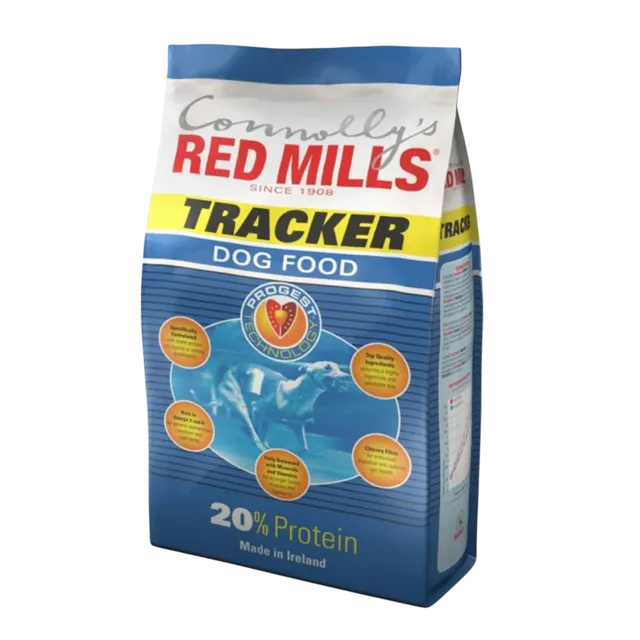
Red Mills Tracker review
Red Mills Tracker is a lean, low fat working dog kibble, and its label is almost all category terms. Cereals lead, with meat and animal derivatives, oils and fats and fish and fish derivatives behind them, then chicory extract and yeast extract at the end. Every vitamin and mineral dose is printed, which plenty of labels never manage, but very little else is pinned down, and that is what puts it in our Poor band.
Our view
Likely to suit
If you are feeding a steady, plain bowl to a dog who does not need a rich one, this is that kind of food.
- Dogs carrying a little more condition than they should, since fat is declared at 8% and the energy figure sits below what a typical adult dry food carries
- Kennels and working homes that want one uncomplicated recipe for a group of dogs
- Owners who like the mineral amounts printed, with zinc at 140 mg, iron at 134 mg and iodine at 2.45 mg per kilo declared
- Older, steadier dogs whose appetite has started to outrun their exercise
Worth watching
The label holds its cards close, so a few points are worth saying plainly.
- Every main entry is a category and not a named ingredient, so which cereal and which animal are in the bag stays unknown
- There is fish here, never named to a species, and that counts if your dog has to avoid fish
- Protein converts to 22.2% of dry matter and fat to 8.9%, gentle for a dog in hard daily work
- Carbohydrate converts to 58.5% of dry matter against the 46.2% a typical adult dry food carries
Written by our editorial team. Independent guidance, not veterinary advice.
How this scores
How we scoreThe Details
Dog fit
If you are feeding a steady, plain bowl to a dog who does not need a rich one, this is that kind of food. The label holds its cards close, so a few points are worth saying plainly.
Dry
Adult
Fish
The score, in context
Our Poor band holds this one, some way under the Good band the typical adult dry food occupies. The reason is almost entirely what the label leaves unsaid. Category terms such as cereals and meat and animal derivatives can cover excellent material or very ordinary material. From the outside nobody can tell which, so we can only read what is declared. The analysis adds to it, with protein at 22.2% of dry matter and fat at 8.9% both on the light side and carbohydrate at 58.5% above what a typical bag carries. Two things the label does properly are worth keeping in view. It doses its vitamins and minerals in print, and it declares its moisture where many labels leave that to be assumed.
What's in it
Ingredients, as declared: Cereals, Meat and Animal Derivatives, Oils and Fats, Fish and Fish Derivatives, Derivatives of Vegetable Origin, Vegetable Protein Extracts, Minerals, Chicory Extract, Yeast Extract.
Named ingredients
Nutritional additives
Vitamin a E672 24000iu, Vitamin D3 E671 2000iu, Alpha Tocopherol Acetate (Vitamin E) 250iu, Copper E4 (Cupric Sulphate Pentahydrate) 28mg, Selenium E8 (Sodium Selenite) 0.33mg, Iron E1 (Iron Sulphate Monohydrate) 134mg, Manganese E5 (Manganese Oxide) 65mg, Zinc E6 (Zinc Oxide) 140mg, Iodine E2 (Calcium Iodate Anhydrous) 2.45mg.
Ingredient notes
Nearly every entry here names a legal category, not an ingredient. Cereals could be rice, wheat, maize or any mixture of them. Meat and animal derivatives covers everything from prime muscle meat to the parts of a carcass nobody puts on a label, and derivatives of vegetable origin is broader still. Broad terms are not proof of poor material, and plenty of decent foods use them to protect a recipe, but they do leave you taking the bag on trust.
Vegetable protein extracts is the entry most worth understanding. It is plant protein, in there to lift the protein figure. A dog gets less out of it than out of the same weight of meat protein, which is part of why the declared 20.0% reads gentler in practice than the number first suggests.
Fat is declared at 8.0%, low for a dry food, and it looks deliberate. This is a recipe pitched at steady condition, not at racing weight. Fibre converts to 2.6% of dry matter. Behind it the chicory extract supplies inulin, which the gut's own bacteria feed on.
Nothing on this label is stronger than the additive panel. Vitamin D3 at 2000 IU and vitamin E at 250 IU are printed with amounts. So are zinc at 140 mg, iron at 134 mg, manganese at 65 mg, copper at 28 mg, iodine at 2.45 mg and selenium at 0.33 mg per kilo. Oxides and sulphates are the forms, with no chelates among them, and a dog's gut generally works a little harder on those. The selenium is sodium selenite.
The yeast extract closing the list is a palatant, there to make a plain recipe taste worth finishing. On a food this understated that is honest work, and dogs tend to appreciate it.
Price and value
£1.11 a kilo. Bags are 15kg, singly or six to a pack.
As a guide, feeding a 15kg adult dog in moderate condition takes around 260 grams a day, assuming about 840 kcal a day (110 × bodyweight^0.75, the standard maintenance estimate). At that rate the daily figure comes to roughly £0.29.
Nutritional analysis
Declared analysis
Estimated using Modified Atwater factors*
20%
8%
2.3%
7%
10%
Dry weight
22.2%
8.9%
2.6%
7.8%
58.5%
As-fed composition
Estimated breakdown of the finished product by ingredient category, from the declared ingredient list and ingoing weights. These are estimates, not measurements.
36.8%
51.5%
1.2%
8.4%
2.1%
Pricing & size
- Pack size
- 15kg (also sold as 6 Pack (6 x 15kg))
- Retailer pricing
- Coming soon
Live retailer pricing is not yet available for this food. Prices, cost per day and where to buy will appear here once retailer data is live.
Ingredients and nutrition are taken from manufacturer data. Retailer pricing is not yet live for this food.
Related dog food guides
Ranked shortlists that include foods like this one.