


Red Mills
Red Mills Racer Plus review
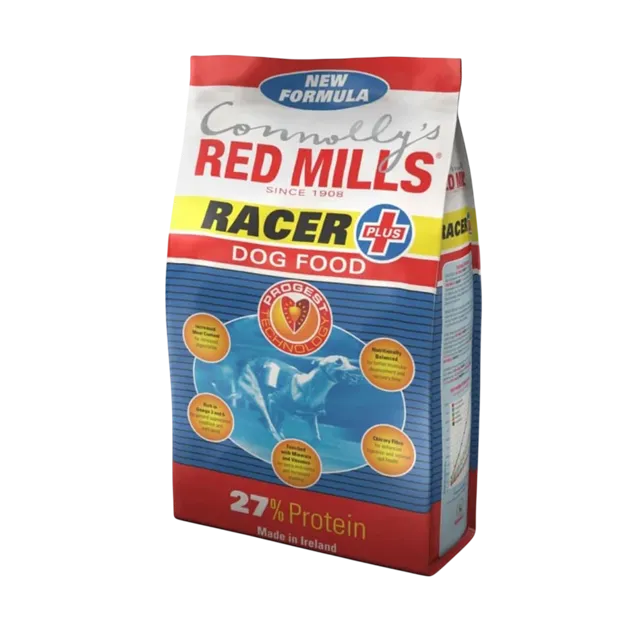
Red Mills Racer Plus is a working dog kibble built the traditional way, on cereals and concentrated dried meats, with no fresh meat or legumes in it. Maize leads the list, dehydrated poultry and dehydrated beef bring the animal protein, and beet pulp, whole linseed and chicory inulin round it off. It is a plain, hard-wearing everyday bowl, and our scoring places it in our Average band, mostly on how little the label pins down.
Our view
Likely to suit
This is the sort of no-nonsense dinner written for a dog that works all day and comes home properly hungry.
- Working and sporting dogs in regular training, which is exactly who the recipe is named for
- Dogs that have never had trouble with cereals, since maize and wheat are both named openly and not hidden behind a group term
- Owners feeding a growing dog alongside a grown one, since adults and puppies are both on the label
- Kennels and multi dog homes that want one straightforward recipe to feed across the board
Worth watching
Some of what this label says deserves a second look before you commit.
- The poultry comes without a species, so an elimination plan cannot rule chicken in or out
- Wheat and maize gluten both appear, worth a look if your dog has a known grain sensitivity
- Fishmeal appears among the ingredients, which puts fish in the bag
- Calcium is not declared anywhere, which leaves the large breed puppy owner short of the one figure they most want
Written by our editorial team. Independent guidance, not veterinary advice.
How this scores
How we scoreThe Details
Dog fit
This is the sort of no-nonsense dinner written for a dog that works all day and comes home properly hungry. Some of what this label says deserves a second look before you commit.
Dry
Puppy, Adult
Poultry
The score, in context
This one lands in our Average band, a step below the Good band the typical adult dry food holds. The reasons are structural, and none of them is alarming. Maize opens the list and maize gluten returns further down to top up the protein figure, an easier route to a protein number than meat is. The poultry entries never name a bird. It is worth saying what the label gets right in return. Moisture is declared and not assumed, the cereals are named, and carbohydrate actually converts to 42.0% of dry matter, under the 46.2% a typical adult dry food carries. It was designed for a fit dog in work, and on that dog it does its job.
What's in it
Ingredients, as declared: Maize, Dehydrated Poultry Meat, Wheat, Poultry Fat, Dehydrated Beef Meat, Maize Gluten, Beet Pulp, Fishmeal, Whole Linseed, Sodium Chloride, Calcium Carbonate, Chicory Inulin, Yeast Extract.
Named ingredients
Nutritional additives
Vitamin a E672, Vitamin D3 E671, Alpha Tocopherol Acetate (Vitamin E), Copper E4 (Cupric Sulphate Pentahydrate), Selenium E8 (Sodium Selenite), Iron E1 (Iron Sulphate Monohydrate), Manganese E5 (Manganese Oxide), Zinc E6 (Zinc Oxide), Iodine E2 (Calcium Iodate Anhydrous).
Ingredient notes
Maize is the first ingredient and wheat the third, so this is a cereal based kibble and it makes no secret of that. Maize is a reliable and digestible grain once cooked. Wheat is the one more often linked with sensitivity. Note it if your dog has run into trouble with grain before.
The animal protein arrives already concentrated. Dehydrated poultry meat and dehydrated beef meat go in dried, so they carry their declared weight through to the finished kibble and lose none of it in the oven. Protein converts to 30.0% of dry matter and fat to 16.7%, a sensible pairing for a dog that is out working, not resting.
If one entry could go, it would be the maize gluten. Maize processing throws it off as a by product, put in to lift a protein figure. Meat protein does more for a dog than plant protein does. At least it sits sixth on the list here, behind both of the meats rather than in front of them.
Beet pulp gives steady fibre and whole linseed brings plant omega 3. Chicory inulin is a prebiotic, and the gut's own bacteria feed on it. Yeast extract sits at the end for palatability. None of that is window dressing. They are the quiet, useful entries that make a plain recipe work.
Oxides and sulphates are the forms the trace minerals take, not chelates, and a dog generally takes those up less readily. Selenium is supplied as sodium selenite. The additive panel names each one but prints no amounts, so there is no dosage here to read.
Price and value
£1.24 a kilo, sold in a 15kg bag and in a pack of six of those bags.
As a guide, a 15kg adult dog in moderate condition needs about 237 grams a day, assuming around 840 kcal a day (110 × bodyweight^0.75, the standard maintenance estimate). That comes to roughly £0.29 a day, and a dog in hard work will want rather more than one resting between seasons.
Nutritional analysis
Declared analysis
Estimated using Modified Atwater factors*
27%
15%
2.2%
8%
10%
Dry weight
30%
16.7%
2.4%
8.9%
42%
As-fed composition
Estimated breakdown of the finished product by ingredient category, from the declared ingredient list and ingoing weights. These are estimates, not measurements.
31.3%
61%
0.2%
5.2%
2.3%
Pricing & size
- Pack size
- 15kg (also sold as 6 Pack (6 x 15kg))
- Retailer pricing
- Coming soon
Live retailer pricing is not yet available for this food. Prices, cost per day and where to buy will appear here once retailer data is live.
Ingredients and nutrition are taken from manufacturer data. Retailer pricing is not yet live for this food.
Related dog food guides
Ranked shortlists that include foods like this one.