
Natural Greatness
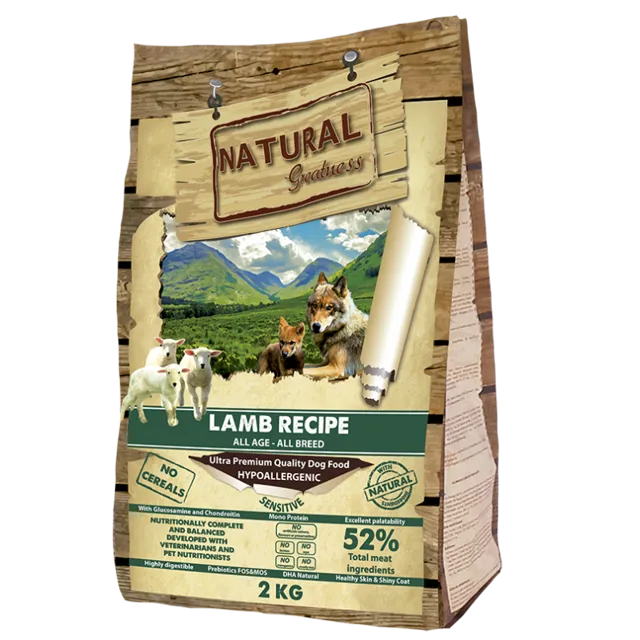
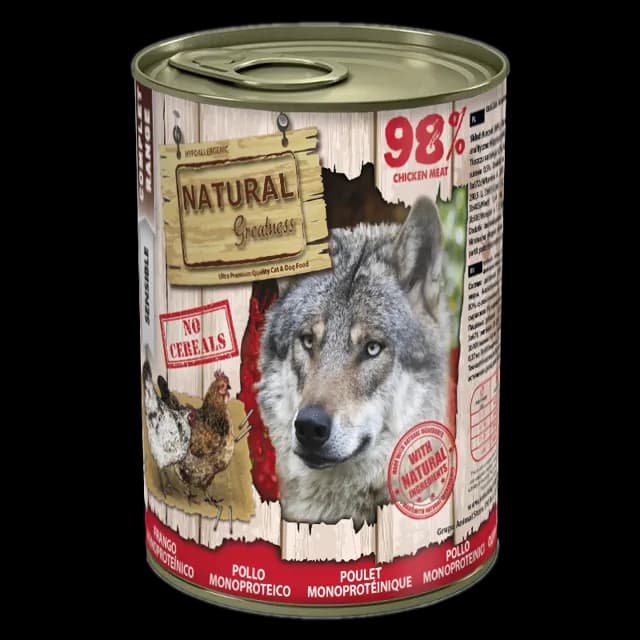
Natural Greatness Ultra Premium All Age & Breed: Lamb Recipe review
Flavour
Natural Greatness All Age & Breed is a two recipe range written to feed a household rather than a life stage. The lamb builds on 24% dehydrated lamb and 11% fresh, with carrot, pumpkin, apple, blueberry, tomato and spinach worked through the list. The Wild recipe piles three dehydrated birds together at 29% and adds fresh rabbit at 10%, which makes it the meatier and more energetic of the two. The lamb sits in our Good band and the Wild recipe a step above it in our Excellent band.
Our view
Likely to suit
One bag that works for every dog in the kitchen is a genuinely useful thing when there is more than one bowl to fill.
- Households with a puppy and an old dog eating side by side, since both recipes cover every life stage
- Dogs that do better on a red meat than a bird, with the lamb recipe leading on dehydrated lamb at 24% and fresh lamb at 11%
- Hard working dogs that burn through their food, because the Wild recipe declares 33.0% protein and 19.0% fat
- Anyone who wants no cereal in the bowl, since the starch in both recipes comes from peas and potato
- Ageing dogs, with glucosamine at 650 mg/kg and chondroitin at 150 mg/kg printed on both labels
Worth watching
Give the label a moment on these points before the first bag arrives.
- One 29% figure covers duck, turkey and chicken together in the Wild recipe, so the share of each bird stays hidden
- The Wild recipe's poultry oil at 12% names no bird, and that matters when a dog has a known poultry problem
- Chicken oil at 11% runs through the lamb recipe as well, so neither bag is genuinely free of chicken
- No calcium figure appears on either label, and that is the number to get from the maker before feeding a big breed puppy through its growth
Written by our editorial team. Independent guidance, not veterinary advice.
How this scores
How we scoreThe Details
Dog fit
One bag that works for every dog in the kitchen is a genuinely useful thing when there is more than one bowl to fill. Give the label a moment on these points before the first bag arrives.
Dry
Puppy, Adult, Senior
Medium
Lamb
The score, in context
The lamb recipe earns our Good band, the ground most adult dry food occupies, and the Wild recipe steps a band above it into Excellent. The two are closer than that sounds, and the reason for the gap is not what you would expect. The Wild recipe carries more meat and more protein, and the space between them opens on nutritional balance, which reads Excellent there against Good on the lamb; on transparency both read Outstanding. The lamb tells you exactly what is in it.
Both are built on dehydrated meat rather than fresh headline weights, and both keep carbohydrate under the level typical of the category, so neither reads as a food coasting on starch.
What's in it
Ingredients, as declared: Dehydrated lamb meat (24%), Fresh lamb meat (11%), Chicken oil (11%), Peas, Potato, Lamb liver hydrolyzate (3%), Carrot, Pumpkin, Potato protein, Yeast, Beet pulp, Salmon Oil (3%), Flaxseed, Mixed fruits (Apple and Blueberries) Mixed vegetables (Tomato and Spinach), Algae, Mannan-oligosaccharides (MOS 0.1%), Inulin (FOS 0.1%), Yucca schidigera, Rosemary, Parsley, Glucosamine 650 mg/kg, Chondroitin 150 mg/kg.
Named ingredients
Nutritional additives
Vitamin a 20000 IU, Vitamin D3 2000 IU, Vitamin E 500 mg, Iron (Sulphate Monohydrate) 75 mg, Iodine (Potassium Iodide) 3.5 mg, Copper (Sulphate Pentahydrate) 10 mg, Manganese (Sulphate Monohydrate) 7.5 mg, Zinc (Oxide) 120 mg, Selenium (Sodium Selenite) 0.15 mg, Taurine 700 mg, L Carnitine 30 mg.
Ingredient notes
The construction is the same in both recipes: dehydrated meat first, then a starch, then an animal oil high enough to matter. Dried meat at the top of a kibble list is the more reliable sight. Its water is gone before anyone works out the percentage. Fresh meat sheds weight in the oven, so an 11% fresh lamb entry does less for the finished food than the figure suggests.
The lamb recipe is the more transparent of the two and the more colourful. Lamb liver hydrolysate at 3% is there to make the food taste of something a dog wants, and salmon oil at 3% and flaxseed bring the omega 3s. Carrot, pumpkin, apple, blueberry, tomato, spinach and algae give it a genuine plate of plants, not a token dusting. Protein converts to 31.5% of dry matter and carbohydrate to 40.2%, well below the 46.2% typical of adult dry food.
The Wild recipe is the muscular one. Its dehydrated block of duck, turkey and chicken runs to 29%, fresh rabbit adds 10%, and hydrolysed chicken liver at 4% deepens the flavour, giving 33.0% protein and 19.0% fat for 405 kcal per 100g. Carbohydrate drops to 33.1% of dry matter, which is a genuinely meat forward figure for a dry food. What that construction gives up is precision: the three birds share one number, poultry oil at 12% names none of them, and a dog with a bird sensitivity is left guessing.
Behind the meat, both labels do the same sensible things. Beet pulp supplies fermentable fibre, yeast and potato protein fill in the middle, and FOS and MOS act as prebiotics for the bacteria that keep a gut settled. Yucca schidigera is a practical addition, aimed at the smell of the stools. Rosemary and parsley close the lamb list, and rosemary also keeps the fats from turning rancid.
Taurine is dosed on both, at 700 mg on the lamb and 750 mg on the Wild recipe, which supports the heart and is worth having on a grain free label. Iron at 75 mg, zinc at 120 mg and iodine at 3.5 mg per kilo: each trace mineral gets its own printed dose. The forms are oxides and sulphates, not the chelates a dog absorbs most easily. Neither label prints a calcium figure, which is the one gap that matters on a bag sold for growth.
How this variety differs
The named and colourful one, with dehydrated lamb at 24%, fresh lamb at 11% and lamb liver hydrolysate at 3%, so the red meat is the only land animal in the recipe. The fats come from chicken oil at 11% and salmon oil at 3%, with carrot, pumpkin, apple, blueberry, tomato, spinach and algae making up the plant side. It sits at 29.0% protein and 17.0% fat for 385 kcal per 100g.
Price and value
Both recipes are sold in 2kg and 10kg bags.
As a guide, a 15kg adult dog in moderate condition would eat about 218 grams a day of the lamb or about 207 grams of the Wild recipe. Both portions come off around 840 kcal a day (110 × bodyweight^0.75, the standard maintenance estimate). The labels are a little more sparing for a quiet dog of that weight, asking 161 grams and 145 grams respectively, so let the waistline settle where your dog belongs between the two.
Nutritional analysis
Declared analysis
29%
17%
2.5%
6.5%
Dry weight
31.5%
18.5%
2.7%
7.1%
40.2%
As-fed composition
Estimated breakdown of the finished product by ingredient category, from the declared ingredient list and ingoing weights. These are estimates, not measurements.
38%
37.2%
8.8%
14%
2%
Pricing & size
- Pack size
- 2 y 10 kg.
- Retailer pricing
- Coming soon
Live retailer pricing is not yet available for this food. Prices, cost per day and where to buy will appear here once retailer data is live.
Ingredients and nutrition are taken from manufacturer data. Retailer pricing is not yet live for this food.
Related dog food guides
Ranked shortlists that include foods like this one.