

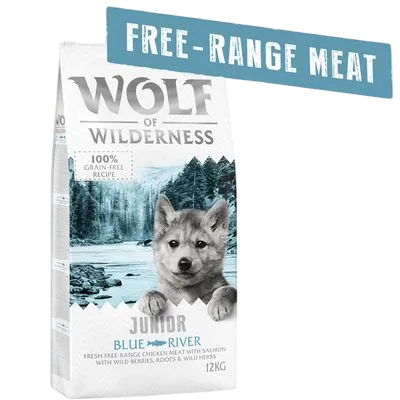

Wolf Of Wilderness
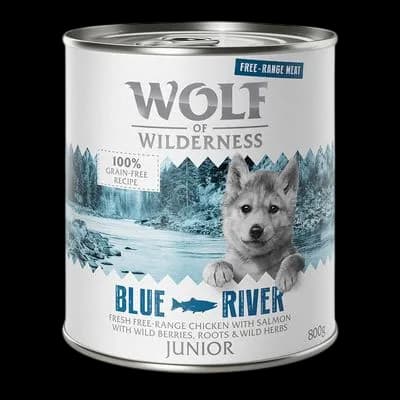
Wolf Of Wilderness Dry Junior: Blue River review
Wolf Of Wilderness Dry Junior takes the brand's grain-free, potato-bound recipe and rewrites it for a dog that is still growing. Chicken heads all three labels, the declared protein sits higher than the adult bags manage, and two of the recipes add glucosamine and chondroitin for young joints. All three recipes land in our Good band, and what separates them is worth understanding before you pick.
Our view
Likely to suit
Puppies grow quickly and eat like it, and this range was written for that stage from the start.
- Owners of growing dogs who want more protein than an adult bag offers, declared at 30% or 31% across the three recipes
- Puppies that do better with no cereal in the bowl, as potato flakes take the starch job in all three
- Young dogs whose owners like joint support started early, with glucosamine and chondroitin printed on Blue River and Wild Hills
- Households with an adult dog in the mix, because Green Fields and Wild Hills are both labelled for the two life stages
Worth watching
Growth is the fussiest stage there is to feed, so a few label facts deserve a proper look.
- Calcium matters more than any other figure when a puppy is heading for a large frame, and none of the three declares it, so have a word with the maker before you commit
- Salmon oil runs through all three as the omega source, so no recipe in this range suits a puppy kept off fish
Written by our editorial team. Independent guidance, not veterinary advice.
How this scores
How we scoreThe Details
Dog fit
Puppies grow quickly and eat like it, and this range was written for that stage from the start. Growth is the fussiest stage there is to feed, so a few label facts deserve a proper look.
Dry
Puppy
Chicken
The score, in context
All three recipes settle in our Good band, and so does the typical adult dry food. The spread is no mystery once you read the lists. Blue River declares more protein than the other two, with dried salmon protein at 10% behind its fresh chicken. Wild Hills spreads its animal content across chicken, duck and a hydrolysed liver palatant. Green Fields leans harder on pea protein and poultry fat, and its pillars come back Good for protein and processing, for nutritional balance and for value, with transparency a step up at Excellent. Treat the difference as construction rather than as a warning; these are recognisably the same food, built with different care.
What's in it
Ingredients, as declared: Fresh free-range chicken meat* (33%), potato flakes, poultry protein (18%, partially dried and hydrolysed), dried salmon protein (10%), salmon oil, dried beet pulp, dried apple, linseed, dried brewer's yeast, dried yeast cell walls (0.2% beta-glucans and mannan oligosaccharides), algae meal (0.1%), dried wild berries (total 0.3% currants, aronia berries), chicory inulin, dried herbs (total 0.2%: dandelion root, camomile, nettle), glucosamine from animal tissue (0.04%), chondroitin sulphate (0.02%), *Chicken from premium animal husbandry - with more space, more bedding and access to open, predominantly vegetated areas.
Named ingredients
Nutritional additives
- **Nutritional additives:** Vitamin A (15,000 IU), vitamin D3 (1600 IU), vitamin E (300 IU), vitamin C (200mg), vitamin B1 (13mg), vitamin B2 [riboflavin] (15mg), vitamin B6 [pyridoxine hydrochloride] (10mg), vitamin B12 (200mcg), niacin (40mg), calcium-D-pantothenate (40mg), biotin (350mcg), folic acid (1.3mg), choline chloride (2500mg), copper [cupric(II)-sulphate-pentahydrate] (12.5mg), zinc [zinc sulphate monohydrate] (100mg), zinc [zinc chelate of glycine hydrate] (50mg), manganese [manganous(II)-sulphate monohydrate] (30mg), iron [ferrous(II)-sulphate-monohydrate] (250mg), iodine [calcium iodate anhydrous] (2.5mg), selenium [sodium selenite] (0.4mg). - **Technological additives:** Antioxidants.
Ingredient notes
Fresh chicken opens every label, at 33% on Blue River, 26% on Wild Hills and 25% on Green Fields, and Blue River's is stated as free-range. Much of that fresh weight leaves as steam in the oven, so the dried entry behind it matters just as much. Blue River puts poultry protein at 18% and dried salmon protein at 10% there, and Wild Hills chicken protein at 12% with poultry and duck proteins behind it. Green Fields has poultry protein at 15% with dried lamb protein at 4%. Protein converts to 33.7% of dry matter on Blue River and 32.6% on the other two.
Potato flakes bind all three recipes and nothing cereal appears anywhere. Peas and pea flour turn up in Wild Hills, pea protein in Green Fields. Read that last one twice: refined pea protein pushes the protein figure up without putting any more animal in the bowl.
Joint support is the clearest split in the range. Blue River prints glucosamine at 0.04% and chondroitin sulphate at 0.02%, Wild Hills lists both without percentages beside them, and Green Fields carries neither. For a large-breed pup whose frame is going to ask a lot of its joints later, that is a real difference between the bags.
The extras are where the range shows its character. Wild Hills adds hydrolysed liver at 2% purely to keep the bowl interesting, then sea buckthorn at 0.2%, ginger root at 0.1% and Mojave yucca. Yucca is there for the smell of what the garden gets. Blue River works algae meal at 0.1% in as a marine source, and all three lean on brewer's yeast for B vitamins and on yeast cell walls at 0.2% for the prebiotic fraction.
The wild berries at 0.3% and the herb blends at 0.2% are the range's flourish. They give the labels their character and they do no harm, but a puppy grows on the meat, the minerals and the fat, not on the camomile.
The trace minerals come mostly as sulphates with a chelated zinc alongside, the form that tends to be absorbed better of the two. Selenium is declared as sodium selenite, the commoner of the two selenium forms permitted here; the yeast-bound version is usually better absorbed, and plenty of well-made foods use the selenite regardless.
How this variety differs
The only recipe here labelled for puppies alone, and the one with the most protein at 31% declared. Its chicken is free-range and said to be so on the label, with dried salmon protein at 10% behind the fresh meat. Both joint entries carry a dose, glucosamine at 0.04% and chondroitin sulphate at 0.02%.
Price and value
Blue River is £3.50 a kilo, with Green Fields and Wild Hills both at £4.17.
As a guide, a 15kg dog in moderate condition eats about 220 grams a day of Green Fields or Wild Hills. That works out at £0.92, assuming around 840 kcal a day (110 × bodyweight^0.75, the standard maintenance estimate). A growing puppy eats more than that against its bodyweight, so treat the figure as a starting point and go by the label's chart for the adult weight you are expecting.
Nutritional analysis
Declared analysis
31%
15%
2.5%
7.2%
Dry weight
33.7%
16.3%
2.7%
7.8%
39.5%
As-fed composition
Estimated breakdown of the finished product by ingredient category, from the declared ingredient list and ingoing weights. These are estimates, not measurements.
61.2%
25.4%
3.4%
5.8%
4.1%
Pricing & size
- Retailer pricing
- Coming soon
Live retailer pricing is not yet available for this food. Prices, cost per day and where to buy will appear here once retailer data is live.
Ingredients and nutrition are taken from manufacturer data. Retailer pricing is not yet live for this food.
Related dog food guides
Ranked shortlists that include foods like this one.