



Lukullus
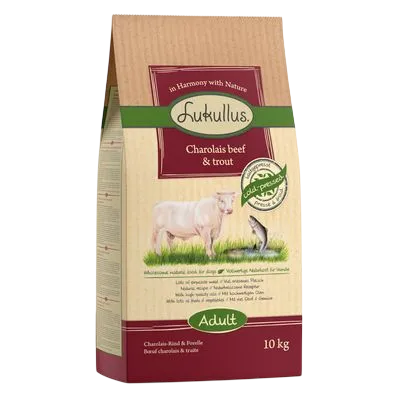
Lukullus Adult Dry: Charolais Beef & Trout review
Lukullus Adult Dry is three cold-pressed recipes with a distinctly European kitchen behind them. Each leads on a dried, named meat, sometimes down to the breed of cattle or duck. Rice, potato or maize carries the carbohydrate, and the tail fills up with linseed, herbs, seaweed, hemp seed and green lipped mussel. Fat is kept modest across all three and protein sits in the high twenties on a dry matter basis, which makes these steady, moderate bowls rather than rich ones. All three land in our Good band.
Our view
Likely to suit
Your dog may do better on an even-tempered bowl than a rich one, and that is what this range is for.
- Dogs that could stand to lose a little, since fat converts to between 10.3% and 10.9% of dry matter across the three recipes
- Quick eaters and gulpers, since cold-pressed pellets crumble once wet and do not swell the way conventional kibble does
- Older dogs alongside adults, with all three recipes labelled for both
- Owners who like a joint extra, since two recipes carry green lipped mussel extract at 0.5% and the third carries mussel meat extract
- Dogs that suit a varied carbohydrate rather than one cereal, given rice, maize, millet, potato and sweet potato spread across the range
Worth watching
Look closely at a few entries on these labels before you choose between them.
- Poultry fat and hydrolysed poultry liver appear without the bird being named, so the Barbary Duck & Lamb and the Charolais Beef & Trout cannot anchor a strict elimination diet
- Egg powder is in two of the three recipes, one to check on if your dog reacts to egg
- Carbohydrate carries a bigger share here than in most cold-pressed food, converting to between 47.7% and 51.6% of dry matter against a category figure of 43.2%
Written by our editorial team. Independent guidance, not veterinary advice.
How this scores
How we scoreThe Details
Dog fit
Your dog may do better on an even-tempered bowl than a rich one, and that is what this range is for. Look closely at a few entries on these labels before you choose between them.
Cold pressed
Adult, Senior
Toy, Small, Medium, Large, Giant
Beef
The score, in context
Our Good band takes all three recipes, which is where the typical cold-pressed food sits too, though these come in a shade below that midpoint. Named meats with printed percentages, a proper spread of oils and a genuinely interesting supporting list earn the band. The carbohydrate share and the unnamed poultry entries keep them from climbing further inside it. The Barbary Duck & Lamb finishes highest of the three, with the other two close behind, so nothing here rests on picking the right one.
Cold pressing is a strong field to be measured against, and a band shared with the category's middle is a solid outcome. These are foods built to be fed easily and daily, and that is what they do.
What's in it
Ingredients, as declared: Dried beef (26%), rice (13%), maize (13%), dried trout (13%), rapeseed oil (5%), seaweed meal, linseed (4.7%), dried apple pomace (4%), dried beet pulp, herb mix (3.5%), sunflower oil, egg powder, hemp seed (1.5%), hydrolysed poultry liver, minerals, green-lipped mussel extract (0.5%), yucca schidigera extract, blueberries (0.3%).
Named ingredients
Nutritional additives
Additives per kg:
Ingredient notes
Cold pressing shapes everything else. The pellets go through a low temperature press, with none of the cooking and expanding a kibble gets. In water they break apart and do not swell. In the bowl they behave exactly as a dry food does. The format has a long following in Germany and the Netherlands, and this range reads like it was written for that audience.
Before it reaches the press the meat is dried and ground, and that changes how the percentages should be read. Dried beef at 26%, dried duck at 21% and Angus beef at 19.3% each stand for a good deal more fresh meat than the number suggests, because the water came out first. Protein lands between 27.1% and 28.3% of dry matter, and the naming is unusually specific, with Angus and Charolais cattle and Barbary duck all called out.
The carbohydrate side is where these recipes differ most from a meat-led food. Wholegrain rice, maize, potato, potato flakes, sweet potato and millet appear across the three, and carbohydrate converts to between 47.7% and 51.6% of dry matter, above the 43.2% a cold-pressed food typically carries. Millet is worth a word of its own: it is gluten free and generally easy on a dog's digestion, and it reads as a deliberate choice.
The character of each recipe sits in the tail of its list. Linseed and hemp seed bring omega 3 fats, seaweed contributes iodine and trace minerals, apple pomace and beet pulp add fibre, and yucca extract turns up on all three. The Angus recipe goes further than the others with fennel seed, dried peat, medicinal clay and algal lime. That last one is a calcium source derived from seaweed, not from a mineral.
Two entries are worth naming for the honesty they lack. Poultry fat on the Barbary recipe and hydrolysed poultry liver on both it and the Charolais leave the bird unnamed. That is standard practice in European labelling, but it does mean a dog reacting to chicken, turkey or goose cannot be matched to those two recipes with confidence. Everything else on all three lists is specific, so it stands out.
One figure needs its basis said out loud: none of these labels declares a moisture content, so the dry matter column is built on the 8% figure standard for a pressed food. The conversions are reliable enough to compare recipes against each other, and the declared as-fed analysis is the harder number of the two.
How this variety differs
Dried beef at 26% and dried trout at 13% make this the meatiest label of the three, with rice and maize at 13% each carrying the starch and rapeseed oil at 5% the fat. Protein converts to 28.3% of dry matter and ash to 4.9%, the lightest mineral load in the range, at 342 kcal per 100g.
Price and value
The Charolais Beef & Trout is £4.33 a kilo, the Barbary Duck & Lamb £5.33 and the Angus Beef & Duck £6.33. Bags run from 1.5kg to 10kg, and the Charolais is also sold as four 1.5kg bags together.
For a 15kg adult dog in moderate condition the standard maintenance estimate of 110 × bodyweight^0.75 gives about 840 kcal a day. A day's feeding then comes to £1.06 on the Charolais, £1.36 on the Barbary Duck & Lamb and £1.62 on the Angus Beef & Duck.
Nutritional analysis
Declared analysis
26%
10%
4%
4.5%
Dry weight
28.3%
10.9%
4.3%
4.9%
51.6%
As-fed composition
Estimated breakdown of the finished product by ingredient category, from the declared ingredient list and ingoing weights. These are estimates, not measurements.
43%
31%
8.6%
6.6%
10.7%
Pricing & size
- Pack size
- New Recipe! 1.5kg, New Recipe! Economy Pack: 4 x 1.5kg, New Recipe! 10kg
- Retailer pricing
- Coming soon
Live retailer pricing is not yet available for this food. Prices, cost per day and where to buy will appear here once retailer data is live.
Ingredients and nutrition are taken from manufacturer data. Retailer pricing is not yet live for this food.
Related dog food guides
Ranked shortlists that include foods like this one.