


Skip to content
Off the Leash
Frolic Complete – —

Frolic

Frolic Complete review

22.8/100Poor
WetAdult

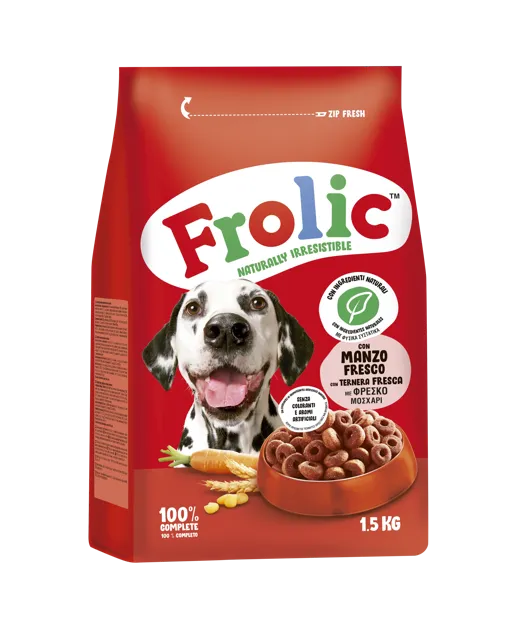
Frolic Complete is a semi-moist food, the halfway format: soft pieces that pour straight from the bag and store like kibble, but chew like something much gentler. There are two recipes, a beef version listed for adult dogs of every size and a chicken-flavour Mini for small breeds. Most of the label speaks in category terms, with wheat, the headline meat and a vegetable each pinned at 4%. Both recipes sit in our Poor band, a reading driven by the vague wording and the size of the cereal share, with nothing alarming in the food itself.

Where to buy: coming soon
Live retailer pricing is coming soon. Once we have prices from UK retailers, the best price, cost per day and where to buy will appear here.

Our view

Likely to suit

If crunchy biscuit is the sticking point in your house, the texture here is the whole appeal.

  • Dogs that struggle with hard kibble through age or dental history or simple preference, since every piece is soft from the bag
  • Owners who want dry-food convenience without the crunch, with nothing to soak or warm and nothing to refrigerate
  • Small dogs, who get their own Mini recipe in an 800g bag sized to suit
  • Adult dogs of every size on the beef recipe, which is listed from toy breeds to giants

Worth watching

This label asks a little more reading than most, so give this section a moment before you decide.

  • Most entries are category terms such as meats and animal by-products, so beyond the named 4% of beef or poultry the exact animals and cereals can change from batch to batch
  • That matters most for strict avoidance feeding, which needs every species named, and a category-style label does not set out to do that
  • Fish oil and fish by-products run through both recipes, so neither version is fish free
  • The Mini recipe adds milk and dairy products along with sugars and colourants, none of which appear on the beef label

Written by our editorial team. Independent guidance, not veterinary advice.

How this scores

How we score
22.8/100Poor
Protein and processingPoor
Nutritional balancePoor
TransparencyAverage
ValuePoor

The Details

Dog fit

If crunchy biscuit is the sticking point in your house, the texture here is the whole appeal. This label asks a little more reading than most, so give this section a moment before you decide.

Food type

Wet

Life stage

Adult

Breed size

Toy, Small, Medium, Large, Giant

Main protein

Beef

The score, in context

Both recipes sit in our Poor band, and they arrive there together. Our scoring gives credit where a label names its ingredients, where meat outweighs cereal and where the maker shows its workings, and a category-declared recipe built mostly on grain collects little of that credit. The band describes the label more than the dinner: this is an everyday food doing an everyday job, and a dog that is settled and well on it is not doing anything wrong.

What's in it

Ingredients, as declared: grains (includes 4% wheat), by-products of vegetable origin, meats and animal by-products (includes 4% fresh meat, includes 4% beef), oils and fats (includes 1% sunflower oil, includes 0.25% fish oil), vegetables (4% carrots), mineral substances, vegetable protein extracts, fish and fish by-products.

Named ingredients

Grains (includes 4% wheat), by-products of vegetable origin, meats and animal by-products (includes 4% fresh meat, includes 4% beef), oils and fats (includes 1% sunflower oil, includes 0.25% fish oil), vegetables (4% carrots), mineral substances, vegetable protein extracts, fish and fish by-products.

Nutritional additives

- **Nutritional additives:** Vitamin A: 5880 UI, Vitamin D3: 1470 UI, Vitamin E (alpha-tocopherols): 106 mg. Calcium iodate anhydride: 2.2 mg, Cupric sulfate pentahydrate: 19 mg, Manganese sulfate monohydrate: 158 mg, Sodium selenite: 0.76 mg, Zinc sulfate monohydrate: 266 mg. _("UI" for IU, and "Calcium iodate anhydride" for calcium iodate anhydrous, are the retailer's translations and are left as published.)_

Ingredient notes

Semi-moist sits between kibble and a can. Moisture is declared at 18% in the beef recipe, and at 20% in the Mini. That is what keeps the pieces soft and pliable. The food still stores like a dry one, and it pours and portions like one too. A dog that finds biscuit hard going is exactly who the format is for.

The list is written mostly in legal category terms: grains, meats and animal by-products, by-products of vegetable origin. Categories let a maker vary the exact species and cereals between batches, which is why so few entries carry a name and a figure. The ones that do are wheat at 4%, the headline meat at 4%, a vegetable at 4%, sunflower oil at 1% and fish oil at 0.25%. Nothing here is hidden so much as declared broadly, and it helps to know which kind of label you are reading.

By-products deserve a fairer hearing than the word usually gets. The term stretches from nutrient-dense organ meat to far plainer fractions, and a category label gives no way of telling where in that stretch any given batch sits. The same reading applies on the vegetable side.

The analysis fills in what the list leaves open. On a dry matter basis the beef recipe holds 20.7% protein and the Mini 21.2%, modest figures either way. Carbohydrate is estimated at 49.5% and 48.8% of dry matter, so cereal carries most of the bowl. Fat is livelier: 20.1% of dry matter in the beef recipe, 18.1% in the Mini. Portions deserve an eye on a less active dog.

The added vitamin and mineral panel is dosed in print: vitamins A, D3 and E, with zinc and manganese behind them. Copper and iodine are there too, and so is selenium. That is the standard supplementation a complete food needs, properly declared, and it is also the part of this label where the declaring is at its most exact.

How this variety differs

The original beef recipe. Beef is named at 4%, alongside 4% fresh meat, within the wider meat fraction, and carrots are the 4% vegetable. It is listed for adults of every size, toy breeds through to giants. It is also the slightly richer of the pair, with fat at 20.1% of dry matter against the Mini's 18.1%. It comes in three bag sizes, the largest 4kg.

Price and value

The beef recipe is £9.46 a kilo across its three bag sizes, the largest of them 4kg. The Mini is £10.99 a kilo from its single 800g bag.

As a guide, a 15kg adult dog in moderate condition works out at about £2.33 a day on the beef recipe and £2.89 a day on the Mini. The basis there is around 840 kcal a day (110 × bodyweight^0.75, the standard maintenance estimate). The label's own guide for the beef recipe feeds 190 grams a day at 10kg.

Nutritional analysis

Declared analysis

Energy
341.5 kcal/100g

Estimated using Modified Atwater factors*

Protein

17%

Fat

16.5%

Fibre

2.5%

Ash

5.5%

Moisture

18%

Dry weight

Protein

20.7%

Fat

20.1%

Fibre

3%

Ash

6.7%

Carbs

49.5%

As-fed composition

Estimated breakdown of the finished product by ingredient category, from the declared ingredient list and ingoing weights. These are estimates, not measurements.

Meat

18.9%

Carbs

69%

Veg

4.3%

Oils

5.5%

Other

2.3%

Pricing & size
Pack size
1,5 Kg · 2,6 kg · 4 KG
Retailer pricing
Coming soon

Live retailer pricing is not yet available for this food. Prices, cost per day and where to buy will appear here once retailer data is live.

Ingredients and nutrition are taken from manufacturer data. Retailer pricing is not yet live for this food.

Related dog food guides

Ranked shortlists that include foods like this one.

All reviews
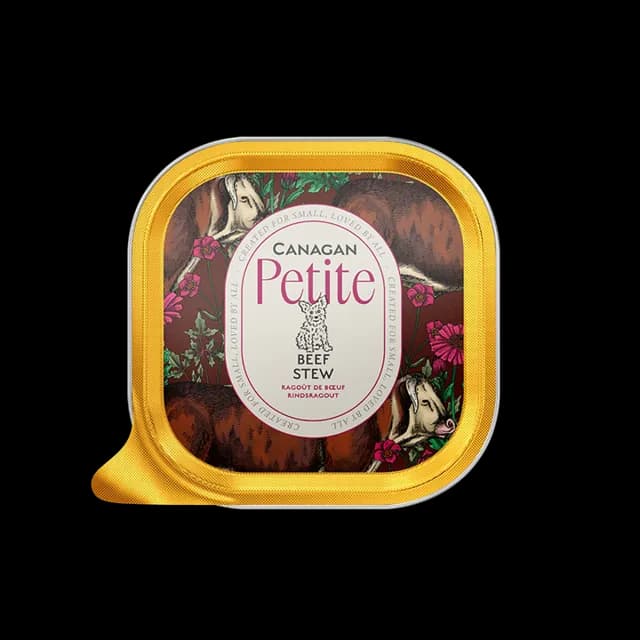
Canagan Petite – Beef Stew Paté
89/100Outstanding
9 varieties
Canagan

Petite

WetAll life stagesSingle protein
View review
Rockster – A Fisherman's Dream
89/100Outstanding
8 varieties

Rockster

Rockster

WetAll life stagesGrain-free
View review

Featured feeding accessories

All feeding accessories

Brackenwood

Slow Feeder Maze Bowl

Slows fast eaters and eases gulping at mealtimes.

From £12.99· 4 retailers
View

Tarn & Co

Raised Double Diner

Height-set stand for easier, tidier eating.

From £28.99· 3 retailers
View

Reviewed by Off the Leash Editorial

Last updated 28 August 2026