

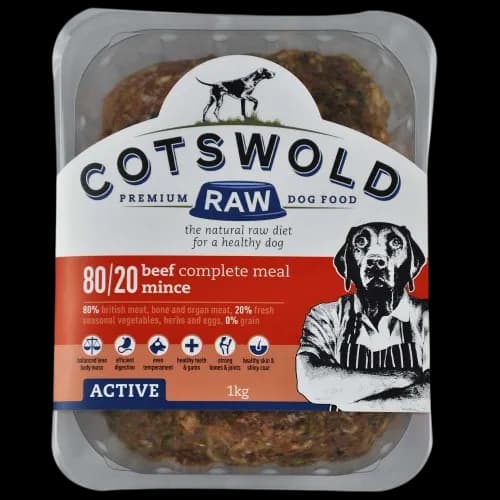

Cotswold Raw
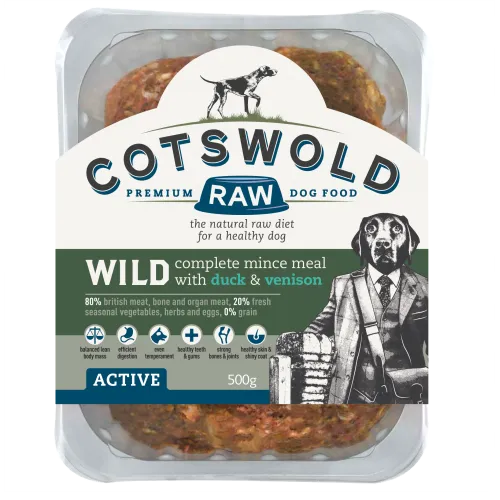
Cotswold Raw Active 80/20 Wild: Duck & Venison review
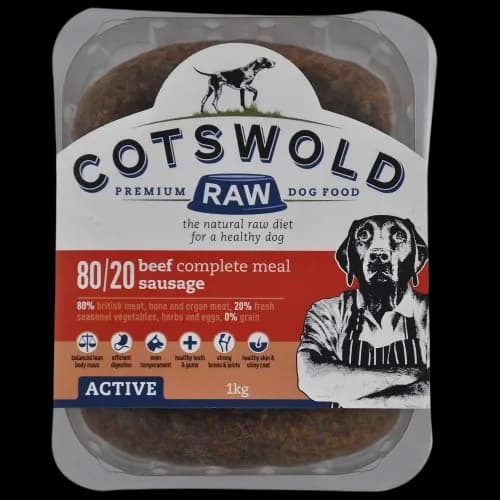
Cotswold Raw Active 80/20 Wild takes the house recipe into game. Venison, wild boar, pheasant, rabbit and duck are paired two and three at a time across four frozen minces, most of them named as British and several of them wild shot. Behind the headline animals, every recipe carries beef heart, liver and kidney. Then comes the same fifth of the bowl, given to carrot, cauliflower, cabbage and broccoli with eggs, flaxseed, kelp, turmeric and herbs behind them, all of it percentaged to two decimal places. All four recipes sit in our Outstanding band.
Our view
Likely to suit
Some dogs have worked their way through the ordinary meats, and this is where you go next.
- Dogs that have run out of everyday proteins, with venison, wild boar, pheasant and rabbit spread across the four
- Owners who want game without sourcing it themselves, since the wild meats arrive already balanced into a complete recipe
- Active dogs in hard condition, with fat between 29.7% and 41.3% of dry matter
- Poultry-fed dogs ready for a change of bird, with duck in three recipes and pheasant in one
- Label readers, since every ingredient down to the spirulina at 0.02% carries a figure
Worth watching
Game reads as exotic, so it is worth being precise about what is actually in each pack.
- Beef heart, liver and kidney run through all four, so none of these can carry an exclusion diet on its own
- The Rabbit & Venison actually leads with British turkey at 25%, ahead of both animals in its name
- Wheatgerm at 0.25% and free range egg at 0.5% in all four
Written by our editorial team. Independent guidance, not veterinary advice.
How this scores
How we scoreThe Details
Dog fit
Some dogs have worked their way through the ordinary meats, and this is where you go next. Game reads as exotic, so it is worth being precise about what is actually in each pack.
Raw
Adult
Toy, Small, Medium, Large, Giant
Venison
The score, in context
Every recipe here sits in our Outstanding band, and so does the raw category's midpoint, so the range is holding a very high line. Given that raw is the toughest company a food can keep on our scoring, four out of four is a strong showing.
Protein and processing, nutritional balance and transparency all read Outstanding on each of the four. The reason is on the label: named animals with their percentages, organ meats itemised, a plant share you can see the whole of, and no premix standing in for any of it. Carbohydrate converts to between 2.6% and 6.8% of dry matter, either side of the 5.0% typical of raw food, and all of it comes from vegetables.
What's in it
Ingredients, as declared: Wild British venison with bone (35%), British duck with bone (30%), beef heart (5%), beef liver (5%), beef kidney (5%), seasonal vegetables (carrots (5%), cauliflower (5%), cabbage (5%), broccoli (5%), free range eggs (0.5%) milled flaxseed (0.5%), wheatgerm (0.25%), kelp (0.15%), turmeric (0.12%), milk thistle (0.05%), dandelion (0.05%), nettle leaf (0.05%), alfalfa (0.025%), spirulina (0.02%), thyme (0.02%).
Named ingredients
Nutritional additives
No separate additives panel is published — the herbs and supplements are inline in the ingredients list, and the brand states "absolutely nothing is added that is not listed on the label".
Ingredient notes
The pairings are the point of this range. Duck & Venison runs venison at 35% with duck at 30%, and Wild Boar & Duck takes the same shares in that order. Wild Range Pheasant & Duck splits 30% and 30%, while Rabbit & Venison spreads itself across turkey at 25%, venison at 20% and rabbit at 20%. Each then adds beef heart, liver and kidney, at 5% each in three of them and with the heart doubled to 10% in the pheasant recipe.
That beef organ set is the honest caveat on an otherwise novel line-up. It gives Cotswold a consistent, nutrient-dense organ profile in every pack, and organ meat is one of the richest micronutrient sources an animal has. The catch is that a dog kept strictly away from beef cannot use these, however unusual the headline meats are.
Three of the four say with bone against their named meats. With no mineral premix in the recipe, that bone is the calcium. The Wild Boar & Duck label does not use that phrase against either animal. Its ash reads 7.9% of dry matter, in line with the rest of the range, so the bone appears to be there even though the wording does not spell it out. Not one of the four labels prints a calcium figure.
Venison, boar, pheasant and rabbit are all lean, dense meats that most dogs have never eaten, and that is exactly what makes them useful. A protein a dog has had no previous exposure to cannot be one it has already reacted to, which is why novel meats are the usual starting point when the everyday ones have caused trouble. Rabbit in particular is about as close as a farmed ingredient gets to what a dog would take for itself.
The plant fifth is identical across the range. Carrot, cauliflower, cabbage and broccoli take 5% apiece. Then come free range eggs at 0.5% and milled flaxseed at 0.5%, followed by wheatgerm at 0.25%, kelp at 0.15% for iodine and turmeric at 0.12%. Milk thistle, dandelion, nettle leaf, alfalfa, spirulina and thyme trail away to 0.02%. Kelp aside, these bottom entries are seasoning rather than working doses, and the printed percentages are candid about it.
Nothing is added beyond the label, so no vitamin and mineral premix appears anywhere here, and the analyses reflect a diet of meat, bone, organ and vegetables. Protein converts to between 42.7% and 54.5% of dry matter, fat to between 29.7% and 41.3%, and energy sits between 182 and 198 kcal per 100g.
How this variety differs
Wild British venison with bone at 35% and British duck with bone at 30%, the two richest game meats in the range put together. Fat converts to 41.3% of dry matter against protein at 42.7%. At 198 kcal per 100g it is the densest of the four, so portions run smallest here, and it is the one for a dog that burns what it eats.
Price and value
All four are £7.95 a kilo, in 500g and 1kg packs.
Take a 15kg adult dog in moderate condition at about 840 kcal a day, the standard maintenance estimate (110 × bodyweight^0.75). That puts these recipes at 425 to 462 grams a day, or £3.38 to £3.67. The spread is energy density rather than the per kilo figure, which never changes: the leaner recipes simply feed in larger portions. Cotswold's label guide is 400 grams a day for a 20kg dog.
Nutritional analysis
Declared analysis
12.9%
12.46%
0.4%
2.4%
69.8%
Dry weight
42.7%
41.3%
1.3%
7.9%
6.8%
As-fed composition
Estimated breakdown of the finished product by ingredient category, from the declared ingredient list and ingoing weights. These are estimates, not measurements.
100%
Pricing & size
- Pack size
- 500 g (£4.95), 1 kg (£7.95)
- Retailer pricing
- Coming soon
Live retailer pricing is not yet available for this food. Prices, cost per day and where to buy will appear here once retailer data is live.
Ingredients and nutrition are taken from manufacturer data. Retailer pricing is not yet live for this food.
Related dog food guides
Ranked shortlists that include foods like this one.