


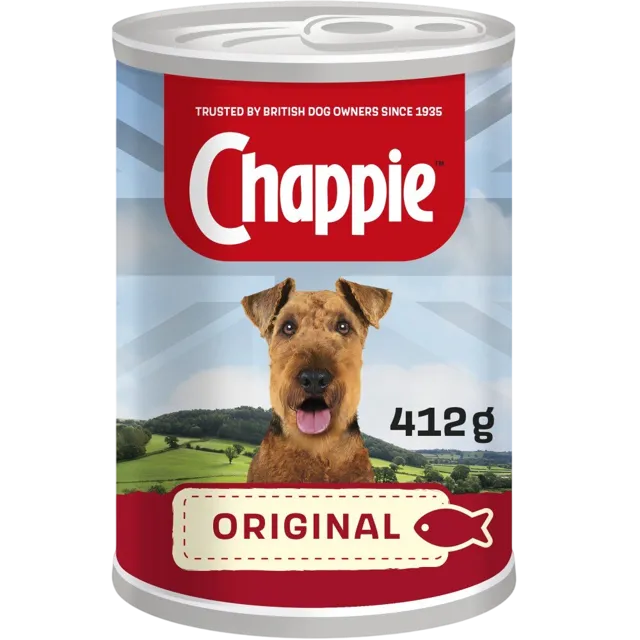

Chappie
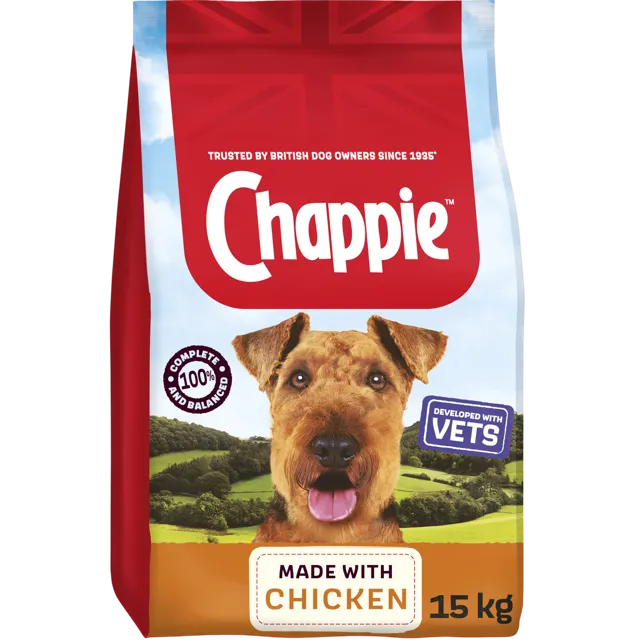
Chappie Dry Food: Made With Chicken review
Chappie Dry Food is a plain, low fat kibble that has been feeding British dogs for generations and has never pretended to be anything more elaborate. Cereals lead both bags, meat and animal derivatives are declared at 15% with 4% of that pinned to a named species, and the rest of the list stays at category level. It sits in our Average band, and that reading is about how plainly and how lightly the recipe is built, not about anything in the bowl. For a dog that thrives on something simple and lean, it remains one of the easiest foods in the country to feed.
Our view
Likely to suit
If your dog does best on food that keeps things simple, this is about as uncomplicated as a bowl gets.
- Dogs that do better on a leaner bowl, since the beef recipe declares 8.0% fat and the chicken just 7.0%
- Owners who want a familiar everyday kibble with a short ingredients list and no surprises in it
- Multi-dog households feeding several mouths the same steady food
- Older dogs taking the day at a gentle pace, given the moderate protein and the low fat behind it
Worth watching
Keep a few label facts in mind before you fill the bowl.
- Only 4% of the 15% meat and animal derivatives is tied to a named species, so an elimination plan wants a label where every animal is named
- Both recipes carry whole wheat inside the cereals entry, one to know if your dog is kept off wheat
- The oils and fats and the derivatives of vegetable origin are given as families, not as single ingredients, so what sits inside them is not on the pack
- Protein is declared at 20.0% in both bags, which is on the gentle side for a working dog or a hard training one
Written by our editorial team. Independent guidance, not veterinary advice.
How this scores
How we scoreThe Details
Dog fit
If your dog does best on food that keeps things simple, this is about as uncomplicated as a bowl gets. Keep a few label facts in mind before you fill the bowl.
Dry
Adult
Toy, Small, Medium, Large, Giant
Chicken
The score, in context
Our Average band is where this one finishes, and the shape of the recipe is what puts it there. Cereals take the top line, the meat is declared as a category with a small named share inside it, and both the fat and the vegetable matter are described by family. The typical adult dry food sits a band above that, in our Good band. Protein and processing and nutritional balance both read Poor on either bag.
What a score cannot pick up is the thing owners actually value here. This is a lean, moderate protein kibble with a very short list, made to the same shape year after year, and plenty of dogs have lived long and comfortable lives on it. Read the band as a comment on how plain the recipe is, not as a warning about the food.
What's in it
Ingredients, as declared: Cereals (including 4% wholewheat* 4%), meat and animal derivatives (15%, including chicken* 4% ), oils and fats, derivatives of vegetable origin, minerals, *natural ingredients.
Named ingredients
Nutritional additives
- **petshop.co.uk** _("Additives per kg: Antioxidants / Nutritional additives")_ — Vitamin A: 6651 IU, Vitamin D3: 817 IU, Vitamin E: 168 mg, Cupric sulphate pentahydrate: 33 mg, Manganese sulphate monohydrate: 300 mg, Potassium Iodide: 1.8 mg, Sodium selenite: 0.3 mg, Zinc sulphate monohydrate: 479 mg - **pet-supermarket.co.uk** _("Nutritional Additives (per kg)")_ — Vitamin A: 11800 IU, Vitamin D3: 1312 IU, Vitamin E: 150 IU, Copper (Copper(Ii) Sulphate Pentahydrate): 4.3mg, Iodine (Potassium Iodide): 1.0mg, Manganese (Manganous Sulphate, Monohydrate): 30.2mg, Selenium (Sodium Selenite): 0.30mg, Zinc (Zinc Sulphate, Monohydrate): 85.4mg. > ⚠ These two additive panels are irreconcilable: Vitamin A 6651 IU vs 11800 IU, zinc 479 mg vs 85.4 mg, > manganese 300 mg vs 30.2 mg. pet-supermarket.co.uk also gives **Vitamin E in IU** where every other > Chappie panel gives it in mg. Recorded as f
Ingredient notes
Cereals lead both bags, with whole wheat named at 4% inside that entry. Cereals as a term stretches across every grain there is, from the best to the plainest, and because the type is not pinned down the mix can shift between batches. Grain carries this recipe, and the estimate says so: carbohydrate at 59.8% of dry matter in the beef, 58.8% in the chicken, against 46.2% for the typical adult dry food.
The meat entry reads meat and animal derivatives at 15%, of which 4% is named, beef in one bag and chicken in the other. That umbrella covers the fleshy parts of slaughtered land animals along with everything derived from processing the carcass. It can be good material or ordinary material, and the pack keeps that to itself. In the beef recipe protein finishes at 21.7% of dry matter, and the chicken reads 22.0%.
Oils and fats, and derivatives of vegetable origin, are the two remaining entries, and both name a family instead of an ingredient. That is the honest limit of this label. You can see the shape of the recipe clearly enough, but not what has been used to build it. That missing detail is the one an owner tracking an intolerance would want most.
Fat is the figure that makes this food what it is. The beef reads 8.0% and the chicken 7.0%. That is genuinely lean for a dry food, and it is the reason so many owners reach for Chappie when a dog needs something plain sitting in their stomach. Fibre is modest too, 2.0% in the beef against 3.5% in the chicken. Neither bag leans on bulk to fill a dog up.
How this variety differs
The chicken bag names chicken at 4% inside the same 15% meat and animal derivatives entry. It is the leaner of the two, 7.0% fat with fibre up at 3.5%. Its cereals include wholewheat as well, so the two recipes are close cousins rather than one being the wheat free alternative to the other.
Price and value
The beef is £2.22 a kilo and the chicken £1.96 a kilo, both sold in 3 kg and 15 kg bags.
As a guide, a 15kg adult dog in moderate condition works out at about 243 grams a day, which comes to £0.54 a day on the beef and £0.48 on the chicken. That assumes a daily requirement of roughly 840 kcal, taken from the standard maintenance sum of 110 × bodyweight^0.75. The beef bag's own table asks 250 grams for a dog of that size, so the two sit close together.
Nutritional analysis
Declared analysis
20%
7%
3.5%
7%
9%
Dry weight
22%
7.7%
3.8%
7.7%
58.8%
As-fed composition
Estimated breakdown of the finished product by ingredient category, from the declared ingredient list and ingoing weights. These are estimates, not measurements.
15%
61.3%
14%
9.8%
Pricing & size
- Pack size
- 3 kg, 15 kg (petshop.co.uk also lists a 28 × 15 kg trade pallet)
- Retailer pricing
- Coming soon
Live retailer pricing is not yet available for this food. Prices, cost per day and where to buy will appear here once retailer data is live.
Ingredients and nutrition are taken from manufacturer data. Retailer pricing is not yet live for this food.
Related dog food guides
Ranked shortlists that include foods like this one.