



Cesar
Cesar Country Stew Trays: Beef, Lamb & Chicken review
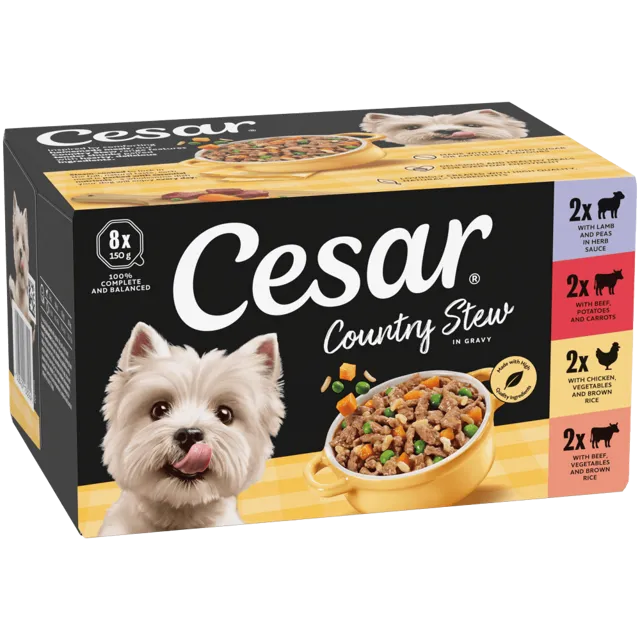
Cesar Country Stew Trays are chunks in gravy, with the chunk making up a little under half of each tray. The labels pin a headline animal at 4% and chicken liver at 4%, then hand everything else to category terms: meat and animal derivatives, cereals, derivatives of vegetable origin. Four selections sit under the range and they do not finish together, with the poultry, beef and lamb trays in our Good band and the other three a step below in Average. The difference is how much each label is willing to name.
Our view
Likely to suit
There is plenty here for the dog who eats with their nose first.
- Fussy eaters who do better with soft chunks in gravy than with anything firmer, since the chunk fills close to half of every tray
- Owners of smaller dogs, as a 150g tray is a serving in itself with nothing to cover and put back in the fridge
- Dogs that take on too little water, with about four fifths of each tray arriving as moisture
- Households that like to rotate the meat, since the selection packs bring several recipes together under one lid
- Dogs that do better on a meat-forward analysis, with protein converting to just under half of dry matter once the water is taken out
Worth watching
For all its dressing, this tray keeps a few things back, and they are best seen before you commit.
- Two names appear at 4% each, the headline animal and the chicken liver, and everything else animal falls under meat and animal derivatives, so no tray here can anchor an elimination diet
- The cereals and the vegetable derivatives go unnamed, which matters if you are avoiding one grain in particular
- At 84 to 89 kcal per 100g, a larger dog needs several trays a day
- The selection packs hold four different recipes under one name, so a dog who must avoid a single animal needs each sleeve read rather than the box
Written by our editorial team. Independent guidance, not veterinary advice.
How this scores
How we scoreThe Details
Dog fit
There is plenty here for the dog who eats with their nose first. For all its dressing, this tray keeps a few things back, and they are best seen before you commit.
Wet
Adult
Toy, Small, Medium, Large, Giant
Chicken
The score, in context
Four selections, four different landings. The poultry, beef and lamb trays come out best, in our Good band; the other three sit a step lower in our Average band, with barely anything between them. Adult wet is a strong shelf with us, and its midpoint reaches our Excellent band, so even the best of these trays sits behind that middle. The analysis is not what holds them back. Protein converts to 47.4% or 48.4% of dry matter depending on the tray, and the estimated carbohydrate sits at 13.9% to 15.3% against 15.8% for typical adult wet food. What holds the range back is the meat, given mostly in category terms. Protein and processing reads Poor on two of the four trays and Average on another, with only the poultry, beef and lamb trays reaching Good on that pillar.
What's in it
Ingredients, as declared: Meat and Animal Derivatives (in the Chunk* 88%, including Lamb 4%, Chicken Liver 4%), Cereals, Vegetables (including Dried Peas 1.2%, equivalent to Peas 4%), Derivatives of Vegetable origin, Minerals, Herbs (Rosemary 0.08%, Parsley 0.02%), 93% natural, Chunk typically 48% of the product, Meat and Animal Derivatives (in the Chunk* 85%, including Beef 4%, Chicken Liver 4%), Cereals (including Dried Carrots 0.6% and Dried Potatoes 1.1%, equivalent to Carrots 4% and Potatoes 4%), Derivatives of Vegetable origin, Vegetables, Minerals, 93% natural, Chunk typically 48% of the product, Meat and Animal Derivatives (in the Chunk* 88%, including Chicken Liver 4%), Cereals (including Brown Rice 1.1%, equivalent to cooked Brown Rice 4%), Derivatives of Vegetable origin, Vegetables (including a mix of Dried Carrots and Peas 0.8%, equivalent to a mix of Carrots and Peas 4%), Minerals, 97% natural, Chunk typically 47% of the product, Meat and Animal Derivatives (in the Chunk* 84%, including Beef 4%, Chicken Liver 4%), Cereals (including Brown Rice 1.1%, equivalent to cooked Brown Rice 4%), derivatives of Vegetable origin, Vegetables (including a mix of Dried Carrots and Peas 0.8%, equivalent to a mix of Carrots and Peas 4%), Minerals, * 93% natural, Chunk typically 47% of the product
Named ingredients
Nutritional additives
Additives per kg:, Nutritional additives:, Vitamin D₃: 269 IU, Vitamin E: 14.6 mg, Copper (Copper(II) sulphate pentahydrate): 1.6 mg, Iodine (Calcium iodate, anhydrous): 0.23 mg, Iron (Iron(II) sulphate monohydrate): 2.9 mg, Manganese (Manganous sulphate, monohydrate): 1.8 mg, Zinc (Zinc sulphate, monohydrate): 16.5 mg
Ingredient notes
Every label in this range is built the same way. There is a chunk, typically 47% to 49% of the tray, and gravy around it. Inside the chunk, meat and animal derivatives run from 81% up to 93% depending on the recipe, and the animals actually pinned by name arrive at 4% each.
Chicken liver at 4% turns up on nearly every sleeve. Few things a maker can put in a wet recipe do as much good as liver. It is dense in B vitamins, copper and iron, and dogs rarely need persuading to eat it. Beside it sit named 4% entries for lamb, beef, turkey, chicken or cod depending on which tray you have picked up.
The rest is categories. Meat and animal derivatives covers any warm-blooded land animal in any proportion, cereals covers any grain, and derivatives of vegetable origin covers almost anything grown. Each is free to move between batches while the printed pack stays exactly as it is. This is standard practice on the mainstream wet shelf, and there is no hygiene concern in it. What it does mean is that the recipe has to be taken on trust.
The analysis reads better than the ingredient list does. Protein converts to 48.4% of dry matter on three of the trays and 47.4% on the poultry selection, with fat between 24.2% and 26.3%. The estimated carbohydrate comes to 13.9% or 15.3%, a shade under the 15.8% the typical adult wet food carries. We arrived at that carbohydrate figure by difference, not by measurement, so treat it as our estimate.
The added panel is brief, and a dose per kilo sits beside each entry: vitamin D3, copper, iodine, iron, manganese and zinc, with vitamin E joining on three of the four trays. Herbs appear at trace level, rosemary at 0.08% and parsley at 0.02%, and they are there for the look of the recipe rather than for your dog.
How this variety differs
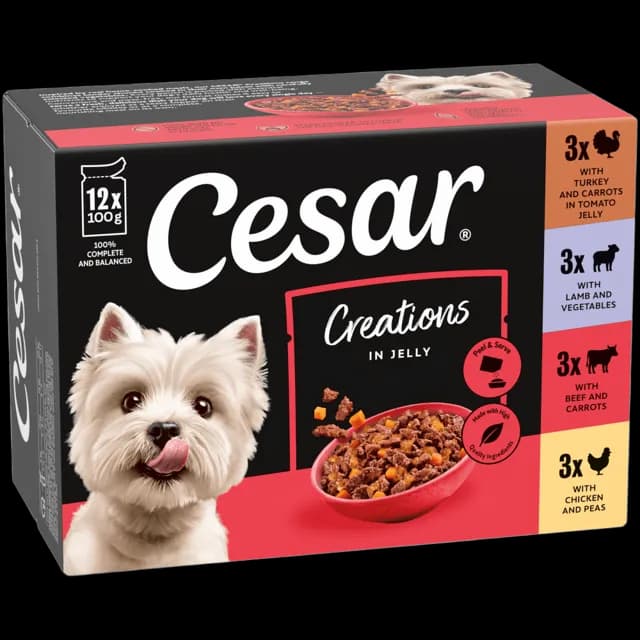
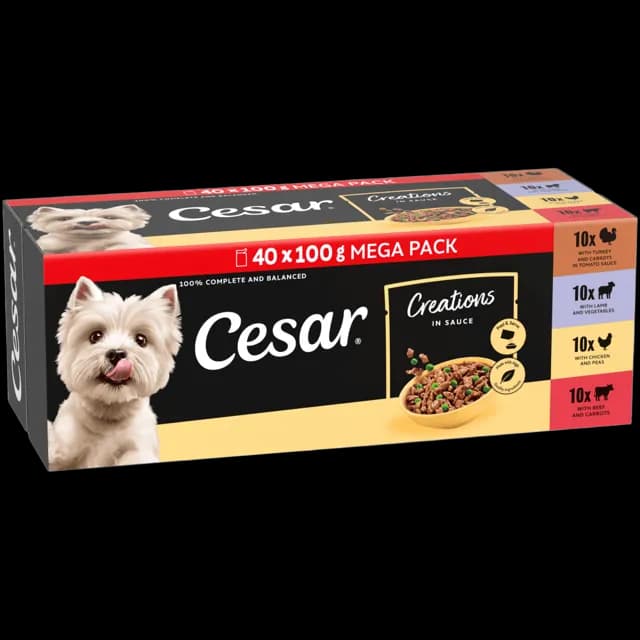
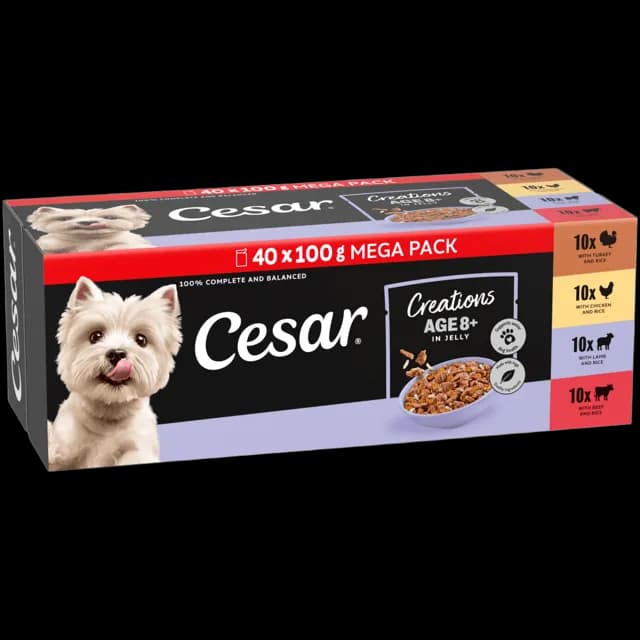
Eight trays across four recipes, with lamb, beef and chicken liver taking turns as the named meat and brown rice, dried carrots, potatoes and peas rotating behind them. Two of the four sleeves name no animal other than chicken liver. If you are steering your dog away from poultry, this box will not serve you well.
Price and value
£5.47 a kilo. The trays are 150g, sold on their own and in packs of 8 and 24.
As a guide, a 15kg adult dog in moderate condition works out at £5.16 to £5.47 a day, or roughly 944 to 1000 grams. Behind that sits the standard maintenance estimate of about 840 kcal a day for a dog that size (110 × bodyweight^0.75). The label's own guide for a 15kg dog is 862.5 to 937.5 grams a day.
Nutritional analysis
Declared analysis
9%
4.5%
0.5%
2%
81.4%
Dry weight
48.4%
24.2%
2.7%
10.8%
13.9%
As-fed composition
Estimated breakdown of the finished product by ingredient category, from the declared ingredient list and ingoing weights. These are estimates, not measurements.
100%
Pricing & size
- Pack size
- 8x150g
- Retailer pricing
- Coming soon
Live retailer pricing is not yet available for this food. Prices, cost per day and where to buy will appear here once retailer data is live.
Ingredients and nutrition are taken from manufacturer data. Retailer pricing is not yet live for this food.
Related dog food guides
Ranked shortlists that include foods like this one.