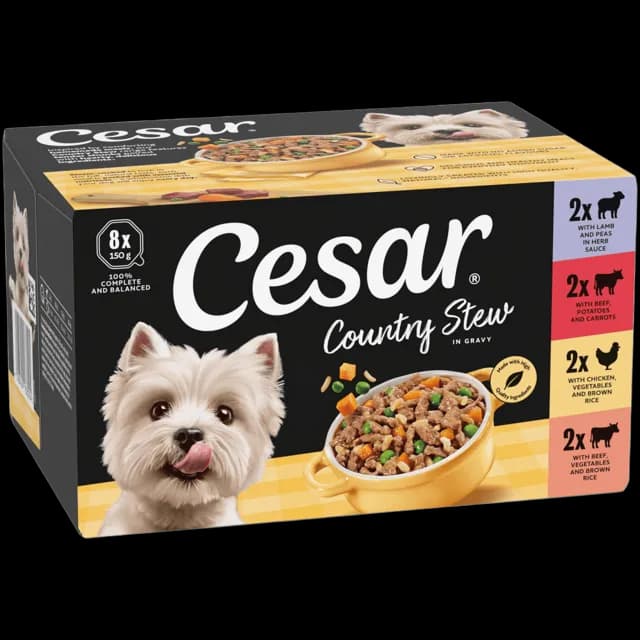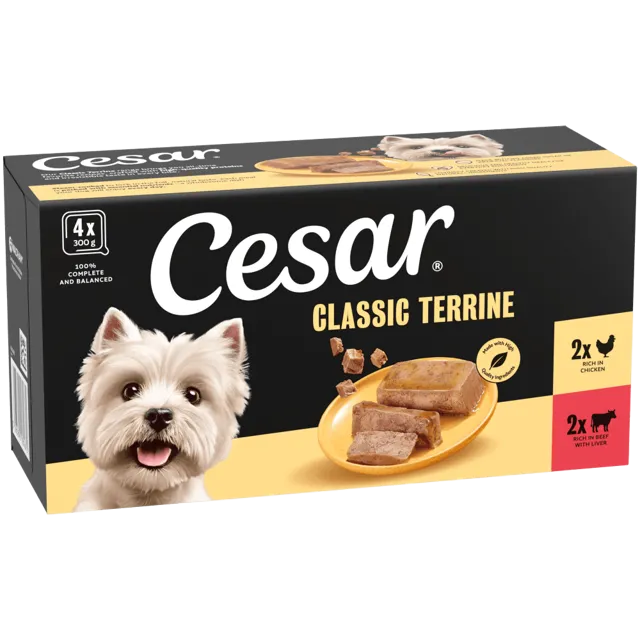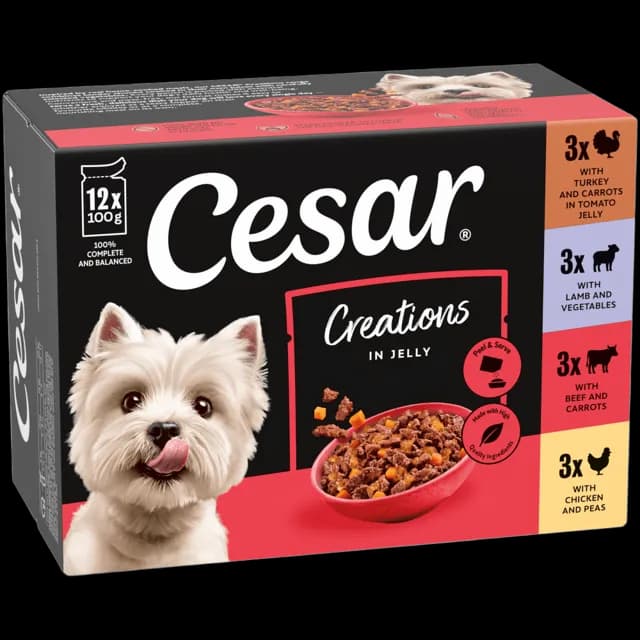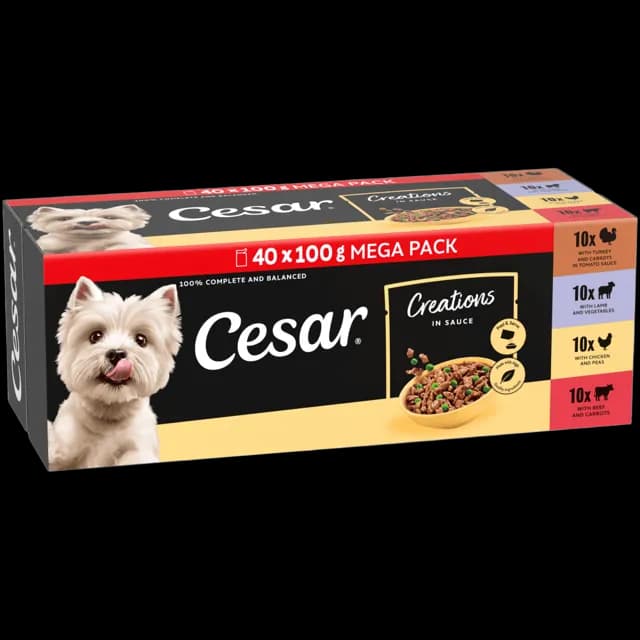




Cesar
Cesar Classic Terrine Trays in Jelly: Beef & Chicken in Jelly review
Flavour
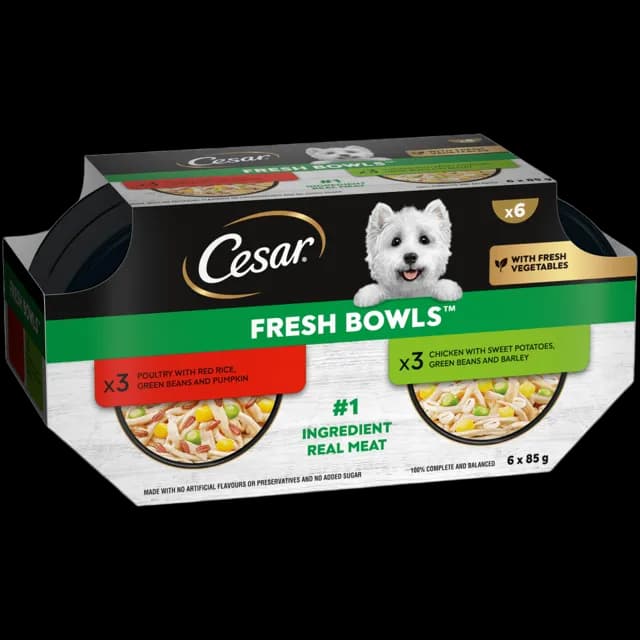
Cesar Classic Terrine trays are single-serve jelly terrines aimed at small dogs, and they are written almost entirely in category language. Meat and animal derivatives make up 60% to 63% of each tray, with one named animal at 14% and sometimes a second at 4%. The rest of the label reads cereals, derivatives of vegetable origin and minerals. The analysis underneath is better than the wording suggests, with protein converting to around half of dry matter and very little carbohydrate. All six trays sit in our Average band, and that placing is about how little the label declares rather than anything worrying in the tray.
Our view
Likely to suit
If your dog is settled on these trays and doing well, nothing here is a reason to change the routine.
- Small dogs, with a sealed tray that is a portion in itself and no tin to cover and keep
- Fussy eaters, because a dog that picks will rarely turn down a jelly terrine
- Older dogs with modest appetites, as these are light trays at 79 to 92 kcal per 100g
- Owners who want a lean wet food, since the carbohydrate estimate runs from 4.1% to 13.5% of dry matter, under the 15.8% typical for adult wet food
- Dogs whose owners value protein above all, which converts to between 47.5% and 53.9% of dry matter across the six
- Households with a puppy as well, thanks to a Junior Poultry tray built to the same pattern
Worth watching
The recipe here is something you have to take on trust, so it helps to know exactly what the label says and what it leaves out.
- The pack front names an animal that is only 14% of the tray, and a second named animal reaches 4% where there is one, with the rest listed as meat and animal derivatives
- Cereals and derivatives of vegetable origin are category terms too, and the maker can swap what goes into them from one batch to the next without touching a word of the label
- None of the six can support an elimination diet, since the unnamed meat could come from any warm-blooded animal
- Cassia gum sets the jelly, declared at 2100 mg per kilo on most of the trays, which matters if you keep a short additive list
- The Junior Poultry tray adds fish and fish derivatives, with no species named
Written by our editorial team. Independent guidance, not veterinary advice.
How this scores
How we scoreThe Details
Dog fit
If your dog is settled on these trays and doing well, nothing here is a reason to change the routine. The recipe here is something you have to take on trust, so it helps to know exactly what the label says and what it leaves out.
Wet
Adult
Toy, Small, Medium, Large, Giant
Chicken
The score, in context
All six trays land in our Average band, and the reason is legibility rather than composition. Transparency reads Good across the six and protein and processing no better than Good, because a label written in category terms gives a scoring system very little to name. The typical adult wet food sits in our Excellent band, so the distance here is real and we are not going to pretend otherwise.
What the numbers do show is worth saying plainly. Nutritional balance reads Outstanding across the range, and protein converts to between 47.5% and 53.9% of dry matter. The carbohydrate estimate stays under the wet-food norm throughout, so the cereals are not doing anything like the work they do in some other big-brand recipes. None of this is a safety verdict. Cesar has fed small dogs for decades and these trays are made to a consistent standard; what you cannot do is read the recipe, because the recipe is not on offer.
What's in it
Ingredients, as declared: Rich in chicken Composition: meat and animal derivatives (60%, natural* 95%, including chicken 14%), cereals, minerals, derivatives of vegetable origin. *Natural ingredients. Rich in beef with liver Composition: meat and animal derivatives (60%, natural* 95%, including beef 14%, chicken liver 4%), cereals, minerals, derivatives of vegetable origin. *Natural ingredients
Named ingredients
Nutritional additives
Additives per kg: Nutritional additives: Vitamin D₃: 250 IU, Vitamin E: 14 mg, Copper (Copper(II) sulphate pentahydrate): 1.7 mg, Iodine (Calcium iodate, anhydrous): 0.28 mg, Iron (Iron(II) sulphate monohydrate): 3.6 mg, Manganese (Manganous sulphate, monohydrate): 2.2 mg, Zinc (Zinc sulphate, monohydrate): 18.1 mg / Technological additives: Cassia gum: 2100 mg.
Ingredient notes
The working list is short and most of it is legal category language. At 60% to 63% depending on the tray, meat and animal derivatives is a term covering any warm-blooded land animal, any part of it, in any proportion. Cereals can mean any grain. Derivatives of vegetable origin can mean almost anything grown. Any of those can change between one batch and the next while the printed label stays exactly the same. That style of writing is common across big-brand wet food, and nothing about it is untoward.
The fixed points are the named animals. One species is declared at 14% of the tray and a second, where the recipe has one, at 4%, and that pairing is what distinguishes a chicken tray from a beef one. Most labels also say that 95% or more of the meat portion is natural. That is a claim about processing, not about species.
Only the analysis gives you something solid to hold on to. Protein converts to between 47.5% and 53.9% of dry matter and fat to between 25.0% and 29.4%, a moderate and digestible balance. The estimated carbohydrate runs from 4.1% to 13.5% of dry matter against the 15.8% typical for adult wet food. Nobody measured those carbohydrate figures. They come out of the difference, and on wet food that method tends to read high, so the true share is likely lower still.
Every entry in the short added panel carries a figure. Vitamin D3 is at 250 IU per kilo, vitamin E at 14 mg, zinc at 18.1 mg, iron at 3.6 mg, manganese at 2.2 mg, copper at 1.7 mg and iodine at 0.28 mg. The lamb tray runs slightly different doses of its own. Cassia gum is the technological additive that gives the jelly its set, declared at 2100 mg per kilo on most of the trays.
Taken as a whole, this is a competently made, moderate wet food sold by one of the best known names on the shelf. Buy it knowing that you are trusting the maker's reputation, because reading the recipe is the one thing this label will not let you do.
How this variety differs
The 300g tray, listing meat and animal derivatives at 60% with chicken named at 14%, alongside a beef with liver version naming beef at 14% and chicken liver at 4%. Liver is the one genuinely nutrient-dense entry to appear anywhere in the range. Protein converts to 47.5% of dry matter.
Price and value
The range is £7.87 a kilo. Trays are 150g and 300g, sold singly or in packs of 4, 8 and 24.
A 15kg adult dog in moderate condition works through roughly 913 to 1063 grams a day, which comes to between £7.19 and £8.37, taking maintenance as about 840 kcal a day (110 × bodyweight^0.75). Wet food carries few calories per gram, so those daily amounts look large next to a dry food and many owners serve trays alongside one.
Nutritional analysis
Declared analysis
9.5%
5%
0.4%
2.4%
80%
Dry weight
47.5%
25%
2%
12%
13.5%
As-fed composition
Estimated breakdown of the finished product by ingredient category, from the declared ingredient list and ingoing weights. These are estimates, not measurements.
100%
Pricing & size
- Pack size
- 4x300g
- Retailer pricing
- Coming soon
Live retailer pricing is not yet available for this food. Prices, cost per day and where to buy will appear here once retailer data is live.
Ingredients and nutrition are taken from manufacturer data. Retailer pricing is not yet live for this food.
Related dog food guides
Ranked shortlists that include foods like this one.