



BullyBillows
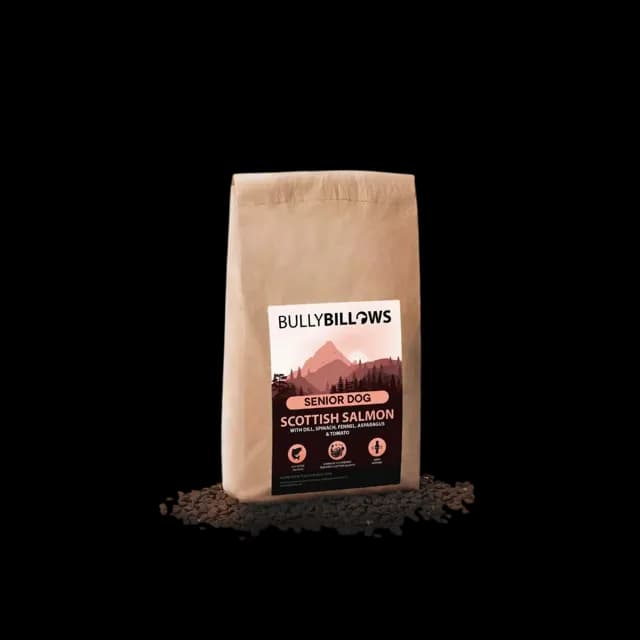
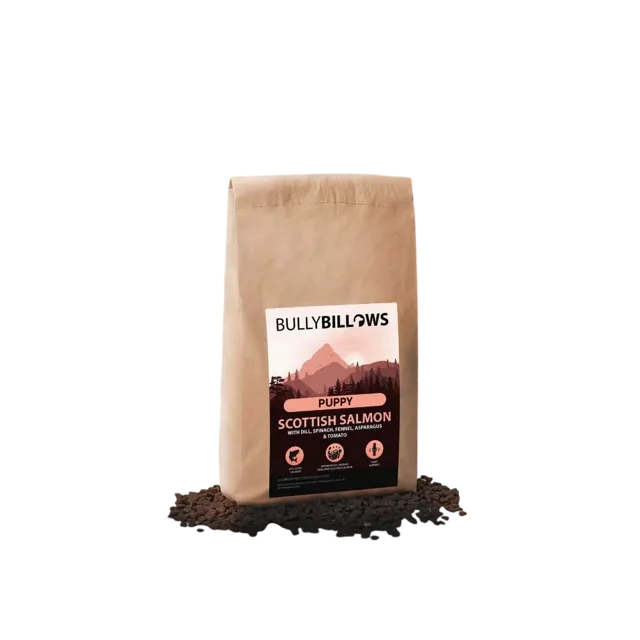
BullyBillows Puppy Dry Food: Scottish Salmon review
Flavour
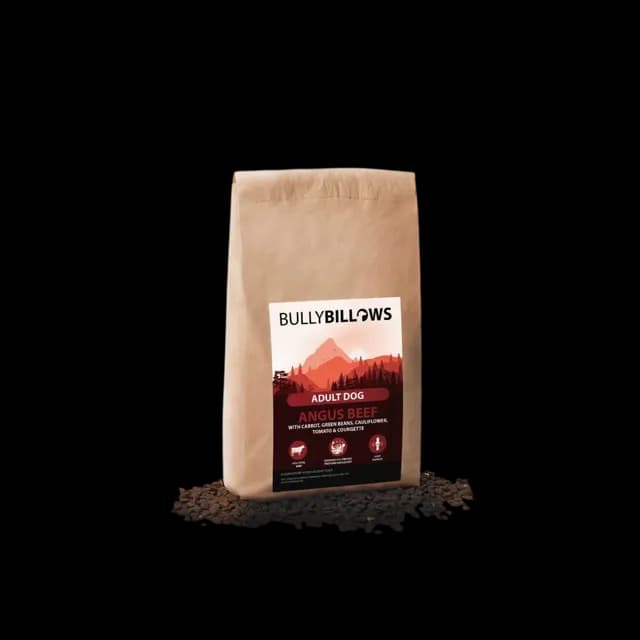
BullyBillows Puppy Dry Food is a pair of grain free growth kibbles built to the same plan. Each one puts a single animal at 65% of the recipe. The label breaks that 65% down: fresh meat first, then the dried share, then the fat or oil. Sweet potato and beans sit behind all of it. Both carry the same printed joint pack and the same prebiotic doses. Where the two part company is the analysis, though both of them land in our Excellent band.
Our view
Likely to suit
If you like knowing exactly which animal your puppy is eating and in what form it arrived, both of these bags will tell you.
- Puppies kept to a single named animal, since each recipe stays with one species from the fresh meat right through to the fat or the oil
- Households that keep grain out, with sweet potato and beans behind the starch and beet pulp for a gentle fibre
- Owners who want early joint support in a printed dose, with glucosamine at 178 mg/kg, methylsulfonylmethane at 178 mg/kg and chondroitin sulphate at 125 mg/kg
- Pups whose digestion needs a hand settling, with fructo-oligosaccharides at 175 mg/kg and mannan-oligosaccharides at 50 mg/kg feeding the friendly gut bacteria
Worth watching
Before you pick a bag, run your eye over a few details on the label.
- The omega 3 supplement names no species in either recipe, which matters to a strict exclusion diet rather than to a simple preference
- The two recipes are not interchangeable nutritionally, with calcium declared differently on each bag, so swapping between them means a fresh look at the analysis
Written by our editorial team. Independent guidance, not veterinary advice.
How this scores
How we scoreThe Details
Dog fit
If you like knowing exactly which animal your puppy is eating and in what form it arrived, both of these bags will tell you. Before you pick a bag, run your eye over a few details on the label.
Dry
Puppy
Toy, Small, Medium, Large, Giant
Salmon
The score, in context
These two are not scored quite alike, though they share a band. The Angus beef occupies our Excellent band, a step above the Good band the typical puppy kibble reaches, with nutritional balance and transparency both Outstanding, value Excellent and protein and processing Good. The Scottish salmon comes in a little lower but holds the same band, with transparency Outstanding, value Excellent and its other two pillars reading Good.
The gap is not about the meat headline, which is 65% either way. It is about what the analysis does with it. The beef recipe declares more protein and more fat over a lighter starch load, and its mineral picture sits more comfortably for a puppy expected to finish large. The salmon recipe still has plenty to offer a fish fed pup, and the variety notes set out where each one stands.
What's in it
Ingredients, as declared: 65% Salmon (Freshly Prepared Scottish Salmon (35%), Dried Salmon (22%), Salmon Oil (5%), Salmon Gravy (3%)), Sweet Potato, Beans, Beet Pulp, Omega 3 Supplement, Dried Superfood Blend* (Including Dill, Spinach, Fennel, Asparagus, Tomato), Minerals, Joint Pack (Glucosamine 178 mg/ kg, Methylsulfonylmethane 178mg/kg, Chondroitin Sulphate 125 mg/kg), Fructooligosaccharides (175 mg/kg), Mannanoligosaccharides (50 mg/kg), Nucleotides, Olive Extract (0.01%), *Each equivalent to 4% Fresh Ingredients.
Named ingredients
Nutritional additives
_(the page labels this "Nutritional Additives (Per KG)")_: - Vitamins: Vitamin A 14,423 IU - Vitamin D3 2,000 1U - Vitamin E 96,805 race Elements: Zinc (Zinc Sulphate Monohydrate) 48 mg, Iron (Iron (Il) Sulphate Monohydrate) 48 mg, Manganese (Manganous Sulphate Monohydrate) 34 mg, iodine (Calcium iodate Anhydrous) 0.96 mg.
Ingredient notes
Both labels do something helpful with their 65% headline: they itemise it. You get the fresh meat, then the dried meat, then the fat or oil, each listed with its own percentage. That shows you how much of the 65% is still water bound and how much is already concentrated. Dried meat has given up its moisture before it goes into the mixer, so it carries more of the finished kibble's protein than its printed share suggests. The freshly prepared portion, meanwhile, shrinks in the oven.
Cereal is absent, so sweet potato and beans hold the kibble together, with beet pulp behind them for a modest, well tolerated fibre. An omega 3 supplement tops up the fatty acids, though it is the one entry on either list that declines to name where it came from.
The supplement tail is identical across the range and printed properly in milligrams per kilo. Glucosamine and methylsulfonylmethane come in at 178 mg/kg apiece with chondroitin sulphate at 125 mg/kg, which is a working joint package rather than a gesture towards one. Fructo-oligosaccharides at 175 mg/kg and mannan-oligosaccharides at 50 mg/kg cover the prebiotic side, and olive extract at 0.01% closes the list as an antioxidant.
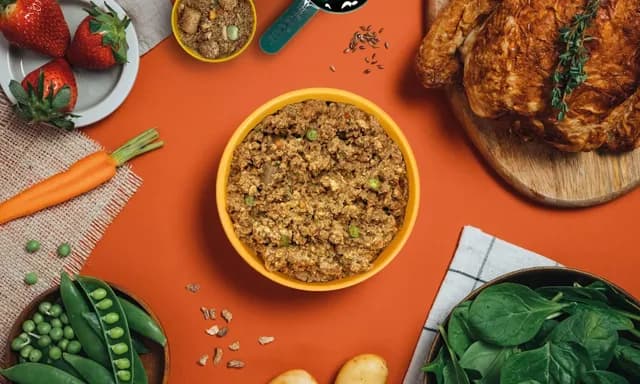
Each bag also carries a dried superfood blend, and the maker is straight about its scale: every entry in the blend is equivalent to 4% fresh ingredients. That puts the vegetables and herbs firmly in the garnish category. These recipes stand on their meat, not on their botanicals.
Both labels declare the full five line analysis and print an energy figure, which is more transparency than a lot of the field manages. The two analyses are not the same though, and neither are the calcium figures, so take the variety notes as the part that decides which bag suits your pup.
How this variety differs
The Scottish salmon recipe breaks its 65% into freshly prepared Scottish salmon at 35%, dried salmon at 22%, salmon oil at 5% and salmon gravy at 3%. Every one of those comes from the same fish, so a pup raised on salmon alone is well served here, and nucleotides appear on this list where the beef recipe has none.
The analysis is lighter. Protein is declared at 32.0%, converting to 34.8% of dry matter, with fat at 15.0% and 16.3% of dry matter. Carbohydrate converts to an estimated 36.4% of dry matter, closer to the 39.0% typical than the beef recipe manages. Ash is higher too, at 9.0% and 9.8% of dry matter, and the printed energy figure is 378 kcal per 100g.
Calcium converts to 1.96% of dry matter. Growth plans for large and giant breeds usually work to a lower level than that. If your pup is expected to finish big, put the figure in front of a vet alongside their feeding plan before this becomes the everyday bag. For a small or medium breed puppy on fish, it reads far more comfortably. The superfood blend here is dill, spinach, fennel, asparagus and tomato.
Price and value
£6.67 a kilo across both recipes, sold in 2kg, 6kg and 12kg bags.
How much a puppy needs changes almost weekly. Read the chart on the bag against your pup's age and the weight you expect them to finish at, and let their waistline settle the final amount.
Nutritional analysis
Declared analysis
32%
15%
2.5%
9%
8%
Dry weight
34.8%
16.3%
2.7%
9.8%
36.4%
As-fed composition
Estimated breakdown of the finished product by ingredient category, from the declared ingredient list and ingoing weights. These are estimates, not measurements.
26.3%
65%
8.7%
Pricing & size
- Pack size
- 2kg, 6kg, 12kg
- Retailer pricing
- Coming soon
Live retailer pricing is not yet available for this food. Prices, cost per day and where to buy will appear here once retailer data is live.
Ingredients and nutrition are taken from manufacturer data. Retailer pricing is not yet live for this food.
Related dog food guides
Ranked shortlists that include foods like this one.