



Alpha
Alpha Everyday review
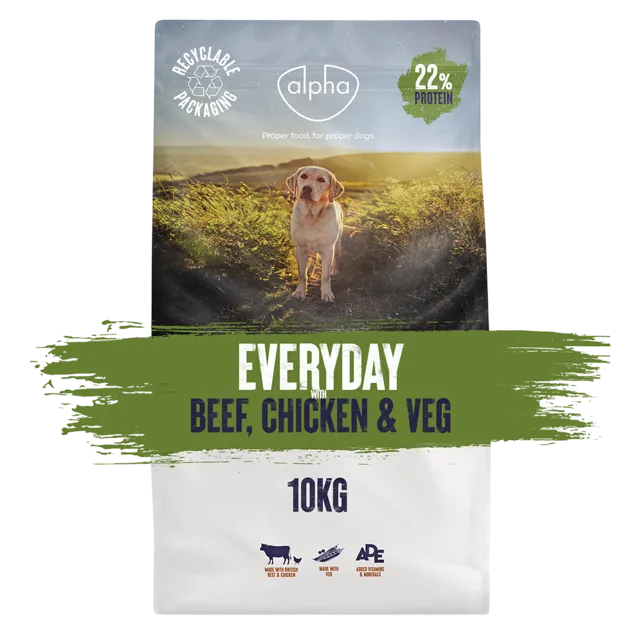
Alpha Everyday is dog feeding at its plainest. The kibble is cereal-based, with 9.0% beef and 4.0% poultry declared inside a broader meat and animal derivatives entry, whole peas at 4.0%, and a vitamin and mineral top-up. It sits in our Poor band, a placing that reflects how little the label pins down and nothing sinister in the bag. Its low fat level gives it a genuine niche for dogs that gain weight easily.
Our view
Likely to suit
Some dogs need nothing fancier than a plain, steady bowl, and yours may be one of them.
- Dogs that hold weight too easily, since fat is declared at just 8.0%
- Multi-dog households, with a 10kg bag built for steady daily feeding
- Dogs with no known sensitivities that do fine on a simple cereal-based recipe
- Owners easing a dog off richer food onto something lighter
Worth watching
Before you pour the first bowl, be clear about what the label leaves open.
- Cereals, meat and animal derivatives and oils and fats are all umbrella terms, so the exact grains, animals and fats can change from batch to batch
- Only beef and poultry are named among the animal content, and the broader derivatives entry means a dog with a specific intolerance has no way of steering around it
- Carbohydrate is estimated at more than half of dry matter, so this is a starch-forward bowl
Written by our editorial team. Independent guidance, not veterinary advice.
How this scores
How we scoreThe Details
Dog fit
Some dogs need nothing fancier than a plain, steady bowl, and yours may be one of them. Before you pour the first bowl, be clear about what the label leaves open.
Dry
Adult
Toy, Small, Medium, Large, Giant
Beef
The score, in context
Our Poor band is where this one lands, and the reason is spelled out in the ingredients list rather than the analysis: nearly every entry is an umbrella term. Cereals could be any grain, the derivatives entries could cover almost any animal or plant matter, and oils and fats could be anything from beneficial oils to heavily processed ones. A transparency reading has nowhere to go with that, and the typical adult dry food, which finishes in our Good band, simply names more of what it contains. The analysis itself is unremarkable rather than alarming, with protein at 24.2% of dry matter and carbohydrate at 53.3%, above the 46.2% typical for the category.
What's in it
Ingredients, as declared: Cereals, Meat and Animal Derivatives (9.0% Beef, 4.0% Poultry), Derivatives of Vegetable Origin, Vegetables (4.0% Whole Peas), Oils and Fats, Minerals.
Named ingredients
Nutritional additives
_Additives (per kg):_ | Additive | Amount | |---|---| | Vitamin A | 17,000 iu/kg | | Vitamin D3 | 1,500 iu/kg | | Vitamin E | 100 mg/kg (as alpha tocopherol) | _Trace Elements (per kg):_ | Trace element | Amount | |---|---| | Zinc (Zinc Oxide) | 80 mg/kg | | Iron (Iron (II) Sulphate Monohydrate) | 40 mg/kg | | Manganese (Manganese (II) Oxide) | 25 mg/kg | | Copper (Copper (II) Sulphate Pentahydrate) | 5.00 mg/kg | | Iodine (Calcium Iodate, Anhydrous) | 1.00 mg/k | | Selenium (Sodium Selenite) | 0.10 mg/kg | Antioxidants.
Ingredient notes
Cereals lead the list without naming a single grain. That is legal and common labelling, but it means wheat, maize, barley or anything else could be doing the work, and the mix can shift between batches without the label changing.
The animal content is declared as meat and animal derivatives with 9.0% beef and 4.0% poultry picked out. Naming those two shares is better than nothing, though the wider entry can draw on any warm-blooded land animal, so the full species mix stays open.
Whole peas at 4.0% are the one named vegetable, with the rest folded into derivatives of vegetable origin. Oils and fats, similarly, names neither the plants nor the animals its content comes from.
The additive panel covers the essentials, vitamins A, D3 and E with a standard set of trace minerals, each dosed on the label. Fat at 8.0% as fed is genuinely low for a dry food, which is where this recipe earns its keep: a lighter bowl for a dog whose waistline needs holding.
Price and value
£1.30 a kilo, sold as a 10kg bag.
Feeding a 15kg adult in moderate condition takes roughly 267 grams a day, about £0.35, worked out from the standard maintenance estimate (110 × bodyweight^0.75, near enough 840 kcal for a dog of that size).
Nutritional analysis
Declared analysis
Estimated using Modified Atwater factors*
22%
8%
4%
8.5%
9%
Dry weight
24.2%
8.8%
4.4%
9.3%
53.3%
As-fed composition
Estimated breakdown of the finished product by ingredient category, from the declared ingredient list and ingoing weights. These are estimates, not measurements.
27.3%
59.7%
6.9%
3.7%
2.4%
Pricing & size
- Pack size
- 10kg - £13.00
- Retailer pricing
- Coming soon
Live retailer pricing is not yet available for this food. Prices, cost per day and where to buy will appear here once retailer data is live.
Ingredients and nutrition are taken from manufacturer data. Retailer pricing is not yet live for this food.
Related dog food guides
Ranked shortlists that include foods like this one.