


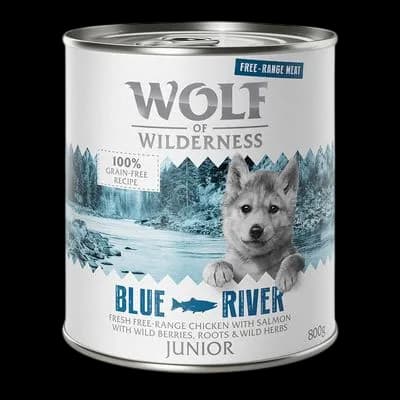
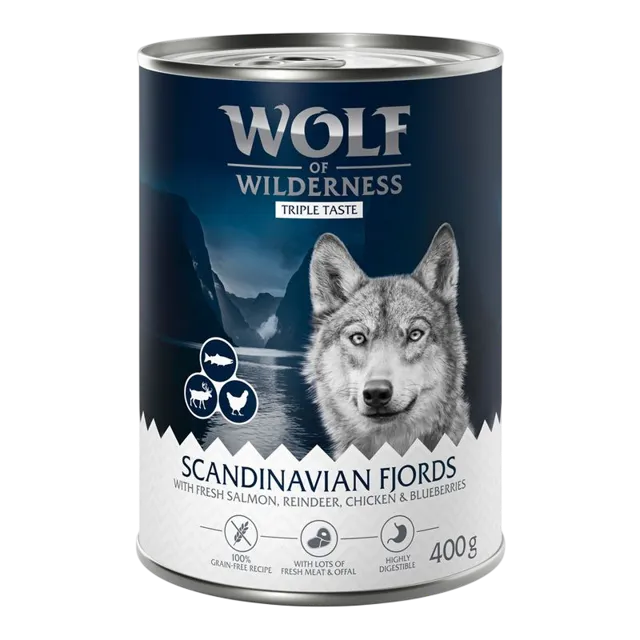

Wolf Of Wilderness
Wolf Of Wilderness 'The Taste Of' Tins: The Taste Of Scandinavia review
Flavour
The Taste Of tins are five postcards from somewhere wilder, each one a blend of named animals in broth with a scatter of berries, a spoonful of oil and eggshell powder for calcium. Canada leans on beef with turkey and cod, Scandinavia on chicken with reindeer and salmon, the Mediterranean on chicken and lamb with trout. The Outback takes beef and chicken with kangaroo, the Savanna beef and turkey with goat. Every animal carries a percentage, no cereal appears anywhere, and all five tins land in our Excellent band.
Our view
Likely to suit
You will pick up a few new animal names reading these labels, and your dog gets to taste them.
- Dogs bored of the usual meats, with kangaroo, reindeer and goat all on these labels
- Owners who want every animal in the tin named and given a percentage beside it
- Dogs kept on very little starch, since the carbohydrate estimate runs between 6.5% and 11.2% of dry matter
- Older dogs, because three of the five tins carry a senior label alongside the adult one
- Households feeding two dogs or more, since one construction runs through all five recipes and only the animals change
Worth watching
There is a lot going on inside each of these tins, so a sensitive dog needs you to read the small print.
- Every tin blends at least two animals, so none of them can be used to anchor an avoidance plan
- Chicken turns up in three of the five, and in the Mediterranean it matches the lamb the tin is named after, at 28.0% each
- Fish appears in three tins as well, cod in Canada, salmon in Scandinavia and trout in the Mediterranean
Written by our editorial team. Independent guidance, not veterinary advice.
How this scores
How we scoreThe Details
Dog fit
You will pick up a few new animal names reading these labels, and your dog gets to taste them. There is a lot going on inside each of these tins, so a sensitive dog needs you to read the small print.
Wet
Adult, Senior
Toy, Small, Medium, Large, Giant
Chicken
The score, in context
All five tins finish inside our Excellent band, level with the middle of the adult wet shelf. Nutritional balance and transparency read Outstanding across the five, with protein and processing Excellent behind them and value Excellent throughout. The construction is why. The named animals add up to between 65.0% and 68.0% of the tin before the broth is counted, and the broth itself is declared with a percentage instead of appearing as water. The carbohydrate estimate tops out at 11.2% of dry matter against 15.8% for the typical adult wet food. Nothing meaningful separates the five, so your dog's preference is the better tie-breaker.
What's in it
Ingredients, as declared: Chicken (45.0%, consisting of heart, meat, stomach, liver, neck, fat), broth (30.6%), reindeer (10.0%), salmon (10.0%), wild berries (2.0%, blueberries), minerals, salmon oil (1.0%), eggshell powder (0.5%), brewer's yeast (0.1%), wild herbs (0.1%, nettle, chamomile, fennel, caraway flour, yarrow), inulin (0.1%). Vitamin E (20 IU/kg), biotin (300 μg/kg), zinc [zinc sulphate, monohydrate] (25 mg/kg), manganese [manganese(II) sulphate, monohydrate] (1.4 mg/kg), copper [copper(II) sulphate pentahydrate] (1 mg/kg), iodine [calcium iodate, anhydrous] (0.75 mg/kg). The Savanna / The Outback, Vitamin D3 (200 IU/kg), vitamin E (20 IU/kg), biotin (300 μg/kg), zinc [zinc sulphate, monohydrate] (25 mg/kg), manganese [manganese(II) sulphate, monohydrate] (1.4 mg/kg).
Named ingredients
Nutritional additives
- **Nutritional additives:** Canada / The Mediterranean Vitamin E (20 IU/kg), biotin (300 μg/kg), zinc [zinc sulphate, monohydrate] (25 mg/kg), manganese [manganese(II) sulphate, monohydrate] (1.4 mg/kg). Scandinavia Vitamin E (20 IU/kg), biotin (300 μg/kg), zinc [zinc sulphate, monohydrate] (25 mg/kg), manganese [manganese(II) sulphate, monohydrate] (1.4 mg/kg), copper [copper(II) sulphate pentahydrate] (1 mg/kg), iodine [calcium iodate, anhydrous] (0.75 mg/kg). The Savanna / The Outback Vitamin D3 (200 IU/kg), vitamin E (20 IU/kg), biotin (300 μg/kg), zinc [zinc sulphate, monohydrate] (25 mg/kg), manganese [manganese(II) sulphate, monohydrate] (1.4 mg/kg). Energy per 100 g Canada: ME (FEDIAF, 2021) 511 kJ / 122 kcal. Scandinavia: ME (FEDIAF, 2021) 397 kJ / 95 kcal. The Mediterranean: ME (FEDIAF, 2021) 397 kJ / 95 kcal. The Savanna: ME (FEDIAF, 2021) 472 kJ / 113 kcal. The Outback: ME (
Ingredient notes
Each tin follows the same idea with different cast members. A lead animal takes between 28.0% and 45.0%, one or two more animals follow with their own percentages, and broth takes between 27.3% and 30.6%. Nothing is left as a category term, which is unusual on a wet shelf where meat and animal derivatives is still the norm.
The animals are declared part by part, and the parts are the point. Hearts, livers, lungs, stomachs, rumen and necks are all named. These recipes are built on whole-carcass eating, not on lean muscle alone. Liver especially is nutrient dense, and it is a good deal of why such short added panels can still hold up.
The novelty is real, not decorative. Kangaroo is at 12.0% in the Outback, goat at 12.0% in the Savanna, reindeer at 10.0% in Scandinavia, cod at 10.0% in Canada and trout at 9.0% in the Mediterranean. A dog who has reacted to the everyday meats has a genuine set of fresh starts here, provided you read the animals sharing the tin as well.
Behind the animals, the supporting cast stays small and sensible. Eggshell powder at 0.5% supplies calcium, brewer's yeast at 0.1% brings B vitamins, inulin at 0.1% works as a prebiotic and wild herbs take another 0.1%. The oils change with the recipe, safflower on Canada, the Savanna and the Outback, salmon oil on Scandinavia and olive oil on the Mediterranean, which also carries rosemary at 0.1%.
The analysis holds steady across the five. Protein converts to between 43.2% and 49.0% of dry matter and fat to between 26.2% and 32.6%, with energy running from 102 to 112 kcal per 100g. These are rich, meat-heavy tins, so a dog moving onto them from a lighter wet food will need a smaller bowl than they are used to.
The added panels are brief and vary by recipe. Vitamin E at 20 IU per kilo and biotin at 300 micrograms appear on all of them, with zinc at 25 mg and manganese at 1.4 mg throughout. Copper at 1 mg and iodine at 0.75 mg go on Scandinavia, and vitamin D3 at 200 IU on the Savanna and the Outback.
How this variety differs
Chicken at 45.0% is the real lead here whatever the name suggests, with reindeer and salmon at 10.0% each and salmon oil at 1.0% on top. Protein converts to 49.0% of dry matter, the highest of the five, and copper and iodine appear on this panel alone.
Price and value
£4.01 a kilo, the same figure across all five tins.
For a 15kg adult dog in moderate condition, the usual estimate is about 840 kcal a day (110 × bodyweight^0.75). That comes to roughly 750 to 825 grams, or between £3.01 and £3.31 a day depending on the tin. The label's own table is wider still. For a 10kg dog it asks somewhere between 440 and 770 grams a day, and the figure moves with the recipe.
Nutritional analysis
Declared analysis
10.3%
5.5%
0.4%
3%
79%
Dry weight
49%
26.2%
1.9%
14.3%
8.6%
As-fed composition
Estimated breakdown of the finished product by ingredient category, from the declared ingredient list and ingoing weights. These are estimates, not measurements.
55%
30.6%
1%
13.4%
Pricing & size
- Retailer pricing
- Coming soon
Live retailer pricing is not yet available for this food. Prices, cost per day and where to buy will appear here once retailer data is live.
Ingredients and nutrition are taken from manufacturer data. Retailer pricing is not yet live for this food.
Related dog food guides
Ranked shortlists that include foods like this one.
Featured in our breed food guides
One of the foods on our Off the Leash shortlist for these breeds.