



Wolf Of Wilderness
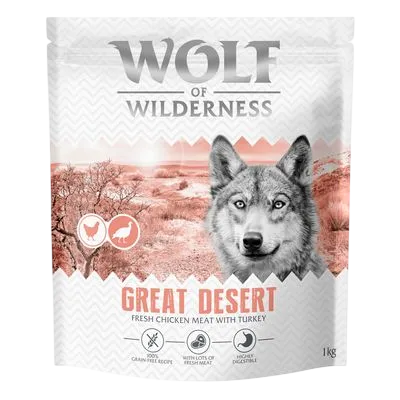
Wolf Of Wilderness Dry Adult: Great Desert review
Flavour
Wolf Of Wilderness Dry Adult is a grain-free range of eight wilderness-themed kibbles, and seven of them are one recipe wearing different coats. That recipe is fresh chicken meat at 25%, potato flakes, a dried protein concentrate, peas or pea protein, poultry fat, then the animal from the front of the bag at 4%. The eighth, the free-range chicken and salmon, is built differently and more richly. Across the range linseed and salmon oil carry the omega 3s, yeast cell walls look after the gut, and wild berries and herbs supply the atmosphere. All eight land in our Good band with little between them, so buy whichever meat suits your dog best.
Our view
Likely to suit
Whichever wilderness scene is printed on the front, there is a version here for a dog who likes a change without a change of stomach.
- Rotation feeders, because the animal on top is the only thing that changes across the eight
- Dogs kept off grain, since nothing cereal-based is on the list and the starch load falls to potato flakes and peas
- Chicken-tolerant dogs, because every recipe in the range is built on chicken
- Active adults, since the declared fat across the eight runs from 14.0% to 16.0%
- Owners after an unusual animal in the bowl, from wild boar and venison to herring and duck
Worth watching
A few details will help you choose between them.
- The animal in the name arrives at 4% in seven of the eight, with fresh chicken at 25% doing the real work underneath
- None of the eight is a fish-free food, because salmon oil is in all of them
- Several labels carry poultry protein or poultry fat with no bird named, and an exclusion diet needs that name
- The free-range chicken and salmon recipe carries dried egg, which the other seven do not
Written by our editorial team. Independent guidance, not veterinary advice.
How this scores
How we scoreThe Details
Dog fit
Whichever wilderness scene is printed on the front, there is a version here for a dog who likes a change without a change of stomach. A few details will help you choose between them.
Dry
Adult
Chicken
The score, in context
All eight reach our Good band, where the middle of the adult dry category also sits. The spread is narrow because the recipes barely differ. Protein converts to between 27.2% and 29.3% of dry matter and estimated carbohydrate to between 43.1% and 46.5%, either side of the 46.2% typical for adult dry food. What separates the higher from the lower is small stuff, mainly how much of the dried protein carries a species name and how the fat and ash happen to fall. None of the gaps is wide enough to steer a healthy dog away from the animal it prefers. Worth adding that none of these labels prints a moisture figure, so the dry matter conversions here assume the 8% a kibble usually holds.
What's in it
Ingredients, as declared: Fresh chicken meat (25%), potato flakes, poultry protein (17.3%), peas, poultry fat, potato starch, turkey protein (4%), dried beet pulp, linseed, lignocellulose, brewer's yeast, salmon oil, sodium chloride, monocalcium phosphate, dried wild berries (total 0.3%: cranberries, blackcurrants, elderberries, raspberries), sunflower oil, apple pomace (0.2%), yeast cell walls (0.2%, a source of beta-glucans and mannan-oligosaccharides), chicory inulin, dried wild herbs (0.03% yarrow, 0.03% dandelion herb, 0.03% dandelion root, 0.03% camomile, 0.03% nettle, 0.03% plantain leaves, 0.03% St John's wort).
Named ingredients
Nutritional additives
- **Nutritional additives — Original recipe:** Vitamin A (12,000 IU), vitamin D3 (1500 IU), vitamin E (250 IU), vitamin C (100mg), vitamin B1 (12mg), vitamin B2 [riboflavin] (12mg), vitamin B6 (8mg), vitamin B12 [cyanocobalamin] (180μg), niacin (35mg), calcium-D-pantothenate (35mg), folic acid (1.2mg), biotin (300μg), choline chloride (2500mg), copper [copper(II) sulphate pentahydrate] (12.5mg), zinc [zinc sulphate monohydrate] (100mg), zinc [glycine zinc chelate hydrate (solid)] (60mg), iron [iron(II) sulphate monohydrate] (200mg), manganese [manganese(II) sulphate monohydrate] (25mg), iodine [calcium iodate anhydrous] (2.3mg), selenium [sodium selenite] (0.35mg). - **Nutritional additives — New recipe:** Vitamin A (12,000 IU), vitamin D3 (1500 IU), vitamin E (150 IU), vitamin B1 (12mg), vitamin B2 (12mg), vitamin B6 (8mg), vitamin B12 (0.18mg), niacinamide (35mg), calcium-D-pantothenat
Ingredient notes
Read past the names and the family resemblance is unmistakable. Seven of the eight open with fresh chicken meat at 25%, then potato flakes, then a dried protein concentrate somewhere between 12.5% and 18.9%, then peas or pea protein and poultry fat. The wild animal on the front, whether that is venison, boar, duck, turkey, lamb, herring or salmon, comes in at 4%. That 4% is a flavour and a talking point. The recipe underneath it is what does the work, and knowing that makes the whole range much easier to shop.
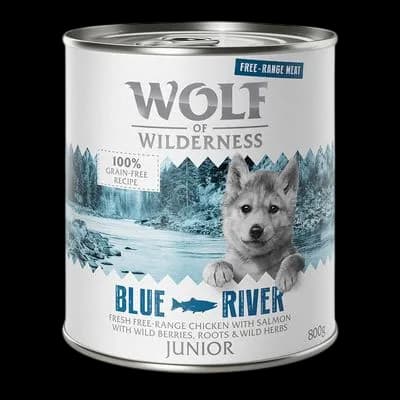
The eighth recipe, Blue River Free-Range Chicken & Salmon, is the one that breaks the pattern. Fresh chicken jumps to 41%, dried salmon protein sits at 10%, and dried egg and calcium carbonate appear where the others put peas and potato starch. It reads as the flagship, and the analysis agrees, with the highest protein of the eight and fat at the top of the range.
Being grain free here means potato flakes doing the starch work, with potato starch, peas and pea protein behind them depending on the recipe. Dried beet pulp gives the gut something to work with, and lignocellulose appears in a few of them as an insoluble fibre.
The gut and coat extras are consistent and sensibly chosen. Yeast cell walls at 0.2% bring beta-glucans and mannan-oligosaccharides, food for the gut flora further down. Chicory inulin does much the same job in most of the recipes, and linseed alongside salmon oil covers both the plant and the marine omega 3s. The wild berries at 0.3% are romance, and so are the seven herbs at 0.03% each. There is no harm in that, as long as you know which part of the label is which.
Two things to keep straight. Poultry fat and poultry protein name a family and stop there, so several of these recipes leave the bird open. Salmon oil is on all eight labels, so no version of this food is fish free. Neither point will trouble most dogs, and both matter a great deal to a dog being taken carefully through an exclusion diet.
One quirk of the labels themselves: several print two sets of nutritional additives, an original recipe and a newer one, so the exact vitamin and mineral figures depend on which bag turns up. The forms are the familiar sulphates with a glycine-chelated zinc alongside them, and every entry is given a figure.
How this variety differs
Turkey protein at 4% joins the fresh chicken here. Under the desert name sits a two-bird recipe. Poultry protein at 17.3% carries the dried share, and estimated carbohydrate lands at 45.0% of dry matter.
Price and value
Per kilo, the turkey recipe is £3.77, Blue River and Wild Hills are £3.79, Deep Seas, Green Fields, Oak Woods and Sunny Glade are £4.02, and the free-range chicken and salmon is £5.00.
As a guide, and assuming around 840 kcal a day (110 × bodyweight^0.75, the standard maintenance estimate), a 15kg adult dog in moderate condition eats between 216 and 231 grams a day. That runs between £0.83 and £1.08 a day depending on the recipe.
Nutritional analysis
Declared analysis
25%
15%
3%
7.5%
Dry weight
27.2%
16.3%
3.3%
8.2%
45%
As-fed composition
Estimated breakdown of the finished product by ingredient category, from the declared ingredient list and ingoing weights. These are estimates, not measurements.
46.3%
45.2%
0.2%
4.9%
3.3%
Pricing & size
- Retailer pricing
- Coming soon
Live retailer pricing is not yet available for this food. Prices, cost per day and where to buy will appear here once retailer data is live.
Ingredients and nutrition are taken from manufacturer data. Retailer pricing is not yet live for this food.
Related dog food guides
Ranked shortlists that include foods like this one.