


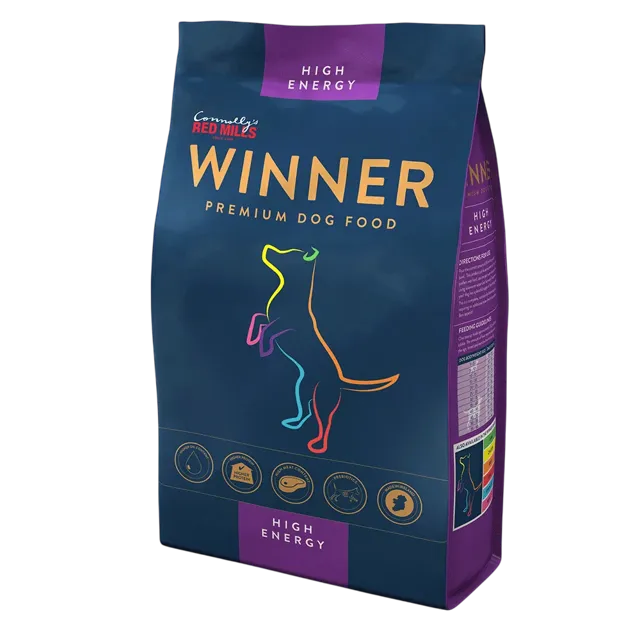

Winner
Winner High Energy review
Winner High Energy is the hardest-working recipe on this label, a maize-based kibble with dehydrated beef and dehydrated chicken behind the cereal and no oats softening the middle of the list. It declares 28.0% protein and 12.0% fat, and estimated carbohydrate converts to 43.2% of dry matter, under the 46.2% that is typical for adult dry food. It sits in our Good band, though the label puts no percentage against either meat and leaves its fat without a species.
Our view
Likely to suit
If your dog works all day and comes home hungry, this recipe was written with that appetite in mind.
- Working and sporting dogs on their feet for most of the day
- Dogs whose condition slips on a standard adult kibble, with protein declared at 28.0% and fat at 12.0%
- Owners who want the protein written on the bag rather than implied by the pictures
- Kennels and working homes feeding several adults at once, as one label covers both adult and senior
Worth watching
Before this settles in as the everyday bag, a few points deserve a look.
- Beef and chicken both appear and the poultry fat names no species, so this cannot clear a dog of either meat
- The name is about the analysis more than the calories, with energy estimated at 338 kcal per 100g against the 357 typical for adult dry food
Written by our editorial team. Independent guidance, not veterinary advice.
How this scores
How we scoreThe Details
Dog fit
If your dog works all day and comes home hungry, this recipe was written with that appetite in mind. Before this settles in as the everyday bag, a few points deserve a look.
Dry
Adult, Senior
Toy, Small, Medium, Large, Giant
Beef
The score, in context
This one reads Good for us, level with the middle of the adult dry category. Put plainly, the analysis is what this food does best. Protein converts to 30.8% of dry matter and estimated carbohydrate to 43.2%, both better than a typical adult dry food manages. Its transparency reads Good and no better, because of what the label withholds. Not one meat entry is given a percentage, and the poultry fat never names its bird. For a hard-working dog whose owner is not running an elimination plan, that gap is paperwork rather than nutrition.
What's in it
Ingredients, as declared: Maize, Dehydrated Beef, Dehydrated Chicken, Poultry, Fat, Whole Linseed, Beet Pulp, Minerals, Chicken Digest, Yeast Extract, Chicory Extract.
Named ingredients
Nutritional additives
_Vitamins:_ | Additive | Per kg | | --- | --- | | E672 Vitamin A | 19,500iu/kg | | E671 Vitamin D3 | 2,000iu/kg | | Alpha Tocopherol Acetate (Vitamin E) | 50iu/kg | _Trace Elements:_ | Additive | Per kg | | --- | --- | | E4 Copper (Copper Sulphate) | 15mg/kg | | E8 Selenium (Sodium Selenite) | 0.1mg/kg | | E1 Iron (Iron Sulphate) | 100mg/kg | | E5 Manganese (Manganese Oxide) | 40mg/kg | | E6 Zinc (Zinc Oxide) | 100mg/kg | | E2 Iodine (Calcium Iodate) | 1.5mg/kg | Listed with no figures: "Antioxidants. Preservatives."
Ingredient notes
Maize opens the list, with dehydrated beef and dehydrated chicken directly behind it. What lifts protein to 28.0% is two dried meats in place of one fresh one. Drying takes the water out before the ingredients are weighed, so the entry keeps its place in the finished kibble.
There is no oat entry on this list, so maize does the starch work more or less alone. Beet pulp is there for fibre, and chicory extract further down carries inulin, a prebiotic that feeds the bacteria in the large intestine.
Whole linseed is the omega 3 source. It is the plant form. A dog turns it into the skin-active and joint-active forms slowly, and quicker from fish oil. Allow a coat a few weeks to show a difference, not a few days.
Ash converts to 10.4% of dry matter, on the higher side for a kibble and a normal consequence of building protein from dried meats, which bring bone minerals along with them. Fibre is light at 2.4% of dry matter, which suits a dog with a settled stomach more than one that needs bulk to firm things up.
Copper at 15 mg, iron and zinc at 100 mg each, manganese at 40 mg and iodine at 1.5 mg per kilo all carry printed figures. They come as sulphates and oxides. A gut takes up the chelated forms more easily.
Price and value
£2.56 a kilo, sold in 3kg and 15kg bags.
Feeding a 15kg adult dog in moderate condition comes to roughly 249 grams a day, or £0.64, using the standard maintenance estimate of about 840 kcal a day (110 × bodyweight^0.75). The label's own table asks 230 to 275 grams at the same bodyweight, and a dog genuinely working hard will eat more than that.
Nutritional analysis
Declared analysis
Estimated using Modified Atwater factors*
28%
12%
2.2%
9.5%
9%
Dry weight
30.8%
13.2%
2.4%
10.4%
43.2%
As-fed composition
Estimated breakdown of the finished product by ingredient category, from the declared ingredient list and ingoing weights. These are estimates, not measurements.
52.1%
40.7%
0.3%
3.4%
3.5%
Pricing & size
- Pack size
- 3kg (£12.08, SKU DG381EA) · 15kg (£38.33, SKU DG374)
- Retailer pricing
- Coming soon
Live retailer pricing is not yet available for this food. Prices, cost per day and where to buy will appear here once retailer data is live.
Ingredients and nutrition are taken from manufacturer data. Retailer pricing is not yet live for this food.
Related dog food guides
Ranked shortlists that include foods like this one.