


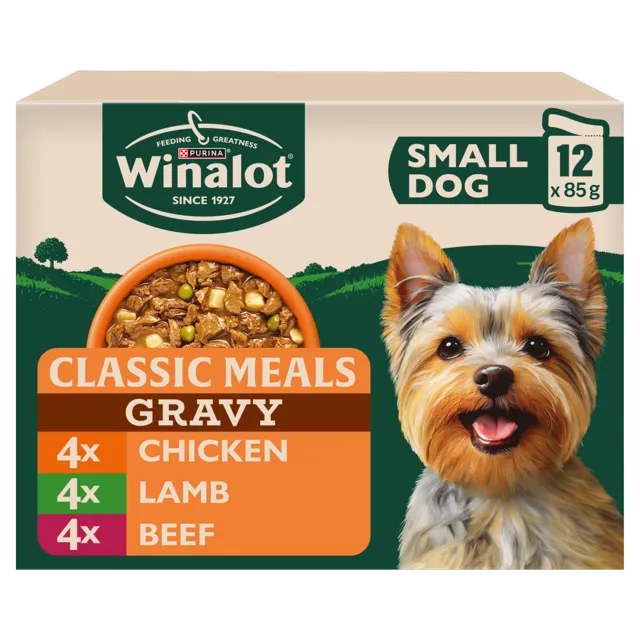

Winalot
Winalot Meaty Chunks: Beef review
Flavour
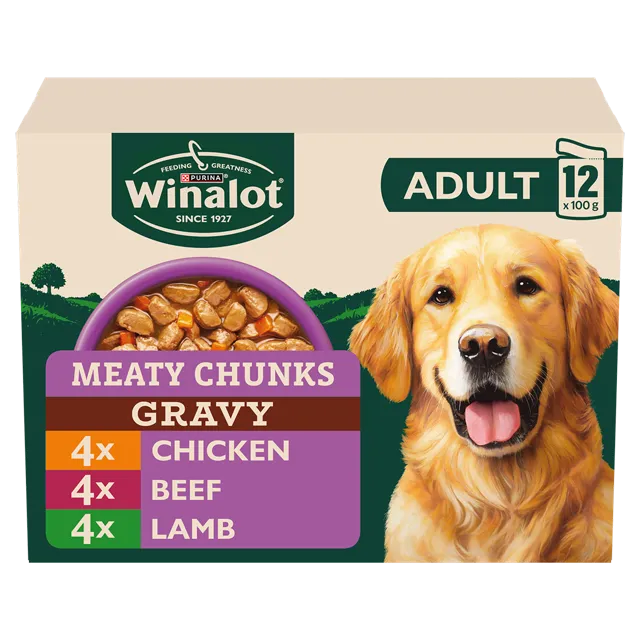
Winalot Meaty Chunks is the brand's pouch range, six labels covering beef, chicken and lamb on their own, a mixed jelly box, a puppy box and a senior box. The named meat is declared at 14% of the chunks on most labels and at 20% on one of the senior recipes. Chunks make up 40% or 46% of the pouch depending on the recipe, and the vegetables are printed as both a dehydrated weight and a fresh equivalent. All six settle in our Average band, so the pouch you reach for is a question of flavour and not of placing.
Our view
Likely to suit
Pouches make the evening simple, and this range stretches to cover most of the household in one format.
- Dogs that prefer chunks in jelly or gravy to a solid loaf they have to break up
- Owners feeding more than one dog, with adult, puppy and senior pouches sharing the same format
- Careful portioners and smaller dogs, since every pouch in the range is 100g
- Dogs that want the starch kept down, as the mixed in jelly pouch carries no cereals at all and estimates out at 16.4% of dry matter as carbohydrate
- Households that rotate meats, with beef, chicken and lamb each fronting a pouch of their own
- Dogs that need moisture in their dinner, since every recipe declares at least 81% of the pouch as water
Worth watching
Whichever pouch you put in the trolley, the same few label habits run through the range.
- Meat and animal derivatives leads every recipe, with only the named animal's share of the chunks pinned down, so no pouch here can anchor an elimination diet
- Cereals appear unnamed on every label except the mixed in jelly pouch
- Various sugars and flavourings are declared throughout the range
- Alongside its chicken and lamb, the puppy pouch lists fish and fish derivatives, one to note if fish stays off the menu in your house
- Carbohydrate converts to an estimated 34.9% of dry matter on the single-meat pouches, where the typical adult wet food runs at 15.8%
Written by our editorial team. Independent guidance, not veterinary advice.
How this scores
How we scoreThe Details
Dog fit
Pouches make the evening simple, and this range stretches to cover most of the household in one format. Whichever pouch you put in the trolley, the same few label habits run through the range.
Wet
Adult
Toy, Small, Medium, Large, Giant
Beef
The score, in context
Six pouches, and they sit closer together on our scale than their labels might suggest. The mixed in jelly box sits at the top of the range, with the highest declared protein of the six and no cereals on its list. The rest of the line follows just behind it in the same Average band. The puppy box lands there too. The senior gravy box, which reads much like the others on paper and prints more of its chunk meat than most, finishes at the foot of the six without leaving that band. The typical adult wet food is an Excellent band food, so these read as the everyday pouch, which is a fair enough place for a supermarket range to sit.
What's in it
Ingredients, as declared: Meaty Chunks Rich in Beef with Potatoes, Meat and animal derivatives (of which beef 14% in the chunks*), Cereals, Vegetables (1% dehydrated potatoes equivalent to 9% potatoes), Minerals, Various sugars, *pouch contains 40% chunks, Ingredients from natural origin, Meaty Chunks Rich in Chicken with Carrots, Meat and animal derivatives (of which chicken 14% in the chunks*), Cereals, Vegetables (0.8% dehydrated carrots equivalent to 7% carrots), Minerals, Various sugars, *pouch contains 40% chunks, Ingredients from natural origin, Meaty Chunks Rich in Lamb with Carrots, Meat and animal derivatives (of which lamb 14% in the chunks*), Cereals, Vegetables (0.8% dehydrated carrots equivalent to 7% carrots), Minerals, Various sugars, *pouch contains 40% chunks, Ingredients from natural origin
Named ingredients
Nutritional additives
IU/kg: Vitamin A: 1476; Vitamin D3: 141, mg/kg: Iron (II) sulphate monohydrate (Fe: 9.9); Calcium iodate anhydrous (I: 0.33); Copper (II) sulphate pentahydrate (Cu: 1.1); Manganous sulphate monohydrate (Mn: 1.2); Zinc sulphate monohydrate (Zn: 15.3). Flavourings.
Ingredient notes
The chunk structure explains most of the percentages. Each pouch is 40% or 46% chunks with sauce or jelly around them. The meat figure applies inside the chunks, not across the whole pouch, so beef at 14% of the chunks is not 14% of the pouch. Winalot prints the chunk share on every label, which is what makes that arithmetic possible at all.
Meat and animal derivatives leads each list, with the named animal fixed inside it. That umbrella covers any part of the carcass of any warm-blooded land animal. Cereals follow on every label but the mixed jelly one, unnamed, and various sugars and flavourings close the list. None of these terms is a quality verdict in itself. Together, though, the front of the pouch can read exactly the same while the recipe behind it shifts from batch to batch.
The vegetables are the most open part of the range. Potatoes appear at 1% dehydrated, equivalent to 9% potatoes, carrots at 0.8% dehydrated, equivalent to 7.2% carrots, peas at 1.2% equivalent to 10.8% peas, and green beans at 0.9% equivalent to 8.1%. These are small amounts doing modest work. Carrots bring vitamin A for healthy eyes, and peas put in fibre and a few minerals.
Two of the panels stand apart from the rest. The mixed in jelly pouch declares 8.5% protein, which converts to 50.0% of dry matter, with estimated carbohydrate at 16.4%, and that combination sits close to what the typical adult wet food manages. The other adult pouches declare 6.5% protein, converting to 37.1% of dry matter, with estimated carbohydrate at 34.9%. Energy is declared rather than estimated across the range, at 75 kcal per 100g on the adult pouches and 84 kcal on the puppy box.
The added panels are dosed individually on every label and they are not identical. Vitamin A runs from 1320 IU/kg on the mixed jelly pouch up to 1900 IU/kg on the senior box. The senior label also carries the heaviest trace minerals of the six, with iron at 39 mg/kg, zinc at 54 mg/kg, copper at 5.8 mg/kg and manganese at 4.9 mg/kg. An older dog absorbing less from the same meal is the usual thinking behind a step up like that.
How this variety differs
The beef pouch, built on chunks rich in beef at 14% of the chunks with 1% dehydrated potatoes, equivalent to 9% potatoes. Of the three single meats, beef has the strongest flavour, and a dog gone off birds will usually take it most readily.
Price and value
£3.70 a kilo on the mixed in jelly, puppy and senior pouches. Everything in the range comes in 100g pouches, with the adult boxes running from 12 pouches up to 80, and the puppy and senior boxes sold as 12.
For a 15kg adult dog in moderate condition needing something like 840 kcal a day (110 × bodyweight^0.75, the standard maintenance estimate), the adult pouches come to about 1120 grams a day. That is £4.14 a day at that per kilo figure. The label's own guide puts a 25kg dog on 1600 grams a day and a 10kg dog on 900 grams.
Nutritional analysis
Declared analysis
6.5%
3%
0.1%
1.8%
82.5%
Dry weight
37.1%
17.1%
0.6%
10.3%
34.9%
As-fed composition
Estimated breakdown of the finished product by ingredient category, from the declared ingredient list and ingoing weights. These are estimates, not measurements.
100%
Pricing & size
- Pack size
- 12x100g, 24x100g, 40x100g, 80x100g
- Retailer pricing
- Coming soon
Live retailer pricing is not yet available for this food. Prices, cost per day and where to buy will appear here once retailer data is live.
Ingredients and nutrition are taken from manufacturer data. Retailer pricing is not yet live for this food.
Related dog food guides
Ranked shortlists that include foods like this one.