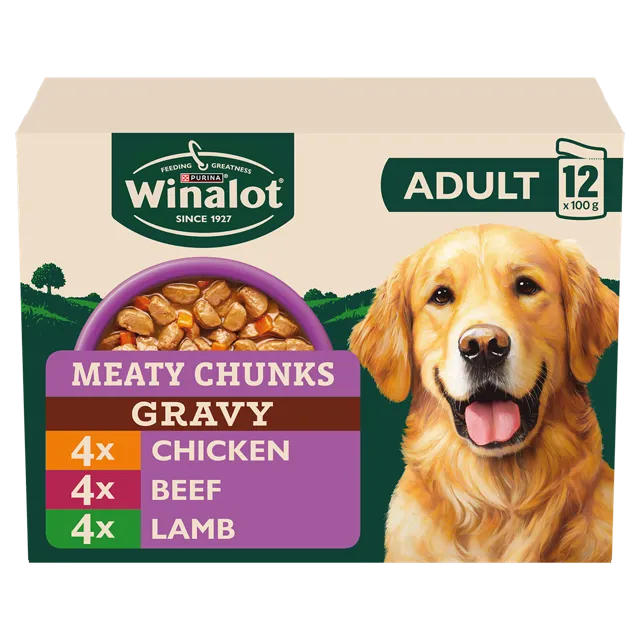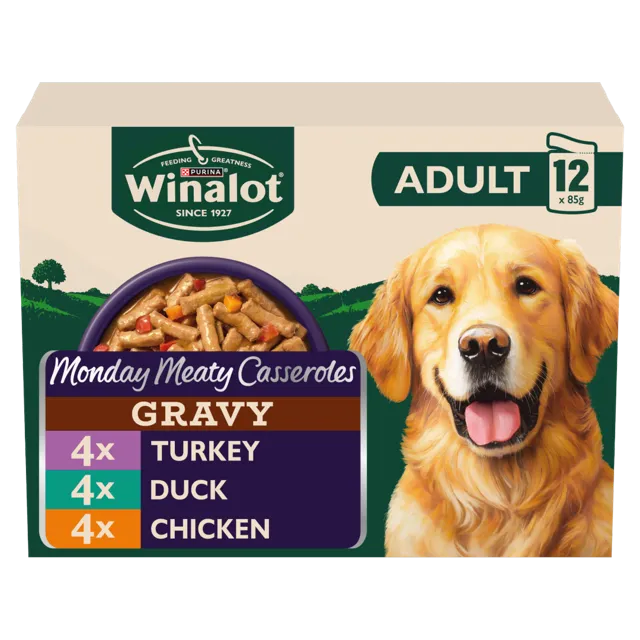



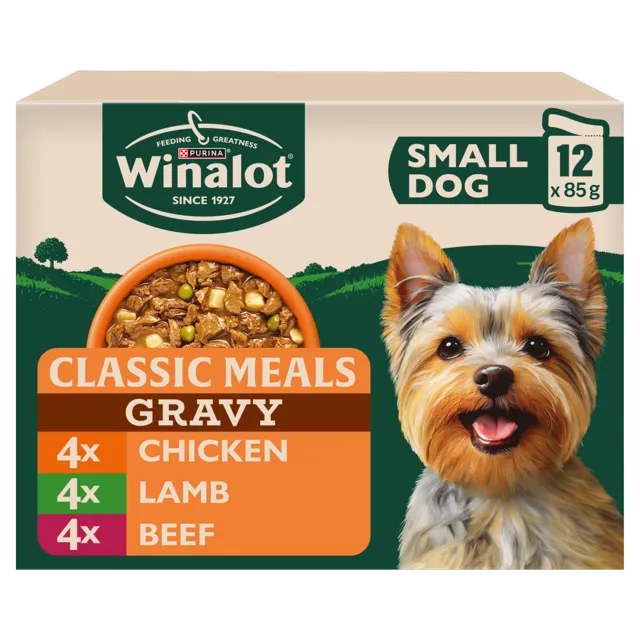

Winalot
Winalot Cod In Gravy review
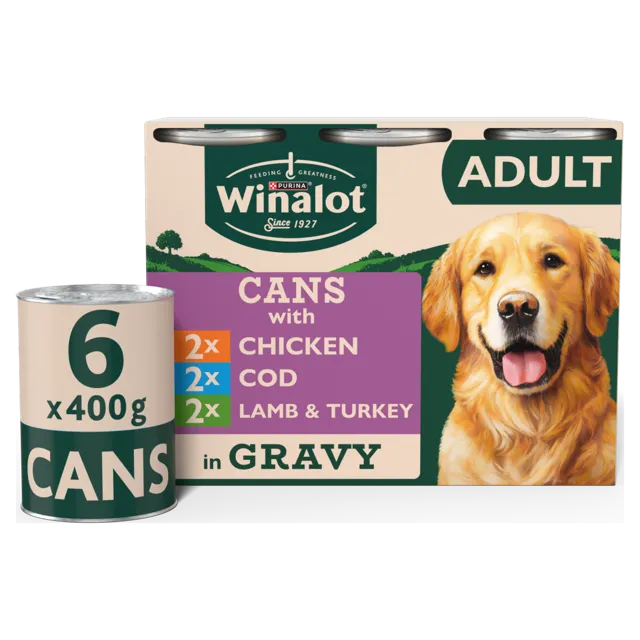
Winalot Cod In Gravy comes as a case of tins in gravy. The name points at one recipe, but the label captured for it covers three: a chicken tin, a cod tin and a lamb and turkey tin. Each names its animal at 4% within meat and animal derivatives. Gravy instead of jelly is the difference in the bowl, and the whole case shares one analysis with a healthy 37.1% of dry matter as protein. Our Average band is where it settles.
Our view
Likely to suit
If your dog turns their nose up at jelly, gravy is very often the answer.
- Dogs that eat more readily when dinner arrives loose in gravy
- Owners feeding a household of different tastes, with chicken, cod and a lamb and turkey tin sharing one case
- Bigger dogs with appetites to match, since these are 400g tins
- Dogs that need more water across the day, with 82.5% of each tin declared as moisture
- Owners who want fish in the rotation without committing to a fish-only food
Worth watching
A few label habits run through all three recipes, and a careful buyer will want to see them coming.
- Each animal is named at 4% and the balance of the meat sits inside meat and animal derivatives, so none of the three tins can carry an elimination diet
- The cereals go unnamed, and so do the vegetable protein extracts alongside them
- Various sugars appear on all three of the lists
- Carbohydrate converts to an estimated 28.0% of dry matter against 15.8% for the typical adult wet food
Written by our editorial team. Independent guidance, not veterinary advice.
How this scores
How we scoreThe Details
Dog fit
If your dog turns their nose up at jelly, gravy is very often the answer. A few label habits run through all three recipes, and a careful buyer will want to see them coming.
Wet
Adult
Toy, Small, Medium, Large, Giant
Chicken
The score, in context
Our Average band is where this case comes to rest, with the typical adult wet food two bands clear of it in Excellent. Protein and processing reads Good, with nutritional balance and transparency both Excellent. The label names an animal in every recipe, then hands the rest of the meat, the grain and the plant protein over to category terms. Protein converting to 37.1% of dry matter is doing a good deal of the work in holding the placement where it is, and the moderate estimated carbohydrate helps too.
What's in it
Ingredients, as declared: Chicken, Meat and animal derivatives (of which Chicken 4%; 96% natural ingredients*), Cereals*, Vegetable protein extracts, Minerals, Various sugars, *Natural ingredients, Cod, Meat and animal derivatives (96% natural ingredients*), Cereals*, Fish and fish derivatives* (Cod 4%), Vegetable protein extracts, Minerals, Various sugars, *Natural ingredients, Lamb & Turkey, Meat and animal derivatives (of which lamb 4% and turkey 4%; 96% natural ingredients*), Cereals*, Vegetable protein extracts, Minerals, Various sugars, *Natural ingredients.
Named ingredients
Nutritional additives
IU/kg: Vitamin A: 1800 Vitamin D3: 172 Vitamin E: 25 mg/kg: Iron (II) sulphate monohydrate: (Fe: 12) Calcium iodate anhydrous: (I: 0.41) Copper (II) sulphate pentahydrate: (Cu: 1.4) Manganous sulphate monohydrate: (Mn: 1.5) Zinc sulphate monohydrate: (Zn: 19)
Ingredient notes
Three recipes, one grammar. Meat and animal derivatives leads each list with the flavour animal fixed inside it, chicken at 4% in one tin, cod at 4% in another and lamb and turkey at 4% apiece in the third. The term itself is wide enough to cover any warm-blooded land animal and any part of the carcass. The flavour name is a promise about taste. It is not a full account of what is in the tin.
The cod tin adds a fish and fish derivatives entry, which is where its 4% of cod is declared. That term is just as broad on the fish side as the meat one is on land, covering anything from prime fillet trimmings to the leftovers of processing. What it does tell you clearly is that fish is present, which is the part that matters if you are avoiding it.
Cereals sit second on each list with vegetable protein extracts behind them, neither of them named. Between them they account for an estimated 28.0% of dry matter as carbohydrate, where the typical adult wet food runs at 15.8%. Various sugars close the list, doing the usual work of lifting palatability in a gravy tin.
The panel behind all this is more forthcoming. Protein converts to 37.1% of dry matter and fat to 20.0%, a sensible pairing for an unfussy adult dog, and energy is declared at 75 kcal per 100g rather than estimated. Vitamins A, D3 and E are printed at 1800, 172 and 25 IU/kg. The trace minerals are dosed individually, with zinc at 19 mg/kg, iron at 12 mg/kg, manganese at 1.5 mg/kg, copper at 1.4 mg/kg and iodine at 0.41 mg/kg.
Price and value
Sold as a case of 6 tins at 400g each.
A 15kg adult dog in moderate condition, assumed to need about 840 kcal a day (110 × bodyweight^0.75, the standard maintenance estimate), would work through roughly 1120 grams a day. The tin's own guide runs heavier still, putting a dog between 12kg and 25kg on 1000 to 1600 grams a day.
Nutritional analysis
Declared analysis
6.5%
3.5%
0.1%
2.5%
82.5%
Dry weight
37.1%
20%
0.6%
14.3%
28%
As-fed composition
Estimated breakdown of the finished product by ingredient category, from the declared ingredient list and ingoing weights. These are estimates, not measurements.
56.5%
17.5%
22.9%
3.1%
Pricing & size
- Pack size
- 6x400g
- Retailer pricing
- Coming soon
Live retailer pricing is not yet available for this food. Prices, cost per day and where to buy will appear here once retailer data is live.
Ingredients and nutrition are taken from manufacturer data. Retailer pricing is not yet live for this food.
Related dog food guides
Ranked shortlists that include foods like this one.