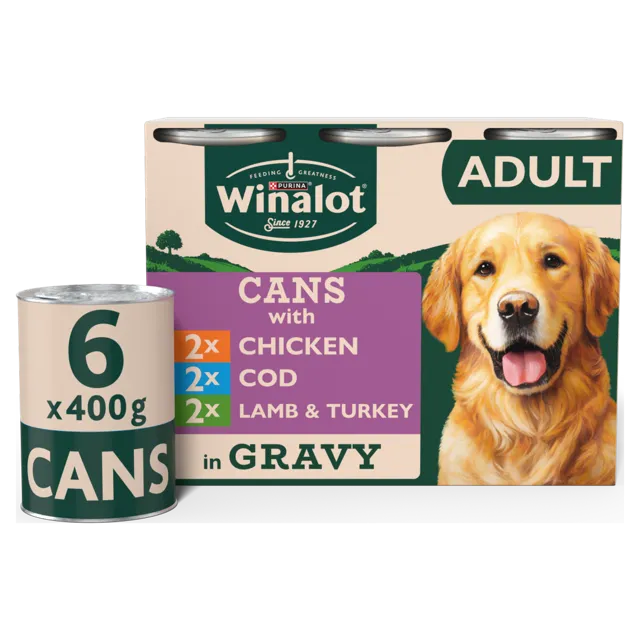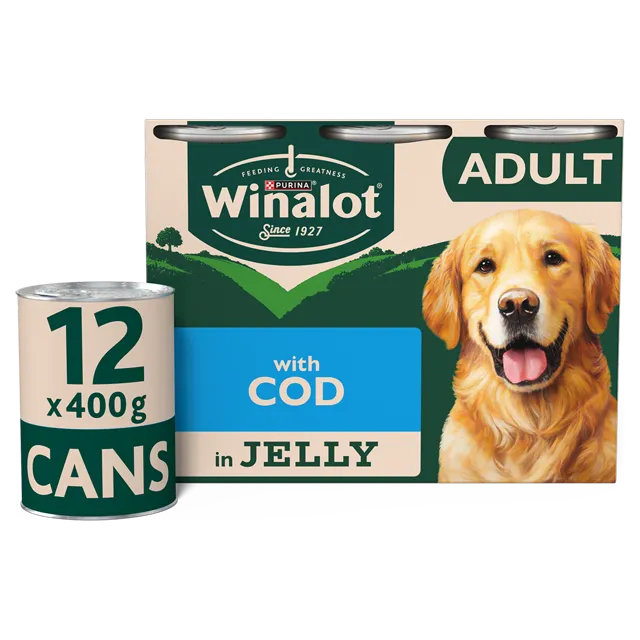




Winalot
Winalot Classics In Jelly: Cod review
Flavour
Winalot Classics In Jelly is the brand's long-standing tin, sold as single flavours. Every label is put together the same way: meat and animal derivatives lead, cereals follow, and behind them come minerals, various sugars and vegetable protein extracts, with the headline animal declared at 4%. Both labels land in our Average band.
Our view
Likely to suit
A jelly tin is still one of the easiest ways to get a hesitant eater through dinner.
- Dogs that prefer their dinner set in jelly, the texture this range has built its name on
- Owners feeding a bigger dog, with 400g tins that cover a real appetite without endless opening
- Dogs who drink less than they should, since moisture on every tin is declared at 81.5%
- Owners who want something stocked almost everywhere and unchanged from one shop to the next
Worth watching
It pays to understand the recipe sitting behind those flavour names.
- The headline animal is declared at 4% on each label, with the remaining animal content inside meat and animal derivatives, so no tin in this range can support an elimination diet
- Neither the cereals nor the vegetable protein extracts are named, so a particular grain or plant protein is hard to steer around here
- Carbohydrate converts to an estimated 32.0% of dry matter, where the typical adult wet food sits nearer 15.8%
- If added sugars stay out of your dog's bowl, note that both labels declare various sugars
Written by our editorial team. Independent guidance, not veterinary advice.
How this scores
How we scoreThe Details
Dog fit
A jelly tin is still one of the easiest ways to get a hesitant eater through dinner. It pays to understand the recipe sitting behind those flavour names.
Wet
Adult
Toy, Small, Medium, Large, Giant
The score, in context
Two labels, one landing: our Average band for both single-flavour tins. The declared analysis is identical across both. An Excellent-band food is what the typical adult wet food looks like, so the whole range sits below that mark. None of this is a safety judgement on a tin that has been feeding British dogs for generations; it is a reading of how much each label is prepared to show.
What's in it
Ingredients, as declared: Meat and animal derivatives* (96% natural ingredients*), Cereals*, Fish and fish derivatives* (of which Cod 4%), Vegetable protein extracts, Minerals, Various sugars, *natural ingredients.
Named ingredients
Nutritional additives
IU/kg: Vitamin A : 1800 Vitamin D3 : 172 Vitamin E : 25 mg/kg: Iron (II) sulphate monohydrate : (Fe: 12) Calcium iodate anhydrous : (I: 0.41) Copper (II) sulphate pentahydrate : (Cu: 1.4) Manganous sulphate monohydrate : (Mn: 1.5) Zinc sulphate monohydrate : (Zn: 19)
Ingredient notes
Read any of these labels and the shape is the same. Meat and animal derivatives comes first and can mean any warm-blooded land animal and any part of it, with only the flavour animal fixed at 4%. Winalot puts a natural ingredients claim of 96% alongside it. That speaks to sourcing, not to what the animal material actually is. Labels on big-brand wet food are often written this way. You are asked to trust the recipe, not to read it.
Cereals follow, unnamed, with vegetable protein extracts behind them adding plant protein of an unstated origin. Between them they explain the carbohydrate figure, which converts to an estimated 32.0% of dry matter against 15.8% for the typical adult wet food. Once the water comes out, that is a meaningful share of the tin. Nothing else separates this construction from a meat-led wet recipe by as much.
Various sugars appear on every label. In a jelly tin they do familiar work, helping the jelly set and lifting the smell and taste that get a picky dog started. Nothing is hidden about it, since the entry is printed plainly, and it is simply something to weigh if you would prefer no sugars were added to your dog's food at all.
What the panel can tell you, it does. Protein converts to 35.1% of dry matter and fat to 18.9%, moderate figures that suit a steady, unfussy adult. Energy is a declared 79 kcal per 100g on both tins. The added panel is dosed throughout, with vitamin A at 1800 IU/kg, vitamin D3 at 172 IU/kg and vitamin E at 25 IU/kg. The minerals run zinc at 19 mg/kg, iron at 12 mg/kg, manganese at 1.5 mg/kg, copper at 1.4 mg/kg and iodine at 0.41 mg/kg.
How this variety differs
Cod is the named fish, at 4%, declared inside a fish and fish derivatives entry rather than as cod standing alone. This is the one single-flavour tin in the range built around fish, and its energy figure is declared at 79 kcal per 100g.
Price and value
£3.12 a kilo on the cod tin. Single flavours come as 12 tins of 400g.
Feed a 15kg adult dog in moderate condition on an energy assumption of 840 kcal a day (110 × bodyweight^0.75, the standard maintenance estimate). That comes to 1063 grams of the cod tin at £3.32 a day. The label's own guide is heavier, putting a dog between 12kg and 25kg on 930 to 1530 grams a day.
Nutritional analysis
Declared analysis
6.5%
3.5%
0.1%
2.5%
81.5%
Dry weight
35.1%
18.9%
0.5%
13.5%
32%
As-fed composition
Estimated breakdown of the finished product by ingredient category, from the declared ingredient list and ingoing weights. These are estimates, not measurements.
48.5%
16.5%
31.9%
3.1%
Pricing & size
- Pack size
- 12x400g
- Retailer pricing
- Coming soon
Live retailer pricing is not yet available for this food. Prices, cost per day and where to buy will appear here once retailer data is live.
Ingredients and nutrition are taken from manufacturer data. Retailer pricing is not yet live for this food.
Related dog food guides
Ranked shortlists that include foods like this one.