


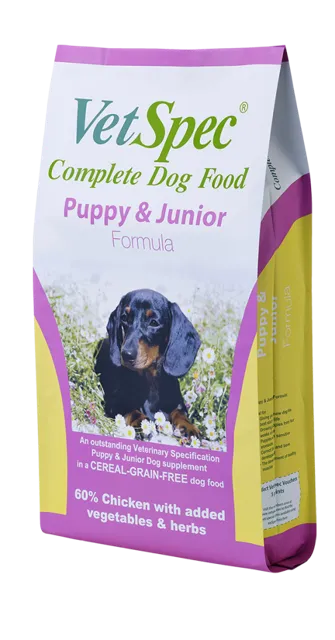

Vetspec
VetSpec Puppy & Junior Formula: Chicken Formula review
VetSpec Puppy & Junior Formula comes in a chicken version and a salmon version built on one blueprint. One named animal leads each list. Potato is the only real starch, with peas and whole linseeds behind it, and neither bag holds a cereal. Fat runs generously in both, which suits a pup with plenty to burn, and a culinary herb blend with named chicory and yeast extracts closes each recipe. Both land in our Good band.
Our view
Likely to suit
Bird or fish, you can pick the protein here and leave the rest of the diet exactly as it is.
- Puppies fed without grain, with potato, peas and sugar beet pulp doing the work cereals usually do
- Owners keeping a pup on fish alone, salmon being the only animal on that recipe from the meal through to the oil
- Lively pups with plenty to burn off, fat being declared at 18.0% on the chicken label and 17.5% on the salmon one
- Owners who like their prebiotics traced to a source, with chicory extract and yeast extract both named on the list
- Households that want to swap protein without swapping brand, since the two recipes share their starch base and their herb blend
Worth watching
A few points sit behind the front of these bags and are worth knowing.
- Owners rearing a giant or large breed pup will find no calcium figure on either bag, though calcium carbonate is on both lists, and VetSpec would need to supply it
- The chicken recipe carries fish oil, so it sits happily with a chicken preference but not with a fish free exclusion plan
- Energy on both bags is our estimate, and the daily amounts are a starting point to check against how your pup looks
- Potato is the single starch in each recipe, so keep that in mind if your pup has previously done better on a mixed carbohydrate base
Written by our editorial team. Independent guidance, not veterinary advice.
How this scores
How we scoreThe Details
Dog fit
Bird or fish, you can pick the protein here and leave the rest of the diet exactly as it is. A few points sit behind the front of these bags and are worth knowing.
Dry
Puppy
Toy, Small, Medium, Large, Giant
Chicken
The score, in context
Our reading puts both recipes in the Good band. The middle of the puppy dry field lands there too, and these two finish a shade above it. They get there on a named animal leading each list and a starch that is declared rather than left vague. Transparency reads Outstanding across the pair, with protein and processing and nutritional balance behind it on Good, which is a label doing the fundamentals properly.
Neither recipe presses higher because of what the analysis leaves out, chiefly the calcium figure. The ingredient notes below set out where those gaps fall.
What's in it
Ingredients, as declared: Chicken (26.2%), chicken meat meal (26.2%), potato (24.2%), chicken fat (6.2%), peas (4.6%), whole linseeds, sugar beet pulp, chicken digest as gravy (1.6%), fish oil, calcium carbonate, sodium chloride, culinary herbs blend (dried seaweed (0.2%), chicory extract as source of fructo-oligosaccharides (0.31%), yeast extract as source of mannan-oligosaccharides (0.08%), alfalfa, yucca extract, rosemary, fennel, basil, thyme, oregano, parsley, aniseed), taurine, DL-methionine, Lysine HCl
Named ingredients
Nutritional additives
- **Vitamins:** Vitamin A 20000iu/kg, Vitamin D3 2000iu/kg, Vitamin E (alpha-tocopherol acetate) 250iu/kg, L-carnitine 250mg/kg, Biotin 3.3mg/kg - **Trace Elements:** Iodine as calcium iodate anhydrous 1.5mg/kg, Iron as iron sulphate monohydrate 40mg/kg, Iron as iron chelate of amino acids hydrate 10mg/kg, Copper as cupric sulphate pentahydrate 5mg/kg, Copper as cupric chelate of amino acids hydrate 1mg/kg, Zinc as zinc oxide 100mg/kg, Zinc as zinc chelate of amino acids hydrate 25mg/kg, Manganese as manganous oxide 25mg/kg, Manganese as manganous chelate of amino acids hydrate 5mg/kg, Selenium as selenized yeast 0.1mg/kg - **Technological Additives:** With antioxidants (tocopherol-rich extracts of natural origin)
Ingredient notes
The two bags are variations on one design. One named animal opens each list. Potato follows as the only starch of any size, with peas, whole linseeds and sugar beet pulp behind it. Neither list carries a cereal of any kind, so both are genuinely grain free. Both are built for an owner who wants the animal on the front to hold good all the way down the list.
Potato is the engine room. Carbohydrate lands at 38.0% of dry matter in the chicken recipe, 40.7% in the salmon, either side of the 39.0% typical of a puppy dry food. Grain free here has not been used as a shortcut to a lighter starch load. Sugar beet pulp adds a mild and well tolerated fibre, and whole linseeds contribute plant omega 3 alongside a little more of that fibre.
Calcium carbonate appears on both lists, which tells you calcium has been added deliberately, but neither label prints how much ends up in the food. On a growth diet that runs from toy breeds to giant ones, that is the one number worth chasing down. Big breed rearing depends on getting it exactly right.
The culinary herbs blend is doing more than seasoning. Chicory extract is named as the source of fructo oligosaccharides and yeast extract as the source of mannan oligosaccharides, the two prebiotics you meet most often in a young dog's food. Dried seaweed, alfalfa and yucca extract sit alongside them, with a run of kitchen herbs from fennel through to aniseed. Naming the source of each prebiotic rather than listing the initials is the sort of habit that says a label expects to be read.
Fat is generous in both, converting to 19.8% of dry matter in the chicken recipe, 19.2% in the salmon. The amino acid additions are named too: methionine and lysine, and taurine with them. Energy is our own estimate on both bags. The chicken works out at 374 kcal per 100g and the salmon at 380, against the 376 typical of the category.
How this variety differs
The chicken recipe splits its poultry evenly, fresh chicken at 26.2% with chicken meat meal at another 26.2%, and chicken fat at 6.2% with chicken digest as gravy at 1.6% for palatability. The starch is potato at 24.2% and peas at 4.6%. The fish oil supplies marine omega 3, which no bird can provide. As fed it reads 28.5% protein and 18.0% fat, converting to 31.3% and 19.8% of dry matter, with ash at 7.5%. This is the one to pick if your pup has always done well on poultry.
Price and value
£9.12 a kilo for the chicken recipe and £9.25 for the salmon, both sold in 2kg and 12kg bags.
Neither figure turns into a fixed daily amount, because a puppy's portion climbs as it ages and as it grows towards its adult frame. Follow VetSpec's chart and let your pup's condition settle where you land. The chart starts at 40g a day for the youngest and reaches 375g at the top.
Nutritional analysis
Declared analysis
Estimated using Modified Atwater factors*
28.5%
18%
2.5%
7.5%
9%
Dry weight
31.3%
19.8%
2.7%
8.2%
38%
As-fed composition
Estimated breakdown of the finished product by ingredient category, from the declared ingredient list and ingoing weights. These are estimates, not measurements.
54%
32.9%
0.2%
7.5%
5.4%
Pricing & size
- Pack size
- 2KG, 12KG
- Retailer pricing
- Coming soon
Live retailer pricing is not yet available for this food. Prices, cost per day and where to buy will appear here once retailer data is live.
Ingredients and nutrition are taken from manufacturer data. Retailer pricing is not yet live for this food.
Related dog food guides
Ranked shortlists that include foods like this one.