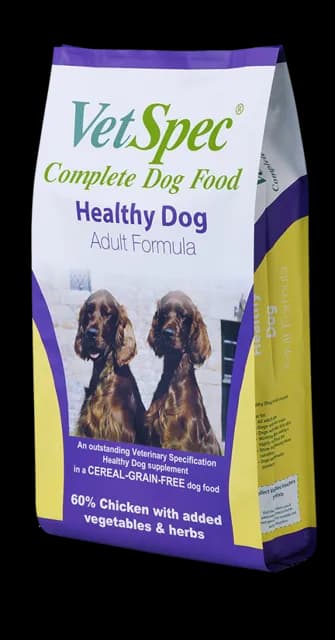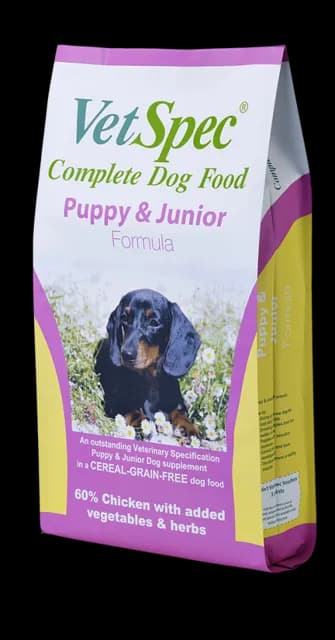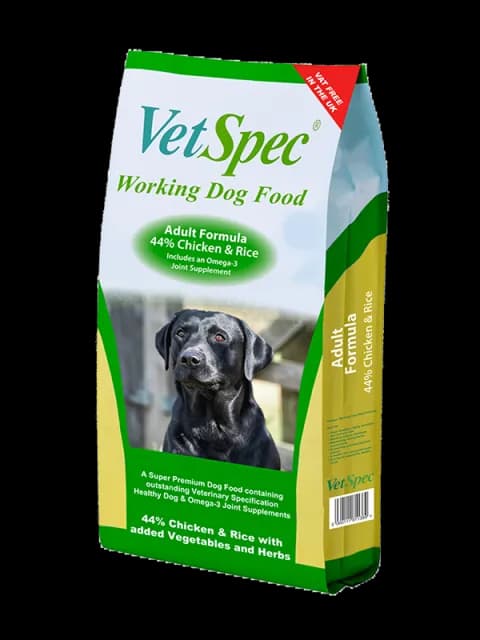

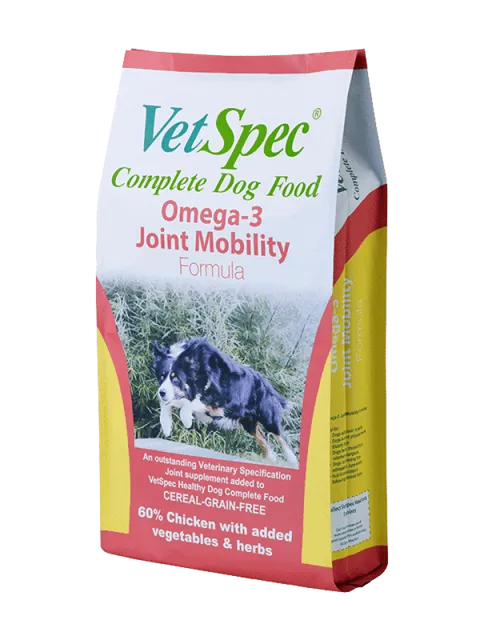

Vetspec
VetSpec Omega-3 Joint Mobility Formula review
VetSpec Omega-3 Joint Mobility takes the brand's standard chicken recipe and aims it at stiffening joints. Chicken heads the list twice, fresh at 26.0% and as meat meal at 26.0%, with potato carrying the starch. The mobility case rests on glucosamine at 0.5%, chondroitin sulphate at 0.06% and omega 3 from both a plant and a marine source. Our scoring reaches the Good band with it, the same band that covers most adult dry food.
Our view
Likely to suit
If your dog is slowing down on the way home from the walk, this is the everyday food that tries to help with that.
- Dogs with joints starting to grumble, since glucosamine at 0.5% and chondroitin sulphate at 0.06% are written into the recipe
- Big, heavy-framed dogs putting a lot of load through their hips and elbows
- Owners who would rather feed the supplement than remember a daily tablet
- Working and sporting dogs, since fat converts to 20.7% of dry matter and the bowl is energy dense
- Chicken-friendly dogs fed without cereal, as potato at 23.9% and peas stand in for grain
Worth watching
A few things deserve a moment before you move your dog onto it.
- Fish oil supplies part of the omega 3, so this is not a fish-free bowl
- Chicken turns up as the meat, as the meal, as the fat and in the gravy, and a chicken-sensitive dog will want something else
- This is a rich and energy dense food, and a dog already carrying extra weight needs their portions handled carefully
- Joint ingredients are a long game rather than a quick fix, so give a new bag several weeks before you judge what it is doing
Written by our editorial team. Independent guidance, not veterinary advice.
How this scores
How we scoreThe Details
Dog fit
If your dog is slowing down on the way home from the walk, this is the everyday food that tries to help with that. A few things deserve a moment before you move your dog onto it.
Dry
Adult
Toy, Small, Medium, Large, Giant
Chicken
The score, in context
This one lands in our Good band, on the same footing as most adult dry food. Most of that work is done by two chicken entries opening the list, protein at 31.0% of dry matter and estimated carbohydrate at 37.4% against the 46.2% typical for adult dry food. Two notes on the figures themselves. The label declares no moisture, so the dry matter conversions here rest on the 8% usual for a kibble, and the calories are our estimate, with nothing declared. Neither changes the shape of the reading, and neither is unusual for a British dry food.
What's in it
Ingredients, as declared: Chicken (26.0%), Chicken meat meal (26.0%), potato (23.9%), chicken fat (6.8%), peas (4.6%), whole linseeds (4.6%), sugar beet pulp, chicken digest as gravy (1.5%), fish oil (1.2%), glucosamine HCl (0.5%), calcium carbonate, sodium chloride, culinary herbs blend (dried seaweed (0.2%), chicory extract as source of fructo-oligosaccharides (0.08%), yeast extract as source of mannanoligosaccharides (0.08%), alfalfa, yucca extract, rosemary, fennel, basil, thyme, oregano, parsley, aniseed), chondroitin sulphate (0.06%), DL-methionine
Named ingredients
Nutritional additives
- **Vitamins:** Vitamin A 20000iu/kg, Vitamin D3 2000iu/kg, Vitamin E (alpha-tocopherol acetate) 250iu/kg, Biotin 3.3mg/kg - **Trace Elements:** Iodine as calcium iodate anhydrous 1.5mg/kg, Iron as iron sulphate monohydrate 40mg/kg, Copper as cupric sulphate pentahydrate 5mg/kg, Copper as cupric chelate of amino acids hydrate 1mg/kg, Zinc as zinc oxide 100mg/kg, Zinc as zinc chelate of amino acids hydrate 25mg/kg, Manganese as manganous oxide 25mg/kg, Selenium as selenized yeast 0.1mg/kg - **Technological Additives:** With antioxidants (tocopherol-rich extracts of natural origin)
Ingredient notes
Chicken is declared twice at the front, fresh at 26.0% with chicken meat meal at 26.0% beside it. Fresh meat comes in heavy with water and leaves the oven a good deal lighter. Protein in the finished kibble is held up by the meal. Putting the two at equal weight is a deliberate way of getting both palatability and substance. Protein converts to 31.0% of dry matter and fat to 20.7%, which is a genuinely rich pairing.
Glucosamine hydrochloride at 0.5% and chondroitin sulphate at 0.06% are the joint entries. Both come with their percentages printed. That is what makes the label worth the read. Supplemented glucosamine is usually made from crustacean shells and chondroitin from animal cartilage, and both are building blocks of cartilage itself. The evidence for them is honestly mixed, so read this as steady daily support rather than as a treatment.
The omega 3 side is the other half of the mobility case and it arrives from two directions. Whole linseeds at 4.6% supply the plant form, which the dog has to convert first. Fish oil at 1.2% supplies the long-chain forms directly. Covering both routes is the sensible way to build this, and it does put fish in the bowl for anyone keeping their dog off it.
The binding is potato at 23.9% and peas at 4.6%, with no cereal involved and sugar beet pulp for the fibre. Chicken fat at 6.8% is a named animal fat, always the better read. Chicken digest at 1.5% is a palatant, broken-down chicken brewed into a broth that keeps the kibble appealing to a fussier dog.
The culinary herbs blend hides the small functional entries. Chicory extract at 0.08% is a source of FOS and yeast extract at 0.08% a source of MOS, prebiotics for the large intestine, with dried seaweed at 0.2% for iodine. The rosemary, basil and aniseed behind them are flavour, and nothing in the recipe rests on them.
A dose is printed beside every trace mineral. The label goes further and declares copper and zinc in two forms each, a simple salt or oxide plus an amino acid chelate, which the gut takes up more easily. Selenium comes as selenised yeast, and of the two permitted forms it is the better one.
Price and value
£9.12 a kilo, sold in 2kg and 12kg bags.
As a guide, a 15kg adult dog in moderate condition works out at roughly 220 grams a day on the estimated 382 kcal per 100g. Taking around 840 kcal a day (110 × bodyweight^0.75, the standard maintenance estimate) as the target, that comes to £2.01 a day. The bag's low activity guide covers an 11kg to 20kg dog with 130 to 200 grams, and a stiffer, slower dog usually sits at the lower end of that.
Nutritional analysis
Declared analysis
Estimated using Modified Atwater factors*
28.5%
19%
2.5%
7.5%
Dry weight
31%
20.7%
2.7%
8.2%
37.4%
As-fed composition
Estimated breakdown of the finished product by ingredient category, from the declared ingredient list and ingoing weights. These are estimates, not measurements.
53.5%
31.3%
0.2%
8%
7%
Pricing & size
- Pack size
- 2KG, 12KG
- Retailer pricing
- Coming soon
Live retailer pricing is not yet available for this food. Prices, cost per day and where to buy will appear here once retailer data is live.
Ingredients and nutrition are taken from manufacturer data. Retailer pricing is not yet live for this food.
Related dog food guides
Ranked shortlists that include foods like this one.