



The Hunger Of The Wolf
The Hunger Of The Wolf Puppy & Junior: Chicken (Large and Giant Breeds) review
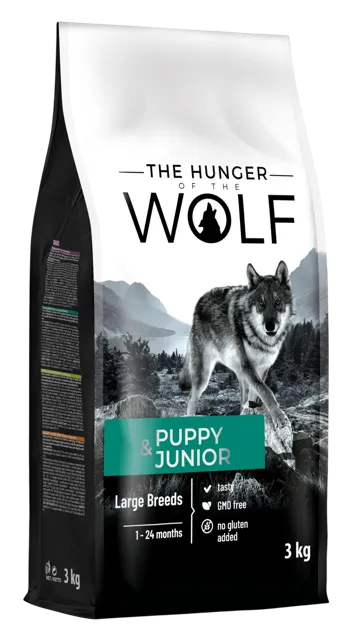
The Hunger Of The Wolf splits its growth range in two: a chicken recipe formulated specifically for large and giant breed puppies, and a lamb and rice recipe pitched at every size. Both print a calcium figure, the single most useful number on a puppy label. The chicken gives 1.2% of dry matter and the lamb 1.58%, both inside the range growing bones want. Meat meals lead each list with maize, wheat or rice carrying the starch behind them, and both recipes sit in our Good band.
Our view
Likely to suit
Rearing a big pup is the harder feeding job, and you can see this range taking it on directly.
- Large and giant breed puppies, with the chicken recipe formulated for them and its calcium converting to 1.2% of dry matter
- Owners who look for the mineral line first, since the lamb recipe declares calcium too and converts to 1.58% of dry matter
- A pup you want to start joint support for early, since glucosamine and chondroitin are both named in the chicken recipe
- Households with dogs of different sizes coming up together, since one recipe is built for big pups and one covers every size
Worth watching
Both recipes share a few label habits that you will want to know about.
- Maize sits high on both lists and wheat appears in the chicken recipe, so neither one suits a pup with a cereal intolerance
- Fish meal appears in both recipes, which matters if fish is kept off your dog's menu
Written by our editorial team. Independent guidance, not veterinary advice.
How this scores
How we scoreThe Details
Dog fit
Rearing a big pup is the harder feeding job, and you can see this range taking it on directly. Both recipes share a few label habits that you will want to know about.
Dry
Puppy
Large, Giant
Chicken
The score, in context
The two recipes are not interchangeable on quality. Both reach our Good band, with the chicken one the stronger reading of the two, so which bag you pick still matters here. Since the typical puppy dry food also occupies the Good band, both recipes keep company with their field.
Nutritional balance reads Good on both recipes. Transparency is the chicken's weak point at Average against Good for the lamb, and protein and processing reverses that, Good for the chicken and Average for the lamb. The calcium declarations are what lift this range above others built on similar ingredients, because a printed, in range figure is exactly what a growth food should be offering and a great many do not.
What's in it
Ingredients, as declared: Chicken meal (29.5 %), maize, wheat, fish meal, poultry fat, rice, hydrolyzed poultry liver, flaxseed, coconut oil, MOS (mannanoligosaccharides), FOS (fructooligosaccharides), beta-glucans, glucosamine, chondroitin, feed additives (vitamins A, D3 and E, choline-chloride, biotin, chelated form of zinc and manganese, organic selenium, lysine, methionine, Enterococcus faecium).
Named ingredients
Nutritional additives
Vitamin A (IE/kg) (E 672): 18.000; Vitamin D3 (IE/kg) (E 671): 1.800; Vitamin E (alfa – tocoferolen): 180; L-carnitine: 50. _Source: the "Vitamins" row of the same composition-matched A+ column as the analysis above. The pack artwork carries a longer trace-element and technological-additive declaration, but only in Spanish, French, German and Italian — it is not published in English anywhere on these pages, so it is not transcribed here._ _Additives are **also declared inline in the ingredient list**, without quantities — from "feed additives" to the end of the statement: "feed additives (vitamins A, D3 and E, choline-chloride, biotin, chelated form of zinc and manganese, organic selenium, lysine, methionine, Enterococcus faecium)."._
Ingredient notes
Start with the calcium, because in a growth food nothing else on the analysis works as hard. The chicken recipe converts to 1.2% of dry matter and the lamb to 1.58%, both inside the range growing bones need. The lower figure on the large and giant breed recipe is deliberate and correct. A big pup laying down skeleton fast is the animal most easily harmed by too much calcium, so a large breed formulation should read lower than a general one. This one does.
Concentrated meat leads each bag. Chicken meal at 29.5% opens one and lamb meal at 20% opens the other. Meal is meat already rendered and dried, so what the label declares is what reaches the finished kibble, with nothing lost in the oven. Fish meal appears in both as a second animal source, and hydrolysed poultry or chicken liver is used in each as a natural palatability coating.
The starch side is conventional. Maize features in both and rice in both, with wheat in the chicken recipe only. Carbohydrate converts to 44.6% of dry matter in the chicken and to 41.3% in the lamb, against the 39.0% typical of a puppy dry food. That is a slightly heavier starch load than average. It is the trade these recipes make for opening with a named, concentrated meat.
The support package differs between the two but is thoughtful in both. The chicken recipe names MOS and FOS as prebiotics, with beta-glucans for immune support. Glucosamine and chondroitin go in for the joints, and Enterococcus faecium closes the list as a live gut culture. That is a well chosen set for a heavy framed pup. In the lamb recipe it is dried chicory for inulin and brewery yeast as a natural MOS source. Dried whole eggs go in too, with a run of plant extracts from rosemary to turmeric. Neither list carries doses, so these are named rather than quantified.
Two practical caveats sit over the analysis. Neither label declares moisture, so the dry matter figures use the standard 8% assumption for a kibble. Both energy figures are our estimates rather than declarations, at 360 kcal per 100g on the chicken, 367 on the lamb, against a 376 typical. The full trace element panel exists on the pack artwork but is published only in Spanish, French, German and Italian, which is why the mineral doses are missing from what you can read here.
How this variety differs
Chicken meal at 29.5% opens this one, with maize and wheat behind it, fish meal as a second protein and rice further down. It is the recipe built for large and giant breeds, and its calcium converting to 1.2% of dry matter is exactly the restraint a big pup's skeleton wants. Glucosamine and chondroitin are named for joints, MOS, FOS and beta-glucans for gut and immune support, and Enterococcus faecium closes the list as a live culture, though none of them carry a dose. Flaxseed and coconut oil round out the fats alongside the poultry fat.
Price and value
£2.71 a kilo.
The chicken recipe's guide is written by the adult size you expect. For a pup heading towards 35kg it runs 340g a day at 2kg of bodyweight, 650g at 6kg and 680g at 9kg. Separate columns cover pups expected to reach 60kg and 80kg. The lamb recipe covers smaller dogs, at 75g a day for a 2 to 6kg pup on track for 5kg and 115g from 6 to 12kg. Pick the column by the adult size first, then work down the rows as the months pass and your pup grows into each one.
Nutritional analysis
Declared analysis
Estimated using Modified Atwater factors*
28%
14%
2.5%
6.5%
Dry weight
30.4%
15.2%
2.7%
7.1%
44.6%
As-fed composition
Estimated breakdown of the finished product by ingredient category, from the declared ingredient list and ingoing weights. These are estimates, not measurements.
44.1%
49.4%
4.4%
2.2%
Pricing & size
- Retailer pricing
- Coming soon
Live retailer pricing is not yet available for this food. Prices, cost per day and where to buy will appear here once retailer data is live.
Ingredients and nutrition are taken from manufacturer data. Retailer pricing is not yet live for this food.
Related dog food guides
Ranked shortlists that include foods like this one.