



Poppy's Picnic
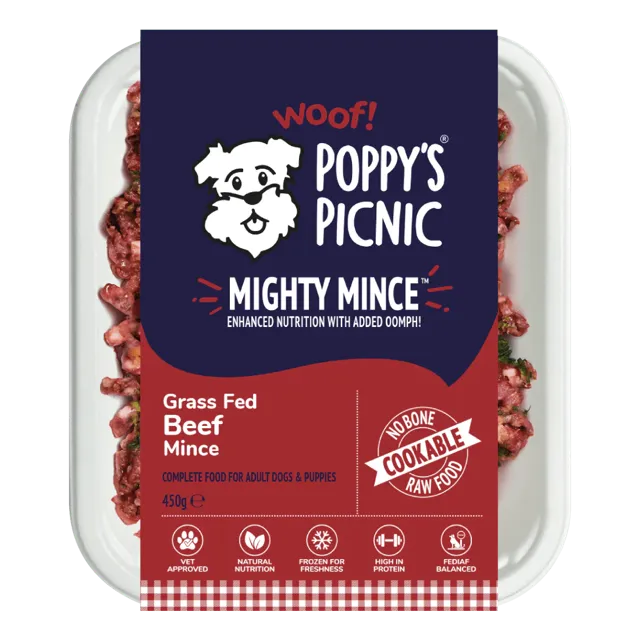
Poppy's Picnic Raw Power Mince: Venison & Duck Mince review
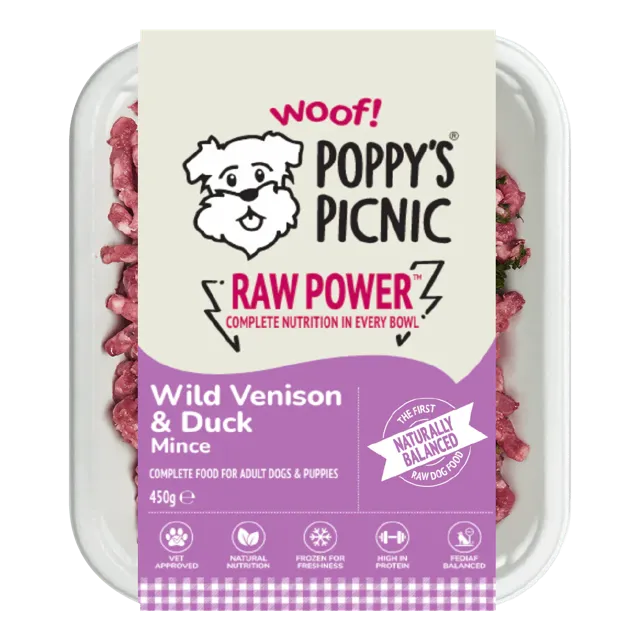
Poppy's Picnic Raw Power Mince is the bone-in end of the brand's raw shelf. Ribs, drumsticks and carcass are worked into the grind alongside mince, heart, liver and kidney, so the calcium arrives the way raw usually delivers it, out of the bone itself. Five recipes cover beef, chicken, lamb and turkey, with a venison and duck pairing making the fifth. They share one base of four fresh vegetables, wheatgerm, salmon oil, kelp, spirulina, wheatgrass and turmeric. Every one of the five sits in our Outstanding band.
Our view
Likely to suit
If you want ground bone in your dog's raw dinner, this is the Poppy's range to start with.
- Raw feeders who want calcium coming from the grind, with ribs, drumsticks or carcass declared on every label
- Owners running the widest rotation, since venison and duck join the usual beef, chicken, lamb and turkey
- Any size of dog and any age, since the label reaches from toy to giant and covers puppies through to old dogs
- Owners who want the animal broken down properly, since each cut carries its own printed share
- Dogs that hold weight easily, with the venison and duck mince the lightest in fat of the five
Worth watching
Bone in the grind changes a few things worth knowing before you fill the freezer.
- Beef organs and wild salmon oil are in all five recipes, so beef and fish are in every bowl
- Calcium runs high on three of the five, reaching 2.01% of dry matter on the Chicken Mince, and that is one for the vet when the bowl is going to a large breed puppy
- The usual raw routine applies: freezer space, thawing in the fridge and a proper clean down afterwards
Written by our editorial team. Independent guidance, not veterinary advice.
How this scores
How we scoreThe Details
Dog fit
If you want ground bone in your dog's raw dinner, this is the Poppy's range to start with. Bone in the grind changes a few things worth knowing before you fill the freezer.
Raw
Puppy, Adult, Senior
Toy, Small, Medium, Large, Giant
Venison
The score, in context
All five recipes land in our Outstanding band, and the typical raw food lands there too. The bar in this category is set very high, and there is nothing ordinary about these labels. Each of the five finishes above the middle of the raw field, with the Beef Mince and the Turkey Mince level at the top of the group. Bone in the grind, a working organ set on every label and printed percentages against almost every entry are what earn the placing. The five sit close enough together that the honest question is which animal suits your dog, not which recipe ranks best.
What's in it
Ingredients, as declared: 28% Wild Venison Mince, 24% Duck (16% Duck Breast, 8% Duck Carcass), 10% Beef Mince, 9% Beef Heart, 4% Beef Kidney, 4% Beef Liver, Fresh Vegetables (4% Sweet Potato, 4% Green Cabbage, 4% Carrots, 4% Parsnip, Parsley), Organic Crude Wheatgerm (a natural source of Manganese), Sustainably Sourced Wild Salmon Oil (a source of Vitamin D and healthy Omega 3 fats), Natural Vitamin E from Sunflower Oil, 0.6% Kelp Seaweed (a source of Iodine), 0.44% Spirulina, 0.34% Wheatgrass, 0.2% Turmeric
Named ingredients
Nutritional additives
No separate additives panel is published — inline in the composition (e.g. Sustainably Sourced Wild Salmon Oil as a source of Vitamin D and Omega 3, Natural Vitamin E from Sunflower Oil, Kelp Seaweed as a source of Iodine, Organic Crude Wheatgerm as a natural source of Manganese).
Ingredient notes
Bone is the point of difference. Beef ribs at 3%, chicken drumstick at 10%, lamb ribs at 7%, turkey drumsticks at 7% and duck carcass at 8% are declared alongside the muscle meat. The calcium in these recipes is ground into the food. That is the traditional raw arrangement, and it is also why the calcium readings here run from 1.10% to 2.01% of dry matter, a good deal higher than a boneless recipe manages.
The organ set is consistent and generous. Beef heart at 9% to 10% runs through the range, with beef liver at 4% throughout and kidney between 3.5% and 4%. On the venison and duck recipe those organs are itemised at the front of the list, with no grouped percentage hiding them. Nothing a dog eats packs more nutrition into a mouthful than liver, with B12 and vitamin A in it along with copper and selenium. That is precisely why these recipes can stand without a supplement panel.
The plant side is deliberately restrained: sweet potato, green cabbage, carrots and parsnip at 4% each, with parsley after them. Naming all four means you can see what the plant fraction actually is. At that inclusion it contributes fibre and antioxidants without pushing starch into a meat-shaped recipe.
There is no vitamin and mineral premix anywhere in this range, and Poppy's says what stands in for one. Salmon oil is declared as the source of vitamin D and omega 3, and sunflower oil as natural vitamin E. Iodine comes from kelp seaweed at 0.6%, and manganese from organic crude wheatgerm. The list ends with spirulina at 0.44%, wheatgrass at 0.34% and turmeric at 0.2%. Those last three are seasoning at that level and the figures do not pretend otherwise. Wheatgrass is a leaf, and none of the gluten proteins that trouble wheat sensitive dogs travel with it.
On the analysis these read exactly like bone-in raw should. Protein converts to between 41.6% and 59.8% of dry matter, with fat between 20.1% and 38.1%. Carbohydrate reaches no more than 13.4%, and most of that is the by-difference estimate sweeping up whatever is not measured, with nothing starchy on the label. Crude ash climbs with bone content, which is why the venison and duck recipe declares 9.4% of dry matter against 3.2% on the beef.
How this variety differs
Wild venison mince at 28% and duck at 24%, the duck itemised as 16% breast and 8% carcass, with beef mince and organs making up the rest. It is the leanest and highest in protein of the five, converting to 59.8% of dry matter against fat at 20.1%, at 144 kcal per 100g. Crude ash is the highest here too at 9.4% of dry matter, which is the duck carcass showing up in the figures.
Price and value
All five are £7.11 a kilo. The pack is 450g, bought one at a time or in boxes of 8, 16, 24, 36 and 44.
On the standard maintenance estimate a 15kg adult dog in moderate condition needs about 840 kcal a day (110 × bodyweight^0.75), which on these recipes means 414g to 583g and £2.94 to £4.15 a day. The Lamb Mince is the densest of the five, and its portions are the smallest; the Venison & Duck is the lightest and feeds in the largest.
Nutritional analysis
Declared analysis
18.4%
6.2%
0.6%
2.9%
69.23%
Dry weight
59.8%
20.1%
1.9%
9.4%
8.8%
As-fed composition
Estimated breakdown of the finished product by ingredient category, from the declared ingredient list and ingoing weights. These are estimates, not measurements.
79%
10.2%
5.3%
5.5%
Pricing & size
- Pack size
- 450g tray/pack, sold as 1 Pack, 8 Packs, 16 Packs, 24 Packs, 36 Packs, 44 Packs
- Retailer pricing
- Coming soon
Live retailer pricing is not yet available for this food. Prices, cost per day and where to buy will appear here once retailer data is live.
Ingredients and nutrition are taken from manufacturer data. Retailer pricing is not yet live for this food.
Related dog food guides
Ranked shortlists that include foods like this one.