



Poppy's Picnic
Poppy's Picnic Power Balls: Wild Boar Meatballs review
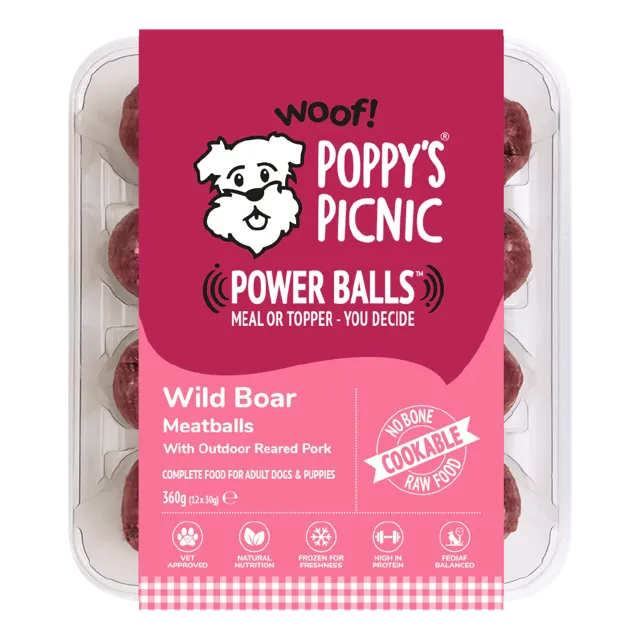
Poppy's Picnic Power Balls take the brand's raw thinking and roll it into meatballs. Each 360g pack puts named grass fed meat and organs at the front, four fresh vegetables at 4% apiece behind them, then wheatgerm, salmon oil, crushed eggshell, kelp, spirulina, wheatgrass and turmeric to finish. It is the shortest label Poppy's prints, the tidiest of its formats to serve, and all four flavours sit in our Outstanding band.
Our view
Likely to suit
Some dogs simply eat better when dinner arrives in pieces rather than as a scoop.
- Owners who want raw without the mess, since meatballs go from pack to bowl without a spoon
- Hand feeders and dogs that need coaxing, because a meatball works as a unit in a way a loose mince does not
- Raw feeders after a short, readable label, with the extras kept to kelp, spirulina, wheatgrass and turmeric
- Dogs at any size and any stage, with the range labelled from toy to giant and for puppies through to older dogs
- Owners after a less common lead animal, with wild boar sitting beside the beef, chicken and lamb
Worth watching
A little planning goes a long way with a frozen food, and the animals repay a close look too.
- Neither beef nor wild salmon oil can be avoided here, since beef carries part of every recipe and the oil appears on each of the four labels
- Calcium here comes from crushed eggshell with no ground bone behind it, and on the Chicken Meatballs it reads 0.71% of dry matter, light for raising a large breed puppy
- Frozen storage, thawing in the fridge and a proper clean down after handling come with the territory
Written by our editorial team. Independent guidance, not veterinary advice.
How this scores
How we scoreThe Details
Dog fit
Some dogs simply eat better when dinner arrives in pieces rather than as a scoop. A little planning goes a long way with a frozen food, and the animals repay a close look too.
Raw
Puppy, Adult, Senior
Toy, Small, Medium, Large, Giant
Wild Boar
The score, in context
Every flavour here reaches our Outstanding band, and so does the typical raw food. All four sit just clear of the category middle. That is worth saying plainly. No field scores higher with us than raw, and keeping level with it takes a genuinely good label. The named meat share, the working organ set and the percentages printed against almost every entry are what do the earning. Differences between the four are small enough that the animal, not the ranking, should decide it.
What's in it
Ingredients, as declared: 49% Wild Boar Mince, 22% Grass Fed Beef Heart, Outdoor Reared Pork Mince, Grass Fed Beef Liver, Grass Fed Beef Kidney, Fresh Vegetables (4% Sweet Potato, 4% Green Cabbage, 4% Carrots, 4% Parsnip, Parsley), Organic Crude Wheatgerm (a natural source of Manganese), Natural Vitamin E from Sunflower Oil, Sustainably Sourced Wild Salmon Oil (a source of Vitamin D and healthy Omega 3 fats), Crushed Eggshells, 0.7`% Kelp Seaweed (a source of Iodine), 0.44% Spirulina, 0.34% Wheatgrass, 0.2% Turmeric
Named ingredients
Nutritional additives
No separate additives panel is published — inline in the composition (e.g. Sustainably Sourced Wild Salmon Oil as a source of Vitamin D and Omega 3, Natural Vitamin E from Sunflower Oil, Kelp Seaweed as a source of Iodine, Organic Crude Wheatgerm as a natural source of Manganese, Crushed Eggshell as the calcium source).
Ingredient notes
Rolling raw into a ball changes the handling, and the recipe stays put. The construction underneath is the same one Poppy's uses across its raw shelf: named muscle meat first, organ meats behind it, a fixed vegetable share, then oils and sea plants to finish. What the format adds is the ability to take dinner out of the pack in pieces, which is a small thing until you have tried to serve a half-thawed block of mince.
Organ meats are doing real work on these labels. Beef heart runs from 3% to 22% depending on the flavour, with beef liver printed between 2% and 4.9% and kidney behind it where the recipe carries one. Liver is exceptionally dense in vitamin A, B12, copper and selenium, and it is the reason a raw recipe can go without a vitamin panel and still stand up.
Four vegetables at 4% each, sweet potato, green cabbage, carrots and parsnip, with parsley after them. That is a leaner produce list than Poppy's uses elsewhere, and it is all the better for being itemised. You can see exactly what the plant fraction is, with no fresh vegetables entry to take on trust. Carrots contribute beta carotene, soluble fibre and antioxidants, and the brassicas add bulk without adding starch.
Nothing here is supplemented from a powder. Crushed eggshells carry the calcium. Vitamin D and omega 3 fats come out of wild salmon oil, natural vitamin E out of sunflower oil, iodine out of kelp seaweed at 0.7%, and manganese out of organic crude wheatgerm. Spirulina at 0.44%, wheatgrass at 0.34% and turmeric at 0.2% close the list, small enough to read as character, and the printed figures are candid about that.
The analyses come out where meat and organ recipes should. Protein converts to between 36.2% and 64.6% of dry matter, fat to between 19.2% and 38.2%, and carbohydrate stays low on three of the four. The Lamb Meatballs estimate at 19.3% of dry matter, a quirk of calculating carbohydrate by difference. There is no cereal or pulse on the label to account for it.
How this variety differs
Wild boar mince at 49% and grass fed beef heart at 22%, with outdoor reared pork mince, beef liver and beef kidney following without figures of their own. That puts four species in one pack, which is a treat for a rotation and a label to read twice on an exclusion diet. It reads at 177 kcal per 100g, with protein at 46.0% of dry matter and fat at 38.2%, the richest fat conversion of the four.
Price and value
Every flavour is £10.56 a kilo. Packs hold 360g, and the boxes run 8, 16, 24, 36 and 44.
Take a 15kg adult dog in moderate condition, needing around 840 kcal a day on the standard maintenance estimate (110 × bodyweight^0.75). Portions run from 378g to 706g and a day's feeding from £4.00 to £7.45. The difference is richness: the Lamb Meatballs put the most energy into a gram, the Chicken Meatballs the least.
Nutritional analysis
Declared analysis
15.4%
12.8%
1.5%
1%
66.53%
Dry weight
46%
38.2%
4.5%
3%
8.3%
As-fed composition
Estimated breakdown of the finished product by ingredient category, from the declared ingredient list and ingoing weights. These are estimates, not measurements.
94.5%
2.5%
1.1%
1.8%
Pricing & size
- Pack size
- 360g tray/pack, sold as 1 Pack, 8 Packs, 16 Packs, 24 Packs, 36 Packs, 44 Packs
- Retailer pricing
- Coming soon
Live retailer pricing is not yet available for this food. Prices, cost per day and where to buy will appear here once retailer data is live.
Ingredients and nutrition are taken from manufacturer data. Retailer pricing is not yet live for this food.
Related dog food guides
Ranked shortlists that include foods like this one.
Featured in our breed food guides
One of the foods on our Off the Leash shortlist for these breeds.