



Optimum Pet Health
Optimum Pet Health Puppy Trays review
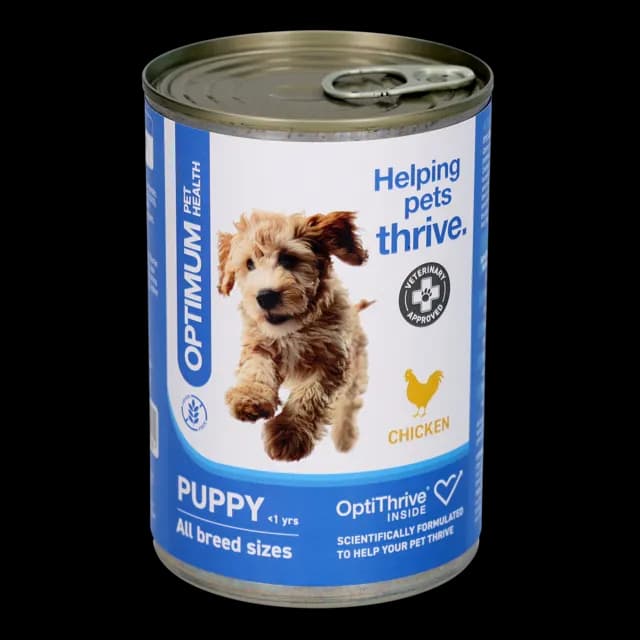
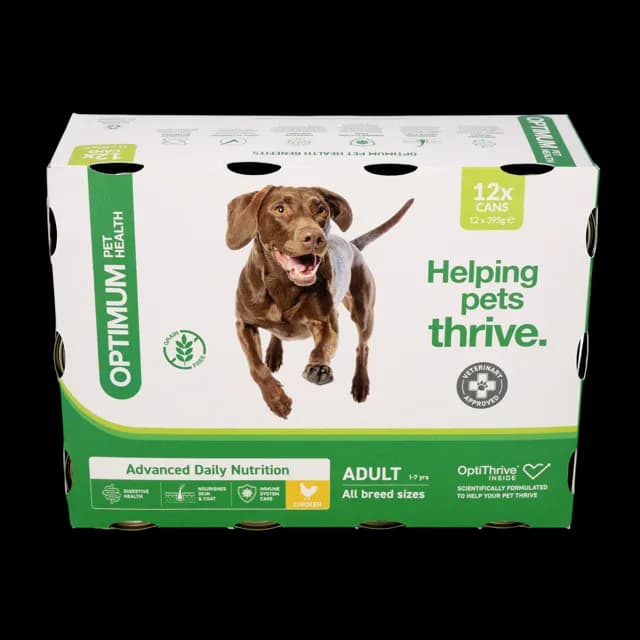
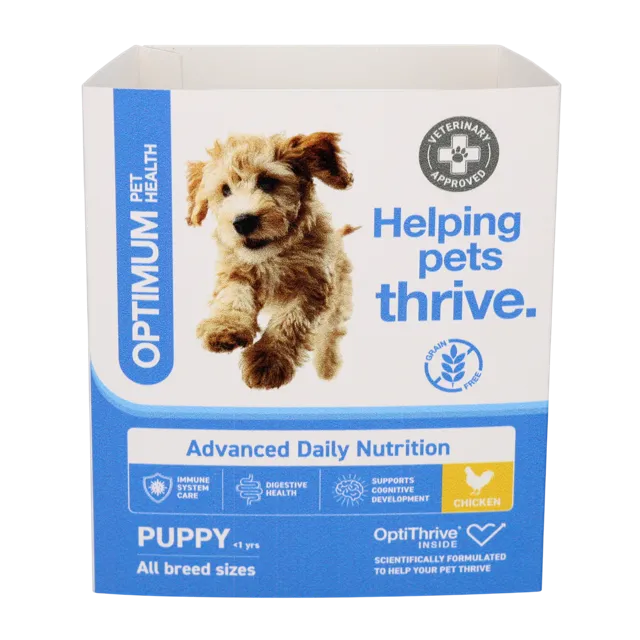
Optimum Pet Health Puppy Trays build a growth meal around one meat and very little else. Chicken is 65% of the tray, and for plant bulk there is only dried peas with dried carrot. The rest of the list is a short run of prebiotics, two tyndallised cultures and a splash of salmon oil. Protein converts to 40.0% of dry matter, carbohydrate stops at 8.0%, and that combination puts the tray in our Excellent band.
Our view
Likely to suit
You will find nothing on this label that needs decoding before you can make up your mind.
- Pups doing well on chicken, the tray's only meat, leading at 65%
- Owners who like the bowl to be mostly meat, with protein converting to 40.0% of dry matter and carbohydrate to only 8.0%
- Pups whose digestion is still settling down, since prebiotic MOS and prebiotic chicory sit at 0.1% each with two tyndallised cultures behind them
- Households mixing wet into a dry diet, since a tray declared at 75% moisture brings water and appetite appeal with it
- Grain-free feeders, with dried peas and dried carrot carrying what little plant matter there is
Worth watching
A few details on this label repay a moment before the trays become the everyday meal.
- The label prints no calcium figure, and that figure is what rearing a large or giant breed turns on, so a big pup's feeding plan is one to settle with your vet
- Chicken is the sole meat, but salmon oil sits in the recipe, and that rules out a fish-free elimination diet
- Wet food feeds in far larger volumes than kibble, so a hungry pup works through trays quickly and the storage space adds up
Written by our editorial team. Independent guidance, not veterinary advice.
How this scores
How we scoreThe Details
Dog fit
You will find nothing on this label that needs decoding before you can make up your mind. A few details on this label repay a moment before the trays become the everyday meal.
Wet
Puppy
Toy, Small, Medium, Large, Giant
Chicken
The score, in context
This recipe holds our Excellent band and finishes clear of the midpoint, in a strong field whose middle already reaches that same band. Construction gets it there, with no flourish needed: one meat at a generous share, and 8.0% of dry matter as starch against the 13.6% typical of the category. At 121 kcal per 100g it carries more energy than the 106 of a typical puppy wet food. Nutritional balance and transparency both read Outstanding, with protein and processing and value in Excellent.
What's in it
Ingredients, as declared: 68443back.jpg (68443_04, single 395g tray)): Chicken (65%), Dried Peas, Dried Carrot, Minerals, Salmon Oil (0.1%), Prebiotic MOS (0.1% including beta glucans 0.03%), Prebiotic Chicory (0.1% including inulin 0.06%), Dried Algae (0.035%, source of omega 3), Dried Rosehip (0.015%), Blueberry extract (0.015%), Tyndallised Lactobacillus helveticus HA-122 (0.0035%), Tyndallised Lacticaseibacillus paracasei HA-108 (0.0035%).
Named ingredients
Ingredient notes
Chicken at 65% drives this recipe, and the analysis agrees with what the front of the tray says. Protein converts to 40.0% of dry matter and fat to 36.0%, with the carbohydrate estimate landing at 8.0%. That is the shape of a meal built on meat, with the plant side held to dried peas and dried carrot.
Whole dried peas carry fibre and B vitamins, along with a spread of minerals and their starch. Dried carrot adds vitamin A and a little soluble fibre. Neither appears in the sort of quantity that would start doing the meat's job. That is what you want sitting behind a 65% headline.
The gut package is small but specific. Prebiotic MOS at 0.1% includes beta glucans at 0.03%, and prebiotic chicory at 0.1% includes inulin at 0.06%. Both work on the large intestine's bacteria, not on the pup directly. Two tyndallised cultures at 0.0035% apiece close the list.
Salmon oil at 0.1% and dried algae at 0.035% cover the marine omega 3 a growing brain and coat need. That is also what puts fish into the allergen picture, chicken being the only meat named on the tray.
Ash converts to 12.0% of dry matter, which tells you the mineral load is generous, but the label stops short of printing calcium. That single figure is what large breed growth turns on, so no claim about rearing a big pup can rest on it here. Small and medium pups are unaffected. Owners whose pup is heading for a large adult frame will want to ask the maker or the vet.
Dried rosehip and blueberry extract at 0.015% apiece sit right at the garnish end of the list, antioxidant touches and not working ingredients. The recipe is honest enough to declare them at that level and not let them look like more than they are.
Price and value
£4.22 a kilo, sold as a single 395g tray and in a 12 x 395g multipack.
What a puppy gets through keeps moving as they put on frame. Set the tray count from how your pup is filling out and from the growth chart on the pack, then look at it again every couple of weeks.
Nutritional analysis
Declared analysis
10%
9%
1%
3%
75%
Dry weight
40%
36%
4%
12%
8%
As-fed composition
Estimated breakdown of the finished product by ingredient category, from the declared ingredient list and ingoing weights. These are estimates, not measurements.
65%
20.9%
8.1%
3.6%
0.1%
2.3%
Pricing & size
- Pack size
- 395g single tray, 12 x 395g multipack
- Retailer pricing
- Coming soon
Live retailer pricing is not yet available for this food. Prices, cost per day and where to buy will appear here once retailer data is live.
Ingredients and nutrition are taken from manufacturer data. Retailer pricing is not yet live for this food.
Related dog food guides
Ranked shortlists that include foods like this one.