


Skip to content
Off the Leash
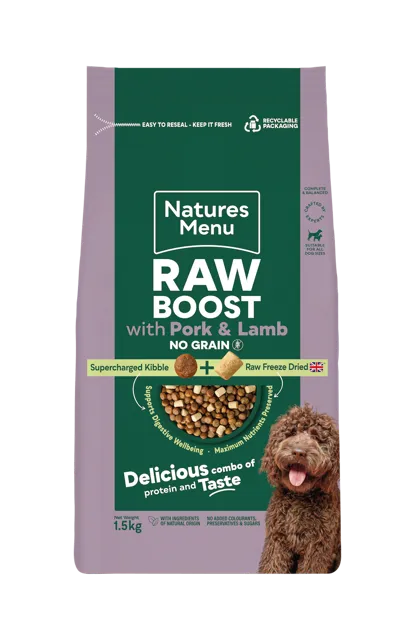
Natures Menu Raw Boost – With Pork and Lamb

Natures Menu

Natures Menu Raw Boost: With Pork and Lamb review

54.8/100Good
DryAdult

Natures Menu Raw Boost is a set of four dry recipes that share a name and not a great deal else. The beef and the chicken are cereal led, built on maize and barley with dehydrated poultry proteins supplying much of the protein. The pork and lamb and the trout go a different way entirely, leading on pea starch and dehydrated potato with no cereal in them beyond maize oil. Chicory root concentrate and a pinch of spirulina run through all four. They land across two of our bands, with the pork and lamb, the beef and the chicken in our Good band and the trout a step behind them in Average.

Where to buy: coming soon
Live retailer pricing is coming soon. Once we have prices from UK retailers, the best price, cost per day and where to buy will appear here.

Our view

Likely to suit

With four recipes this different sharing one name, it pays to know exactly which bag you are picking up.

  • Pork leads one recipe and trout another, so a dog who has tried everything else has somewhere new to go
  • Trout at 13%, backed by white fish and salmon, makes that bag the pick for a dog who does better on fish
  • Owners looking to avoid cereal, as the pork and lamb and the trout recipes carry maize only as the oil
  • Active dogs, with fat at 16% in the beef and chicken bags and 14.5% in the other two
  • Owners who like the gut ingredients declared, with chicory root concentrate printed at 0.2% or 0.8% depending on the recipe

Worth watching

The differences between these bags matter more than usual, so a few points deserve a close read.

  • The beef recipe names beef at 7.5% and takes most of its protein from poultry, so it reads as a poultry food with beef in it
  • Hydrolysed animal proteins in the beef and chicken bags cover poultry, pork and fish at once, so neither anchors a strict elimination trial
  • Lard supplies the fat in the trout recipe, so the fish leads it without being the only animal in it

Written by our editorial team. Independent guidance, not veterinary advice.

How this scores

How we score
54.8/100Good
Protein and processingAverage
Nutritional balanceAverage
TransparencyExcellent
ValueGood

The Details

Dog fit

With four recipes this different sharing one name, it pays to know exactly which bag you are picking up. The differences between these bags matter more than usual, so a few points deserve a close read.

Food type

Dry

Life stage

Adult

Breed size

Toy, Small, Medium, Large, Giant

Main protein

Pork

The score, in context

These four do not travel together. The pork and lamb leads the four, and it, the beef and the chicken all sit in the Good band that marks the middle of the adult dry shelf. The trout finishes a step behind in Average, its protein and processing reading Poor. What separates them is how much of the protein is named and how much of the plant side is cereal. The trout recipe puts trout at 13% near the top and keeps its named meat entirely to fish, and even so it is the one bag whose protein and processing reads Poor. The chicken bag, by contrast, opens with fresh chicken at 21% and then leans on dehydrated poultry proteins, hydrolysed animal proteins and maize in several forms, which is what pulls it down. The analysis across the range is close, with protein between 25.5% and 26.0% and estimated carbohydrate between 45.2% and 47.3% of dry matter. The spread comes down to ingredient naming, not to anything on the panel.

What's in it

Ingredients, as declared: Pea starch, dehydrated pork proteins, dehydrated potato, pork* 10%, dehydrated peas*, lamb* 4%, lard, linseed*, maize oil, hydrolysed pea protein, dried chicory root concentrate (source of inulin)* 0.8%, minerals, lignocellulose, spirulina (Arthrospira platensis)* 0.1%, dried pineapple stem concentrate*. *Natural ingredients.

Named ingredients

Pea starch, dehydrated pork proteins, dehydrated potato, pork* 10%, dehydrated peas*, lamb* 4%, lard, linseed*, maize oil, hydrolysed pea protein, dried chicory root concentrate (source of inulin)* 0.8%, minerals, lignocellulose, spirulina (Arthrospira platensis)* 0.1%, dried pineapple stem concentrate*. *Natural ingredients.

Nutritional additives

_(the page labels this panel "Nutritional additives (Per Kg)")_ Vitamin A 25650 IU; vitamin D3 1140 IU; vitamin E 337 mg; biotin 1 mg; copper(II) sulphate pentahydrate 31 mg; iron(II) sulphate monohydrate 247 mg; potassium iodide 1.8 mg; sodium selenite 0.2 mg; zinc sulphate monohydrate 365 mg; manganous sulphate monohydrate 117 mg.

Ingredient notes

The beef bag is the one most likely to surprise. Dehydrated poultry proteins lead it, maize and fresh chicken follow, and the beef itself is declared at 7.5%, well down the order. Everything is printed in the right sequence, which is honest labelling, but a shopper reaching for the word beef should know that most of the protein in the bag comes from birds.

The chicken recipe starts more promisingly, with fresh chicken at 21% at the front, then falls back on dehydrated poultry proteins, maize, maize meal, barley and maize protein. Baking drives the water off, so what is left of the 21% fresh chicken counts for less in the finished kibble than its spot on the list would suggest. The unnamed poultry entries carry more of the finished food than the named one does.

The pork and lamb recipe is a different animal in every sense. Pea starch leads, dehydrated pork proteins follow, and pork at 10% and lamb at 4% are the named meats, with lard as the fat. No poultry and no fish appear in it. That makes it the bag to reach for when the common birds have caused trouble, and plenty of dogs have simply never met pork.

The trout recipe leads its animal side with trout at 13%, backed by dehydrated trout proteins, white fish and salmon, so fish is the whole of its named meat. The fat, though, is lard. That puts pork in the bag, and a dog kept away from pork should have that noted.

Pea starch and dehydrated peas carry a good deal of the pork and lamb and the trout recipes, with pea protein and hydrolysed pea protein in the trout as well. A dog gets less complete protein from plants than from meat, so the panel figures on those two bags are not all animal in origin. Against that, both avoid cereal apart from maize oil, and a refined oil carries very little of the protein a sensitive dog actually reacts to.

Lignocellulose turns up in the chicken, the pork and lamb and the trout bags. It is purified plant fibre. The pale powder adds bulk and hardly any energy, and it does the job it is put there to do. Recognise it for what it is, though: a manufactured fibre and not the sort that comes attached to a vegetable.

The extras are broadly common across the range. Chicory root concentrate supplies inulin, a prebiotic that feeds gut bacteria, at 0.2% in the cereal led pair and 0.8% in the other two. Spirulina at 0.1% appears in all four and a macroalgae blend at 0.36% in the beef and chicken, both bringing trace minerals. Dried pineapple stem concentrate closes the pork and lamb and the trout lists, a traditional source of the enzyme bromelain.

The mineral panel is the same on every bag and is given per kilogram, with zinc sulphate at 365 mg and iron sulphate at 247 mg the largest entries. The sulphate forms are used here, not chelates, and that is the everyday choice. Biotin at 1 mg alongside them is a nice touch on a food at this level.

How this variety differs

Pea starch leads, then dehydrated pork proteins and dehydrated potato, with pork at 10% and lamb at 4% as the named meats and lard as the fat. No poultry, no fish and no cereal beyond maize oil, which makes it the clearest read in the range for a dog with a problem around birds. Protein is 25.5% and fat 14.5%, chicory root concentrate is dosed at 0.8%, and it comes out top of the four in our Good band.

Price and value

The chicken, the pork and lamb and the trout are £3.00 a kilo. The beef is £9.00 a kilo, and it is the one recipe sold in the 3kg bag alone; the other three come in 1.5kg and 3kg.

As a guide, a 15kg adult dog in moderate condition eats about 223 grams a day of the beef or the chicken and 227 grams of the pork and lamb or the trout. The daily allowance behind those portions is about 840 kcal (110 × bodyweight^0.75, the standard maintenance estimate). That works out at £0.67 a day on the chicken, £0.68 on the pork and lamb and on the trout, and £2.00 on the beef. The calorie figures behind those portions are estimates, so treat the amounts as a starting point.

Nutritional analysis

Declared analysis

Energy
370 kcal/100g

Estimated using Modified Atwater factors*

Protein

25.5%

Fat

14.5%

Fibre

3%

Ash

7%

Moisture

5%

Dry weight

Protein

26.8%

Fat

15.3%

Fibre

3.2%

Ash

7.4%

Carbs

47.3%

As-fed composition

Estimated breakdown of the finished product by ingredient category, from the declared ingredient list and ingoing weights. These are estimates, not measurements.

Meat

35.2%

Carbs

56.8%

Veg

0.9%

Oils

4.1%

Other

3%

Pricing & size
Pack size
1.5KG, 3KG
Retailer pricing
Coming soon

Live retailer pricing is not yet available for this food. Prices, cost per day and where to buy will appear here once retailer data is live.

Ingredients and nutrition are taken from manufacturer data. Retailer pricing is not yet live for this food.

Related dog food guides

Ranked shortlists that include foods like this one.
All reviews

Featured feeding accessories

All feeding accessories

Brackenwood

Slow Feeder Maze Bowl

Slows fast eaters and eases gulping at mealtimes.

From £12.99· 4 retailers
View

Tarn & Co

Raised Double Diner

Height-set stand for easier, tidier eating.

From £28.99· 3 retailers
View

Reviewed by Off the Leash Editorial

Last updated 28 August 2026