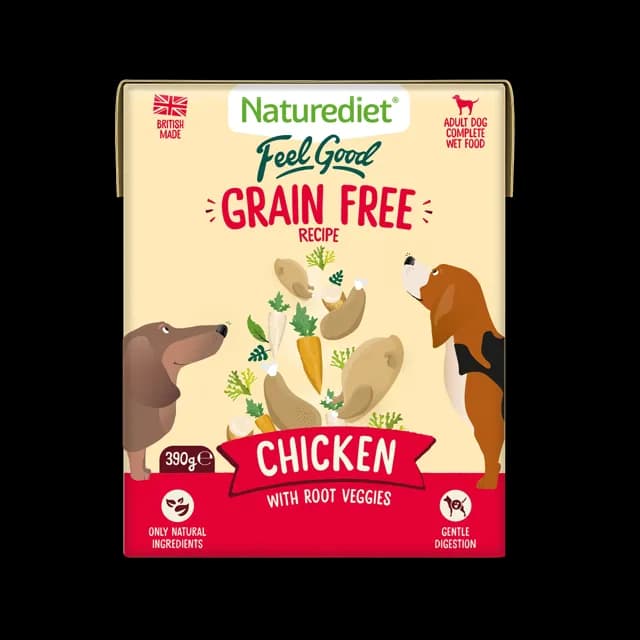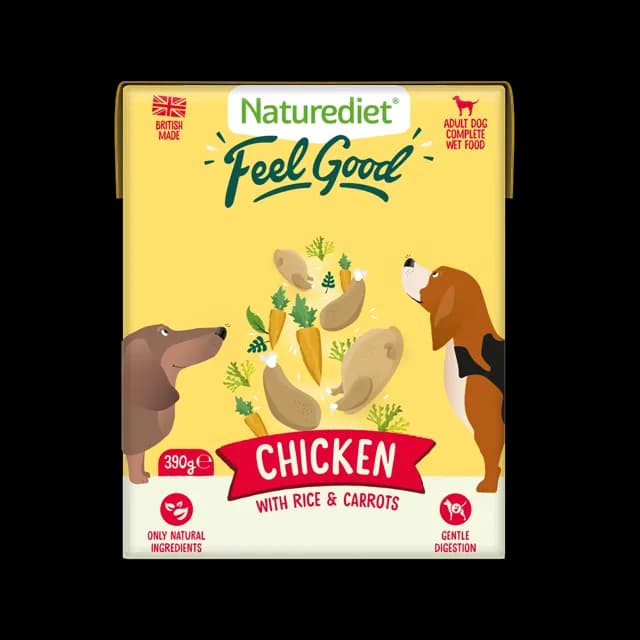




Naturediet
Naturediet Purely: British Farmed Chicken review
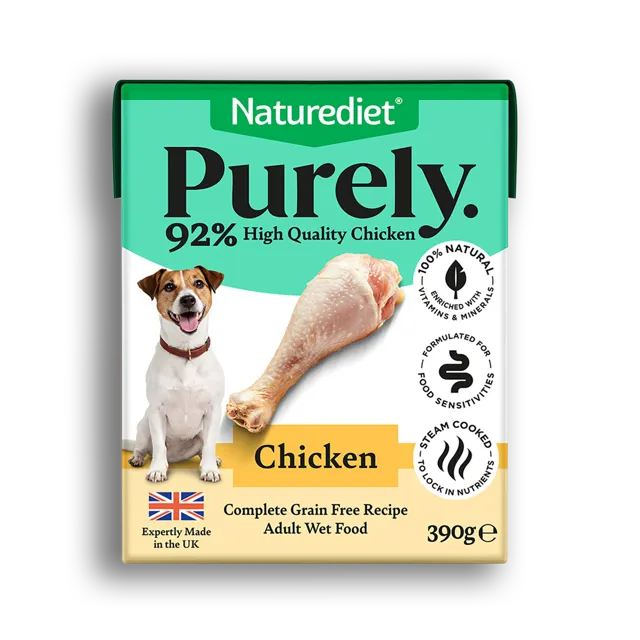
Naturediet Purely prints the shortest label the brand makes: the animal at 92% and, beyond the added vitamins and minerals, nothing else. Chicken, lamb, or salmon with whitefish, cooked in the carton it is sold in, with no rice, no vegetables and no botanical tail. All three cartons finish near the top of our Excellent band, with nutritional balance and transparency both reading Outstanding and protein and processing and value each Excellent.
Our view
Likely to suit
When you want the ingredient list to fit on a single line, this is what that looks like.
- Dogs on an elimination diet, since the chicken and the lamb cartons each carry one animal and nothing else that came from one
- Owners who read every word on a label, because here there is barely a word to read past the meat
- Households avoiding grain and vegetables alike, as no plant ingredient is declared at all
- Working dogs and hard keepers, with 147 kcal per 100g against the 97 typical of adult wet food
- Fussy eaters, since a carton that is almost entirely meat has very little to hide behind
Worth watching
A label this short still leaves a couple of things unsaid.
- The list stops at 92%, so the balance of the carton is not itemised beyond the added vitamins and minerals
- The salmon carton names its whitefish only as whitefish, and that counts if you keep a strict fish list
- This is a rich food by wet standards, at 32.8% fat on a dry matter basis, so a dog with a delicate stomach will want a slow changeover
Written by our editorial team. Independent guidance, not veterinary advice.
How this scores
How we scoreThe Details
Dog fit
When you want the ingredient list to fit on a single line, this is what that looks like. A label this short still leaves a couple of things unsaid.
Wet
Adult
Toy, Small, Medium, Large, Giant
Chicken
The score, in context
The three cartons finish level with one another, near the top of our Excellent band, and that is the strongest showing anywhere in the Naturediet line. Those readings come from doing one thing thoroughly: naming a single animal, printing its share, and leaving the rest of the label empty. Because the typical adult wet food sits in our Excellent band too, the band alone understates the distance here. What actually separates them is how little of this carton goes unexplained.
What's in it
Ingredients, as declared: Chicken - 92%
Named ingredients
Nutritional additives
_(the page labels this "Added Vitamins & Minerals (per kg):")_: - Vitamin A - 3,000IU - Vitamin D3 - 250IU - Iron (as Iron (II) Sulphate Monohydrate) - 12mg - Copper (as Copper (II) Sulphate Pentahydrate) - 1.2mg - Manganese (as Manganous Sulphate Monohydrate) - 2mg - Zinc (as Zinc Sulphate Monohydrate) - 25mg
Ingredient notes
The animal is declared at 92% and it is the only ingredient on the list. On the chicken and the lamb that is one species and one species only, which is rare enough on any shelf and rarer still at this sort of simplicity. The salmon carton splits its 92% between salmon at 64% and whitefish at 28%. Two species make that a fish recipe, not a single-species one.
There is no rice here, no potato, no pea and no oil to speak for, so the analysis comes almost entirely from the meat. Protein converts to 37.5% of dry matter and fat to 32.8%, and energy reaches 147 kcal per 100g where the typical adult wet food sits at 97. No carbohydrate is declared, so the 14.1% of dry matter here is our own working. On a carton with no starch ingredient at all, that figure is mostly the arithmetic catching what the analysis leaves over.
The last of the carton is what the label never accounts for. The named animal covers 92% and the added vitamins and minerals cover a fraction more, and the remainder is simply not itemised. On a recipe this plain that is a small thing, but it is the one question the list leaves you holding.
The added panel is short, and there is a printed figure per kilo against every entry: vitamins A and D3, then iron, copper, manganese and zinc. The fish carton differs slightly again. It drops manganese and prints less vitamin A than the meat cartons. A food this heavily meat-based carries a great deal of its micronutrition in the ingredient itself. That is how a panel this brief reads as a strength.
How this variety differs
Chicken at 92%, described on the pack as British farmed, and one of the two cartons that keeps the whole recipe to a single species. The analysis is identical across the range, so the choice here is entirely about the animal.
Price and value
All three recipes are £4.42 a kilo, in 390g cartons sold in boxes of 12 and 18.
As a guide, a 15kg adult dog in moderate condition would eat about 571 grams a day, which comes to around £2.53, assuming about 840 kcal a day (110 × bodyweight^0.75, the standard maintenance estimate). This carton is denser than most wet food, so the daily portion comes out below what the wet shelf usually asks for. Naturediet's own chart puts a dog of that weight between 390 and 683 grams a day.
Nutritional analysis
Declared analysis
12%
10.5%
2%
3%
68%
Dry weight
37.5%
32.8%
6.2%
9.4%
14.1%
As-fed composition
Estimated breakdown of the finished product by ingredient category, from the declared ingredient list and ingoing weights. These are estimates, not measurements.
95.2%
4.8%
Pricing & size
- Pack size
- 12 x 390g cartons - £21.00 · 18 x 390g cartons - £31.05
- Retailer pricing
- Coming soon
Live retailer pricing is not yet available for this food. Prices, cost per day and where to buy will appear here once retailer data is live.
Ingredients and nutrition are taken from manufacturer data. Retailer pricing is not yet live for this food.
Related dog food guides
Ranked shortlists that include foods like this one.