


Skip to content
Off the Leash
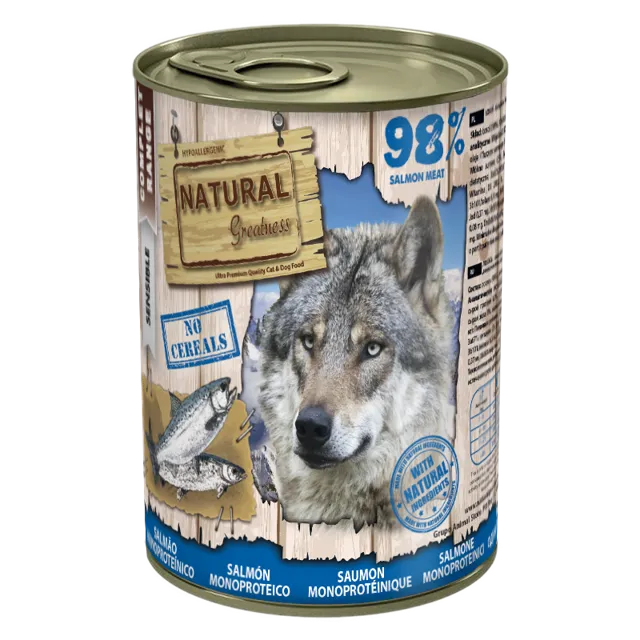
Natural Greatness Monoprotein Complete Wet Adult – Salmon

Natural Greatness

Natural Greatness Monoprotein Complete Wet Adult: Salmon review

83.2/100Outstanding
WetAdult

Natural Greatness Monoprotein Complete Wet Adult does exactly what its name promises and almost nothing beyond it. Each can is 98% one named animal, with an added fat making up the rest, and there is no cereal, no vegetable bulk and no botanical flourish anywhere on the list. Chicken, lamb, rabbit, salmon and turkey give five ways to keep a dog on a single animal, with four of them in our Outstanding band and the rabbit a step behind in Excellent.

Where to buy: coming soon
Live retailer pricing is coming soon. Once we have prices from UK retailers, the best price, cost per day and where to buy will appear here.

Our view

Likely to suit

If you have ever put a can back on the shelf because the list ran on too long, this is about as short as wet food gets.

  • Dogs on a strict avoidance plan, since every recipe is built on one named animal at 98% with only an added fat behind it
  • Owners who like a composition of two lines, one for the meat and one for the fat
  • Dogs who do not drink enough, since four fifths of every can arrives as moisture
  • Rotation feeders, since chicken, lamb, rabbit, salmon and turkey are built to one identical pattern
  • Dogs meeting an unfamiliar meat for the first time, thanks to a rabbit recipe most dogs will never have tried

Worth watching

The simplicity that makes this range so easy to choose also leaves a few things for you to plan around.

  • The Rabbit label writes its added fat as oils and fats, without saying whether it came from a plant or an animal, where the other four say vegetable
  • There is no fruit or vegetable content at all, and crude fibre converts to 2.5% of dry matter, so a dog that does better with a little more bulk will want something alongside
  • Crude ash converts to 15.0% of dry matter in the chicken, rabbit and salmon cans, a reminder of how much bone and mineral sits inside that 98%
  • Each recipe leans on the meat itself for its omega oils, with no named fish oil on the label

Written by our editorial team. Independent guidance, not veterinary advice.

How this scores

How we score
83.2/100Outstanding
Protein and processingExcellent
Nutritional balanceOutstanding
TransparencyOutstanding
ValueOutstanding

The Details

Dog fit

If you have ever put a can back on the shelf because the list ran on too long, this is about as short as wet food gets. The simplicity that makes this range so easy to choose also leaves a few things for you to plan around.

Food type

Wet

Life stage

Adult

Breed size

Toy, Small, Medium, Large, Giant

Main protein

Salmon

The score, in context

The typical adult wet recipe already reaches Excellent on our scoring, so the shelf these cans stand on is a strong one. Most of them sit a step clear of that company. What lifts them is protein and processing, which reads Excellent on all five labels, a rating very few foods of any kind manage. Protein converts to between 40.0% and 47.5% of dry matter and estimated carbohydrate tops out at 10.0%, against the 15.8% that adult wet food typically carries. Nutritional balance reads Outstanding right across the five, and transparency does the same on four of them, with the rabbit a shade behind at Excellent.

What's in it

Ingredients, as declared: Salmon (98%), Vegetable oils and fats.

Named ingredients

Salmon (98%), Vegetable oils and fats.

Nutritional additives

Vitamin a 2670iu, Vitamin D3 290.5iu, Zinc Sulphate Monohydrate 15.62mg, Iron II Carbonate (Siderite) 6.5mg, Copper II Sulphate Pentahydrate 1.64mg, Potassium Iodide 0.37mg, Manganous Sulphate Monohydrate 1.12mg, Selenium (Organic) 0.08mg.

Ingredient notes

There is really only one thing to weigh up here, and it is the 98%. That figure is the named animal, printed on the front of the can and repeated in the composition, and behind it comes an added fat at roughly 0.8% of the recipe. Nothing else is declared. Protein lands between 40.0% and 47.5% of dry matter depending on which animal you pick. By the standards of the wet shelf that is a genuinely meat-led analysis.

Fat is the other headline. It converts to 32.5% of dry matter across most of the range and 34.2% in the lamb. These are rich cans. They suit a working or active dog well, and they ask you to watch the portions if your dog is already carrying weight.

Vegetable oils and fats is the one broad term on the labels. It tells you the fat comes from a plant without telling you which plant, and wording of that kind lets the source move between batches while the printed list stays the same. On a composition this short it stands out more than it would on a long one, though it is doing a very small job. The rabbit can goes a step broader still, listing only oils and fats. That leaves the origin open. If a particular animal is the one you are keeping out, it matters.

The added panel is short, and there is a figure beside every entry: vitamin A and vitamin D3, then zinc, iron, copper, iodine, manganese and selenium. The selenium is the organic form, not the sodium salt most makers reach for, which is a small sign of care on a label that had no obligation to bother. In a recipe this meat-dense the micronutrition largely comes with the meat, so a short panel here reads as confidence, not economy.

What you do not get is any plant matter to speak of. The choice is deliberate, not an oversight. Estimated carbohydrate runs from 5.0% of dry matter in the chicken to 10.0% in the rabbit, where the typical adult wet food sits at 15.8%. If your dog does well on meat and water and little else, that is the whole appeal.

How this variety differs

Salmon at 98%, the only fish in the range and the obvious choice once poultry and red meat have been tried. Protein converts to 42.5% of dry matter, and the oily flesh does the job a separate fish oil would do on a longer list.

Price and value

The Rabbit is the recipe with a figure to hand, at £7.08 a kilo. The range is sold in 170 gram and 400 gram cans.

As a guide, feeding the Rabbit works out at around £6.31 a day for a 15kg adult dog in moderate condition, or roughly 892 grams. About 840 kcal a day is the target behind those numbers (110 × bodyweight^0.75, the standard maintenance estimate). The same estimate lands between 863 and 895 grams a day across the five recipes, the turkey being the lightest portion because it carries the most energy per can.

Nutritional analysis

Declared analysis

Energy
94.4 kcal/100g
Protein

8.5%

Fat

6.5%

Fibre

0.5%

Ash

3%

Moisture

80%

Dry weight

Protein

42.5%

Fat

32.5%

Fibre

2.5%

Ash

15%

Carbs

7.5%

As-fed composition

Estimated breakdown of the finished product by ingredient category, from the declared ingredient list and ingoing weights. These are estimates, not measurements.

Meat

98%

Added water

1.2%

Oils

0.8%

Pricing & size
Pack size
170 / 400 grams.
Retailer pricing
Coming soon

Live retailer pricing is not yet available for this food. Prices, cost per day and where to buy will appear here once retailer data is live.

Ingredients and nutrition are taken from manufacturer data. Retailer pricing is not yet live for this food.

Related dog food guides

Ranked shortlists that include foods like this one.
All reviews

Featured feeding accessories

All feeding accessories

Brackenwood

Slow Feeder Maze Bowl

Slows fast eaters and eases gulping at mealtimes.

From £12.99· 4 retailers
View

Tarn & Co

Raised Double Diner

Height-set stand for easier, tidier eating.

From £28.99· 3 retailers
View

Reviewed by Off the Leash Editorial

Last updated 28 August 2026