



Morrisons
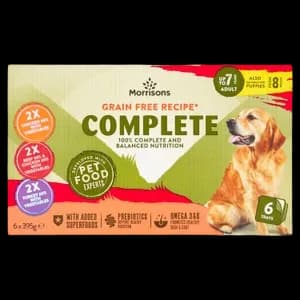
Morrisons Complete: With Chicken, Rice And Vegetables review
Morrisons Complete is the everyday adult kibble of the own-label range, sold as a beef and vegetables recipe and a chicken, rice and vegetables one. Both are built the same way, with cereals first and meat and animal derivatives at around a quarter of the food. One meat is named at 4%, and a fully dosed vitamin and mineral block closes the list. Both recipes read Poor on our scoring, below the Good band the typical adult dry food reaches. That is what happens when nearly every entry on a label names a category and not an ingredient.
Our view
Likely to suit
If you feed a houseful of dogs who all get along with the same bowl, one recipe covering the lot is a good part of the appeal.
- Adult dogs of every size, with feeding tables that start at the smallest lap dogs and run out beyond 45kg
- Households choosing between beef and chicken for a dog with a preference rather than a real intolerance
- Dogs that do better on less fat, since the beef recipe converts to 9.8% of dry matter and the chicken to 9.3%
- Owners who want vitamins A, D3 and E and six trace elements dosed per kilo in print
Worth watching
Both labels leave a few questions open, and it is better to know what they are.
- Each recipe names one meat at 4% and leaves the rest of its meat and animal derivatives unattributed, so neither can carry a diet trial
- Neither label says what the cereals are, which makes it hard to steer a dog clear of wheat
- The chicken recipe's name mentions rice, though the ingredients list keeps to the general term cereals, so the rice is nowhere confirmed on the panel
- Calcium is fuller than a meat-led kibble would read, converting to 2.61% of dry matter in the beef and to 2.42% in the chicken
Written by our editorial team. Independent guidance, not veterinary advice.
How this scores
How we scoreThe Details
Dog fit
If you feed a houseful of dogs who all get along with the same bowl, one recipe covering the lot is a good part of the appeal. Both labels leave a few questions open, and it is better to know what they are.
Dry
Adult
Toy, Small, Medium, Large, Giant
Chicken
The score, in context
Both of these finish in our Poor band while the typical adult dry food finishes in Good. The two recipes sit close enough together that the choice between them is about the meat on the front, not the result. Scoring cannot credit what a label refuses to say, and here cereals, meat and animal derivatives, oils and fats and derivatives of vegetable origin account for nearly everything in the bag. Estimated carbohydrate at 54.3% and 56.1% of dry matter against 46.2% typical keeps the nutritional balance reading down too, and protein and processing reads Poor on both. Set that against what the food actually is, though: a complete, fully supplemented daily kibble that a great many dogs eat contentedly for years.
What's in it
Ingredients, as declared: Cereals, Meat and Animal Derivatives (25%, including 4% Chicken), Oils and Fats, Minerals, Vegetables (0.5% Dried Peas, Equivalent to 4% Peas), Derivatives of Vegetable Origin
Named ingredients
Nutritional additives
_Vitamins_ — Vitamin A 17,000 IU; Vitamin D₃ 1,500 IU; Vitamin E 70mg _Trace Elements_ — Iodine (calcium iodate anhydrous) 2.5mg; Selenium (sodium selenite) 0.1mg; Copper (copper (II) sulphate pentahydrate) 8mg; Iron (iron (II) sulphate monohydrate) 60mg; Manganese (manganese (II) oxide) 50mg; Zinc (zinc oxide) 100mg
Ingredient notes
Cereals sits at the top of both lists, so grain is the base of the food in each case. The heading covers every grain there is without committing to one, which allows the mix to shift from batch to batch and leaves an owner with nothing to check a suspected reaction against. It is not evidence of poor material; it is an absence of evidence either way.
Meat and animal derivatives carries the meat: 25.5% of the beef recipe, 25% of the chicken, and in each case 4% pinned to whichever meat the bag names on the front. Both beef and chicken are digestible, well-liked meats, and 4% is a real declaration. The rest falls under a legal heading covering the fleshy parts and processing products of warm-blooded land animals. What sits inside it can be very good or very ordinary, with nothing on the outside to tell you which.
The two recipes part company on their plant side. The beef declares 5% dried peas and brings in yeasts and seeds, neither of which the chicken carries. The chicken recipe declares 0.5% dried peas and tells you that this equates to 4% peas before drying. Both close with derivatives of vegetable origin, the catch-all for what is left once vegetables, legumes, cereals and oil seed have been processed.
On the analysis the pair are near neighbours. Protein converts to 22.8% of dry matter in the beef and to 22.0% in the chicken. Fat comes to 9.8% and 9.3%, and estimated carbohydrate to 54.3% and 56.1%, against the 46.2% a typical adult dry food carries. Ash reads 9.8% and 8.8% with calcium at 2.61% and 2.42% of dry matter, the fuller mineral profile you get from a cereal base with a heavy supplement on top. Neither label declares an energy figure, so the calorie numbers shown are our estimates.
The additive block is identical across the two, and it is the most informative part of either label. Vitamins A and D3 are declared in international units and vitamin E at 70mg per kilo. After those, zinc at 100mg, iron at 60mg, manganese at 50mg, copper at 8mg, iodine at 2.5mg and selenium at 0.1mg. These come as oxides and sulphates, not as chelates, so absorption is a shade less efficient. Each one is printed with a dose beside it.
How this variety differs
The chicken, rice and vegetables recipe puts its meat at 25%, with 4% named as chicken. On a dry matter basis its fat sits at 9.3%, the leaner of the two. Its pea declaration is the smaller one, 0.5% dried peas equivalent to 4% before drying, and estimated carbohydrate comes out at 56.1% of dry matter. Rice is named in the product name but not on the ingredients list, which keeps to cereals throughout, so treat the rice as unconfirmed. This is also the recipe sold in the larger bags.
Price and value
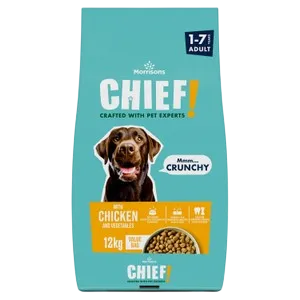
The beef and vegetables recipe is £1.29 a kilo and the chicken, rice and vegetables recipe £1.04. The chicken is sold in 6kg and 12kg bags.
On the standard maintenance estimate of 840 kcal a day (110 × bodyweight^0.75), a 15kg adult dog in moderate condition eats about 258 grams of the beef at £0.33 a day. The chicken works out at 262 grams and £0.27. The beef label asks 180 to 360 grams for a dog between 10kg and 25kg, the chicken 180 to 410 grams for one between 10kg and 30kg. Portion to the waistline and not to the scoop.
Nutritional analysis
Declared analysis
Estimated using Modified Atwater factors*
20%
8.5%
3.5%
8%
9%
Dry weight
22%
9.3%
3.8%
8.8%
56.1%
As-fed composition
Estimated breakdown of the finished product by ingredient category, from the declared ingredient list and ingoing weights. These are estimates, not measurements.
25%
47%
6.6%
13%
8.4%
Pricing & size
- Pack size
- 12Kg · 6Kg · approx. 3 kg (not stated in the product name; this total weight is derived from Morrisons' own price-per-kg)
- Retailer pricing
- Coming soon
Live retailer pricing is not yet available for this food. Prices, cost per day and where to buy will appear here once retailer data is live.
Ingredients and nutrition are taken from manufacturer data. Retailer pricing is not yet live for this food.
Related dog food guides
Ranked shortlists that include foods like this one.