



Hownd
Hownd Plant Powered Superfood Wet: Fresh Blueberry review
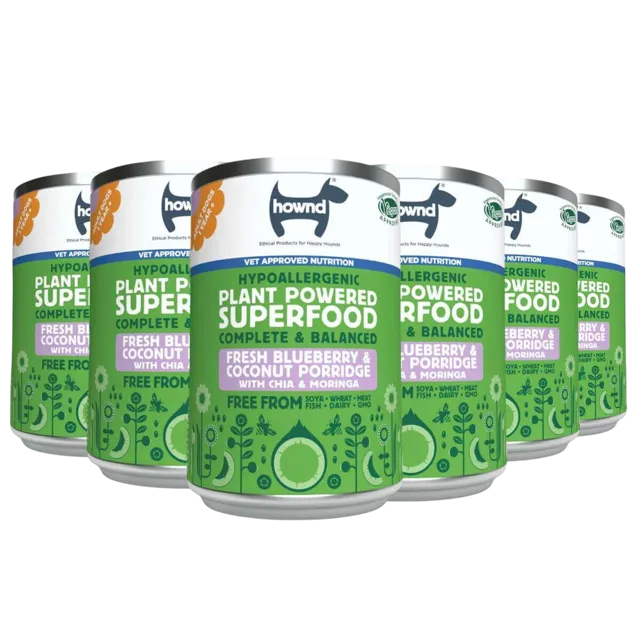
Hownd Plant Powered Superfood Wet is a meat-free can and it makes no secret of it. Pumpkin heads all three recipes, lentils, quinoa, oat flakes and pea protein carry the substance, and marine algae, moringa and beetroot finish the list. Papaya, blueberry and quinoa are the three flavours, and all three land in our Average band, which is a reading of how a plant-built recipe scores rather than a comment on the care behind it.
Our view
Likely to suit
If you feed a plant-based household and want your dog eating the same way, this is a range built for exactly that.
- Households feeding without meat, since no animal ingredient appears on any of the three ingredient lists
- Dogs that have reacted to several meats, as there is no chicken, beef or fish here to work around
- Owners who want the amino acids a meat-free bowl leans on printed with doses, with taurine at 1,500 mg and DL-methionine at 2,200 mg in every kilogram
- Dogs of any size, since one can covers toy breeds and giants alike
- Dogs that drink too little, with about three quarters of every serving arriving as moisture
- Owners who rotate, because the construction stays the same across all three recipes and only the fruit and the protein blend move
Worth watching
A meat-free bowl asks a few different questions of a label, so here is what to read before you switch.
- Pea, potato, hemp and lentil supply all the protein, and a dog takes less usable amino acid from plants than from meat, so run the switch past your vet before it becomes the whole diet
- All three labels carry oat flakes, so grain is in the bowl
- Carbohydrate converts to an estimated 42.6% to 44.8% of dry matter across the range, where the typical adult wet food runs at 15.8%
- The recipes are built around pumpkin and legumes, so a dog used to a strongly meaty smell may want a slower changeover than usual
Written by our editorial team. Independent guidance, not veterinary advice.
How this scores
How we scoreThe Details
Dog fit
If you feed a plant-based household and want your dog eating the same way, this is a range built for exactly that. A meat-free bowl asks a few different questions of a label, so here is what to read before you switch.
Wet
Adult
Toy, Small, Medium, Large, Giant
The score, in context
All three recipes land together in our Average band, with the typical adult wet food some way above them in our Excellent band. The reason is structural, and nothing to be uneasy about. Our scoring rewards named animal content and a moderate carbohydrate share, and a deliberately meat-free recipe has neither to offer. Protein and processing settles at Poor and nutritional balance at Average, while transparency reads Outstanding on the strength of everything the label prints. Read it as a food doing something the scale was never built to measure. If a plant-based bowl is what you are after, this is a carefully assembled one, with the amino acids a dog would normally take from meat supplemented in print rather than left to chance.
What's in it
Ingredients, as declared: Pumpkin (15%), Lentils, Quinoa, Pea Protein, Oat Flakes (3%), Lupins, Coconut Flakes (2%), Chia Seeds (2%), Blueberries (2%), Moringa (1%), Brewer's Yeast (1%), Minerals, Canola Oil, Potato Protein, Marine Algae, Beetroot.
Named ingredients
Nutritional additives
_(the page labels this "Nutritional Additives (per kg)")_: | Additive | Per kg | |---|---| | Vitamin A | 3,500 IU | | Vitamin D3 | 350 IU | | Vitamin B12 | 75ug | | Vitamin B1 | 10mg | | Vitamin B2 | 6mg | | Vitamin B6 | 3mg | | Vitamin E | 35mg | | L-Carnitine | 500mg | | Taurine | 1,500mg | | DL-Methionine | 2,200mg | | Iodine as Calcium Iodate Anhydrous | 0.5mg | | Selenium as Sodium Selenite | 0.02mg | | Iron as Sulphate Monohydrate | 20mg | | Copper as Copper (II) Sulphate Pentahydrate | 3mg | | Zinc as Zinc Sulphate Monohydrate | 30mg | | Manganese (Manganous sulphate monohydrate) | 3mg |
Ingredient notes
Pumpkin leads every recipe, at 8% in the papaya version and 15% in the other two. At those levels the pumpkin is a working ingredient. Behind it the protein arrives from several directions at once: lentils, pea protein, potato protein, quinoa and brewer's yeast, with hemp protein joining on the quinoa recipe. Protein converts to between 22.2% and 26.0% of dry matter, a moderate figure. Plant proteins carry less usable amino acid for a dog than the same weight of meat would.
Carbohydrate is the figure that moves this food away from the wet norm. It converts to an estimated 42.6% to 44.8% of dry matter against 15.8% for the typical adult wet food, and fibre runs from 8.0% to 16.0% of dry matter depending on the recipe. That is simply what happens when pumpkin, lentils, oats and quinoa are asked to carry a meal on their own.
The added panel is where this range earns its stripes. Taurine at 1,500 mg, DL-methionine at 2,200 mg and L-carnitine at 500 mg in every kilogram cover the amino acids a dog would usually take from meat without anyone giving it a thought. Marine algae brings the long-chain omega-3 that would otherwise come from fish. There is a full vitamin and trace element panel alongside, with a printed dose against every entry. Not many labels go that far.
The superfood billing rests on moringa at 1%, blueberries, beetroot, chia seeds and coconut flakes, all at trace level. Take them as a pleasant flourish. The serious part of the recipe is the pumpkin, the legumes and the supplement panel standing behind them.
How this variety differs
Pumpkin doubles to 15% and blueberries are declared at 2%, with oat flakes at 3% and coconut flakes at 2% behind them. Fat converts to 8.0% of dry matter, the lowest in the range. A dog that finds richer food unsettling will get on with it.
Price and value
Every recipe is £8.75 a kilo, in a 400 g can that comes singly or in a 6-pack.
As a guide, a 15kg adult dog in moderate condition would cost between £7.99 and £8.86 a day depending on the recipe. The figure rests on about 840 kcal a day (110 × bodyweight^0.75, the standard maintenance estimate). That comes to roughly 913 to 1012 grams. The label's own guide for a dog of 11 to 24 kg runs from 625 to 1140 grams a day across the three recipes.
Nutritional analysis
Declared analysis
6%
2%
4%
2%
75%
Dry weight
24%
8%
16%
8%
44%
As-fed composition
Estimated breakdown of the finished product by ingredient category, from the declared ingredient list and ingoing weights. These are estimates, not measurements.
10%
60.2%
15.8%
1.1%
12.9%
Pricing & size
- Pack size
- 400 g can - sold as a single can or a 6-pack (a trade case is also listed under "Food Trade Cases")
- Retailer pricing
- Coming soon
Live retailer pricing is not yet available for this food. Prices, cost per day and where to buy will appear here once retailer data is live.
Ingredients and nutrition are taken from manufacturer data. Retailer pricing is not yet live for this food.
Related dog food guides
Ranked shortlists that include foods like this one.