
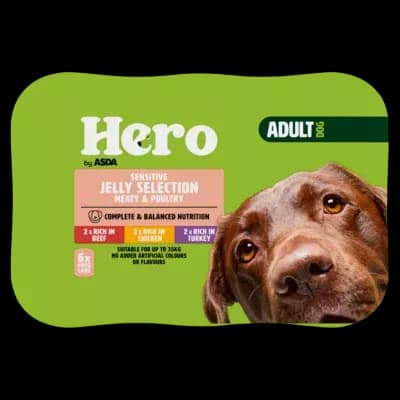

Hero by Asda
Hero by Asda Working Dog Dry review
Hero by Asda Working Dog comes in a big sack, written for dogs that work for their keep. Meat and animal derivatives are declared at 28%, with chicken named at 4%. The rest is general: cereals, vegetables, oils and fats and derivatives of vegetable origin. Energy sits at 331 kcal per 100g, under the 357 a typical adult dry food carries, so the label answers with generous portions instead. It sits in our Poor band.
Our view
Likely to suit
If your dog never seems to stop, this is a bag built around volume.
- Working dogs and hard exercising adults, the dogs this label is aimed at
- Households feeding more than one active dog out of the same sack
- Dogs with big appetites, since the feeding guide runs to 780 grams a day at the top of its chart
- Owners who like to see a meat figure on the front, declared here at 28%
Worth watching
Before you move a companion dog onto this one, a couple of points are worth weighing.
- The recipe is pitched at working dogs, so a pet dog on ordinary walks will need well under the amounts printed on the bag
- At 331 kcal per 100g the food is less energy dense than the typical adult dry food, so a genuinely hard working dog has to eat a lot of it
- Chicken at 4% is the only animal named, so this bag is no use for an exclusion diet
- Carbohydrate is estimated at 52.2% of dry matter, so a dog who thrives on a meat heavy bowl may want more than this list offers
Written by our editorial team. Independent guidance, not veterinary advice.
How this scores
How we scoreThe Details
Dog fit
If your dog never seems to stop, this is a bag built around volume. Before you move a companion dog onto this one, a couple of points are worth weighing.
Dry
Adult
Toy, Small, Medium, Large, Giant
Chicken
The score, in context
This one reads Poor on our scale. Almost every entry names a category where an ingredient should be. A label that will not name its meat, its grain or its oil leaves a reader nothing to check. A typical adult dry food gets into our Good band on the strength of being more specific.
In its favour, the recipe carries a comparatively generous meat declaration at 28%. Its carbohydrate estimate of 52.2% of dry matter is not far off the 46.2% typical for a food built this way. Fed to the dog it names, it is a plain, honest working ration.
What's in it
Ingredients, as declared: Cereals, Meat and Animal Derivatives 28% (Including 4% Chicken), Vegetables (4% Peas), Oils and Fats, Derivatives of Vegetable Origin, Minerals, Chicory Root (0.1%)
Named ingredients
Nutritional additives
Zinc (as Zinc Oxide) 40 mg/kg, Iron (as Iron (II) Sulphate Monohydrate) 40 mg/kg, Vitamin D₃ 1200 IU/kg, Iodine (as Calcium Iodate Anhydrous) 2 mg/kg, Antioxidants , Vitamin A 12000 IU/kg, Manganese (as Manganous Oxide) 30 mg/kg, Copper (as Copper (II) Sulphate Pentahydrate) 8 mg/kg, Vitamin E 90 mg/kg, Selenium (as Sodium Selenite) 0.1 mg/kg
Ingredient notes
Working dog food is sold for dogs in genuine work, and the feeding guide is written accordingly. It asks 275 to 465 grams a day for a dog between 10kg and 20kg. That is a lot of kibble, and it is the clearest signal on the bag about who the recipe is meant for.
Meat and animal derivatives at 28% is the protein source and the largest single entry after the cereals. The term covers the parts of slaughtered land animals not sold for human food, which spans good material and ordinary material alike, with nothing on the label to tell you which is in the sack. Chicken at 4% is the only species named.
Cereals, vegetables, oils and fats and derivatives of vegetable origin round the list out. Peas are pinned down at 4% within the vegetables, and chicory root at 0.1% is there for its inulin, a prebiotic fibre that supports the gut's own bacteria.
The tension worth understanding is between the badge and the energy. Protein converts to 25.0% of dry matter and fat to 9.2%, and the food delivers 331 kcal per 100g against 357 for the typical adult dry food. A hard working dog needs a great many calories, and this recipe supplies them by volume rather than by density, which is why the portions on the chart run so large.
The added panel comes with doses printed: zinc 40 mg, iron 40 mg, manganese 30 mg, copper 8 mg, iodine 2 mg and selenium 0.1 mg per kilo. Vitamin A runs to 12000 IU per kilo, with vitamin D3 at 1200 IU and vitamin E at 90 mg. The minerals are oxides and sulphates rather than chelates, the straightforward inorganic forms.
Price and value
£0.74 a kilo, sold in a 17kg sack.
For a 15kg adult in moderate condition, around 840 kcal a day (110 × bodyweight^0.75, the standard maintenance estimate) works out at about 254 grams and £0.19 a day. A dog of that size in real work will need considerably more, and the label's own chart asks 275 to 465 grams for dogs between 10kg and 20kg.
Nutritional analysis
Declared analysis
23%
8.5%
3.5%
9%
Dry weight
25%
9.2%
3.8%
9.8%
52.2%
As-fed composition
Estimated breakdown of the finished product by ingredient category, from the declared ingredient list and ingoing weights. These are estimates, not measurements.
28%
46.6%
14.4%
7.7%
3.3%
Pricing & size
- Pack size
- 17kg
- Retailer pricing
- Coming soon
Live retailer pricing is not yet available for this food. Prices, cost per day and where to buy will appear here once retailer data is live.
Ingredients and nutrition are taken from manufacturer data. Retailer pricing is not yet live for this food.
Related dog food guides
Ranked shortlists that include foods like this one.