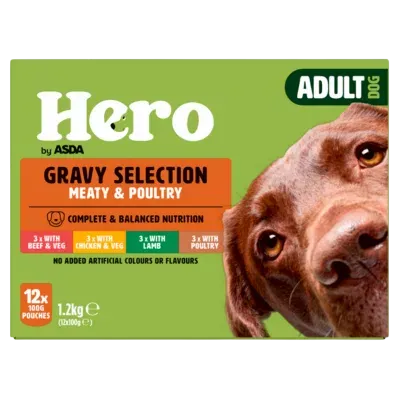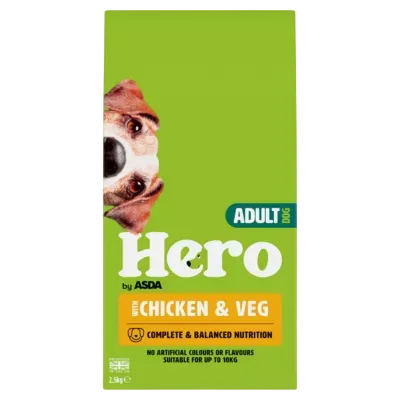



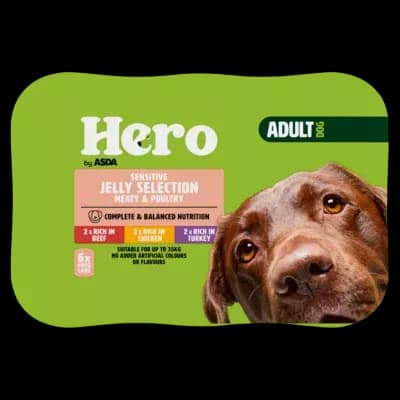

Hero by Asda
Hero by Asda Small Dog Adult Dry review
Hero by Asda Small Dog Adult is a compact everyday kibble for little dogs, with protein declared at 24%, though a share of that comes from vegetable protein extracts rather than from meat. Meat and animal derivatives make up 26%, with chicken named at 4%. Energy is 363 kcal per 100g, a touch above the 357 a typical adult dry food carries, which suits a small stomach that has to fit a day's calories into a small bowl. It sits in our Poor band.
Our view
Likely to suit
With a little dog you are filling a small bowl, so every mouthful counts for more than it would for a big dog.
- Small breed adults, the only size the label sets amounts for, with a guide running up to 10kg
- Owners who want a fuller protein figure in a little dog's bowl, declared here at 24%
- Busy small dogs with brisk routines, since the recipe carries 363 kcal per 100g
- Homes with a little dog who eats grain and chicken without complaint
Worth watching
A few entries on this list change how you should read the front of the bag.
- Part of the protein figure is plant, not meat, since vegetable protein extracts sit third on the list
- There is no help here for isolating a problem protein, because the meat appears only as meat and animal derivatives
- Chicken is the single named animal, at 4%, so a chicken sensitive dog needs that kept in mind
- The feeding guide on the label stops at 10kg, so it is written for little dogs and not for a mixed household
Written by our editorial team. Independent guidance, not veterinary advice.
How this scores
How we scoreThe Details
Dog fit
With a little dog you are filling a small bowl, so every mouthful counts for more than it would for a big dog. A few entries on this list change how you should read the front of the bag.
Dry
Adult
Small
Chicken
The score, in context
Our band here is Poor, and the ingredient list explains it faster than the analysis does. Cereals lead, and the meat is given as a category with no animal named. Vegetable protein extracts sit third, a term that names neither the plant nor the process used to refine it. Saying more is most of what carries a typical adult dry food into our Good band.
Read as a practical bowl for a small dog, though, it does the basic job it sets out to do. Protein is respectable at 26.1% of dry matter, the energy density suits a dog who eats in small amounts, and the mineral panel is dosed in print rather than left vague.
What's in it
Ingredients, as declared: Cereals, Meat and Animal Derivatives 26% (including 4% Chicken), Vegetable Protein Extracts, Vegetables (4% Peas in the Pea Component), Oils and Fats, Derivatives of Vegetable Origin, Minerals, Chicory Root (0.1%)
Named ingredients
Nutritional additives
Selenium (as Sodium Selenite) 0.1 mg/kg, Vitamin E 90 mg/kg, Copper (as Copper (II) Sulphate Pentahydrate) 8 mg/kg, Iron (as Iron (II) Sulphate Monohydrate) 40 mg/kg, Zinc (as Zinc Oxide) 40 mg/kg, Vitamin D₃ 1200 IU/kg, Antioxidants , Vitamin A 12000 IU/kg, Iodine (as Calcium Iodate Anhydrous) 2 mg/kg, Manganese (as Manganous (II) Oxide) 30 mg/kg
Ingredient notes
Vegetable protein extracts are the entry that most shapes how you read this label. They are refined plant proteins, usually drawn from soya, maize or wheat, and they lift a headline protein figure without adding meat. For a dog, animal protein does more than plant protein does, so the 24% on the analysis is doing a little less work than it first appears to.
The animal side is meat and animal derivatives at 26%. As a legal catch all, the term says nothing about species or cut. Chicken named at 4% is the one firm fact on that front.
Cereals, vegetables, oils and fats and derivatives of vegetable origin fill out the rest under category names. A maker can follow the market from batch to batch with labelling like this. It also means a dog with a suspected intolerance cannot be worked out from this list alone.
Nothing on this label reads better than the analysis. Protein converts to 26.1% of dry matter and fat to 10.9%, with carbohydrate estimated at 50.5% against 46.2% for the typical adult dry food, so the plant share sits only a little above normal. At 363 kcal per 100g the food is slightly denser than the 357 typical, which is a sensible fit for a dog whose daily portion is measured in tens of grams.
Chicory root at 0.1% supplies inulin as a prebiotic. The added minerals come with printed doses: zinc 40 mg, iron 40 mg, manganese 30 mg, copper 8 mg, iodine 2 mg and selenium 0.1 mg per kilo. Vitamin A is at 12000 IU, vitamin D3 at 1200 IU and vitamin E at 90 mg per kilo. The forms used are oxides and sulphates, the plain inorganic versions, not chelates.
Price and value
£1.19 a kilo, in a 2.5kg bag.
Our standard comparison dog, a 15kg adult in moderate condition needing around 840 kcal a day (110 × bodyweight^0.75, the usual maintenance estimate), would eat about 231 grams a day at £0.28. For the dogs this recipe is actually aimed at, the label asks 60 to 100 grams up to 5kg and 100 to 200 grams from 5kg to 10kg.
Nutritional analysis
Declared analysis
24%
10%
3%
8.5%
Dry weight
26.1%
10.9%
3.3%
9.2%
50.5%
As-fed composition
Estimated breakdown of the finished product by ingredient category, from the declared ingredient list and ingoing weights. These are estimates, not measurements.
26%
59.3%
8.3%
4.5%
1.9%
Pricing & size
- Pack size
- 2.5kg
- Retailer pricing
- Coming soon
Live retailer pricing is not yet available for this food. Prices, cost per day and where to buy will appear here once retailer data is live.
Ingredients and nutrition are taken from manufacturer data. Retailer pricing is not yet live for this food.
Related dog food guides
Ranked shortlists that include foods like this one.