


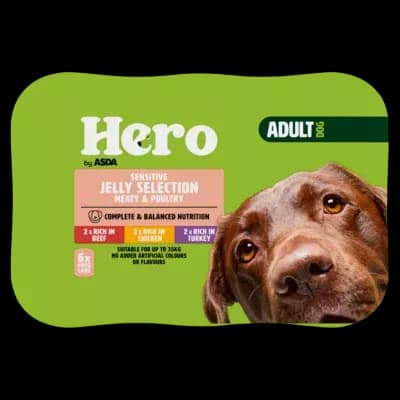

Hero by Asda
Hero by Asda Light Adult Dry review
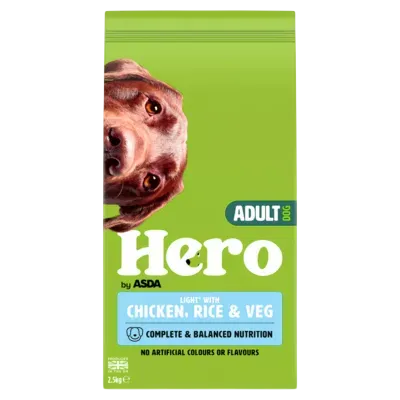
Hero by Asda Light Adult is an everyday kibble sold as a two part mix, a chicken and rice component at typically 40% of the product alongside a pea component at typically 60%. Meat and animal derivatives account for 22% of the recipe, with chicken named at 4% and nothing else attributed to a species. Fat is held to 7.5% and the energy works out at 318 kcal per 100g against 357 for the typical adult dry food, which is exactly what a light diet is for. It lands in our Average band, and almost all of that is down to how little the label names.
Our view
Likely to suit
When your vet says a little weight needs to come off, this is a gentler way to do it than halving dinner.
- Adult dogs on a weight watch, fat kept down to 7.5% and energy at 318 kcal per 100g
- Owners of steady, unhurried dogs whose big outing is a lap of the park rather than a morning on the hills
- Households feeding a mix of sizes, since the label sets amounts from the smallest adults up to 40kg
- Adult dogs that have never reacted badly to chicken or to grain
Worth watching
A few entries on this label want explaining before you fill the bowl.
- Meat and animal derivatives is all the label says of the meat, so no animal is named and no elimination diet can rest on it
- Chicken is the single species on the list, at 4%, which is worth knowing if chicken has ever upset your dog
- Carbohydrate is estimated at 57.0% of dry matter against 46.2% for the typical adult dry food, so plants make up much of the bowl
- Moisture is not declared, so the dry matter column runs on the 8% assumed for a kibble of this kind
Written by our editorial team. Independent guidance, not veterinary advice.
How this scores
How we scoreThe Details
Dog fit
When your vet says a little weight needs to come off, this is a gentler way to do it than halving dinner. A few entries on this label want explaining before you fill the bowl.
Dry
Adult
Toy, Small, Medium, Large, Giant
Chicken
The score, in context
Our reading comes out Average, and the naming shapes it on the nutrition side as much as on the disclosure one. Five of the seven entries on the ingredient list are umbrella terms, wide enough to cover different material from one batch to the next. We cannot credit a label for what it will not name. A typical adult dry food reaches our Good band largely by naming more.
Where the recipe does answer for itself is the brief on the front. Fat at 7.5% and 318 kcal per 100g are genuinely restrained, and when a waistline needs taking in, that is the figure to watch.
What's in it
Ingredients, as declared: Cereals (4% Rice in the Rice Component), Meat and Animal Derivatives 22% (4% Chicken in the Chicken Component), Vegetables (4% Peas in the Pea Component), Derivatives of Vegetable Origin, Oils and Fats, Minerals, Chicory Root (0.1%), Total Meat and Animal Derivatives 22%, Chicken & Rice Component Typically 40% (of Which 4% Chicken & 4% Rice) Pea Component Typically 60% (of Which 4% Peas)
Named ingredients
Nutritional additives
Iron (as Iron (II) Sulphate Monohydrate) 40 mg/kg, Vitamin E 90 mg/kg, Iodine (as Calcium Iodate Anhydrous) 2 mg/kg, Manganese (as Manganous (II) Oxide) 30 mg/kg, Antioxidants , Vitamin A 12000 IU/kg, Selenium (as Sodium Selenite) 0.1 mg/kg, Copper (as Copper (II) Sulphate Pentahydrate) 8 mg/kg, Vitamin D₃ 1200 IU/kg, Zinc (as Zinc Oxide) 40 mg/kg
Ingredient notes
There are two kibbles in this bag. A chicken and rice component makes up typically 40% of the product and a pea component the other 60%, and inside those, chicken, rice and peas are each declared at 4%. Everything else arrives under a category name.
Meat and animal derivatives at 22% is the protein backbone. In law that term takes in the parts of slaughtered land animals that never reach the butcher's counter. It stretches from genuinely good material down to the very ordinary, and nothing on the pack shows a reader which end the bag came from. Cereals, vegetables and the oils and fats work the same way, naming neither a plant nor a source.
Chicory root at 0.1% is the one functional extra. It supplies inulin, a soluble fibre the good gut bacteria thrive on, and at that level it is a quiet nudge and no more.
The analysis reads as a light diet should. Protein converts to 21.7% of dry matter and fat to 8.2%, both modest. Carbohydrate is estimated at 57.0% of dry matter against 46.2% for the typical adult dry food. That makes for a plant heavy bowl, so a dog with a big appetite may finish quickly and go looking for more.
The added panel is dosed in print: zinc 40 mg, iron 40 mg, manganese 30 mg, copper 8 mg, iodine 2 mg and selenium 0.1 mg per kilo. The vitamins are printed too, A at 12000 IU, D3 at 1200 IU and E at 90 mg per kilo. Oxides and sulphates supply the trace minerals here, not chelates, and those older forms make a dog's gut work a little harder to take them up.
Price and value
£1.19 a kilo, sold in a 2.5kg bag.
As a guide, a 15kg adult dog in moderate condition would eat about 265 grams a day, working from roughly 840 kcal a day (110 × bodyweight^0.75, the standard maintenance estimate). That comes to £0.31 a day. The label's own table asks 200 to 360 grams for dogs from 10kg to 20kg, and the waistline settles the rest.
Nutritional analysis
Declared analysis
Estimated using Modified Atwater factors*
20%
7.5%
3%
9%
Dry weight
21.7%
8.2%
3.3%
9.8%
57%
As-fed composition
Estimated breakdown of the finished product by ingredient category, from the declared ingredient list and ingoing weights. These are estimates, not measurements.
62%
26.4%
7.3%
2.6%
1.7%
Pricing & size
- Pack size
- 2.5kg
- Retailer pricing
- Coming soon
Live retailer pricing is not yet available for this food. Prices, cost per day and where to buy will appear here once retailer data is live.
Ingredients and nutrition are taken from manufacturer data. Retailer pricing is not yet live for this food.
Related dog food guides
Ranked shortlists that include foods like this one.